













Bilingual Education Is More Than Translation: Developing Academic Language Proficiency
Translating each sentence correctly does not necessarily create bilingual competence
In many bilingual classes, teachers speak in English and then translate back into Vietnamese to ensure students understand. This solves the immediate difficulty, but if the translation always appears immediately, students are more likely to wait for the Vietnamese part instead of processing the context, sentence structure, and main idea themselves. They can follow today's lesson but are still confused when reading books, taking tests or studying with teachers who don't translate.
Effective bilingual teaching does not mean teaching the same content twice or building two separate vocabulary lists. The goal is to use both languages to access knowledge, while developing the ability to read, speak and write in an academic environment. The mother tongue is still important, but needs to be used as a bridge for students to gradually move towards independent use of English.
The nature of effective bilingual teaching
A bilingual education program needs to simultaneously develop subject content and the language used to learn that content. Knowing the water cycle means the water cycle is not enough; Students must also be able to read the explanation, understand the stages and use words like evaporate, condense, because or therefore to present the cause-effect relationship.
1. Background knowledge and understanding of concepts: Connect the new lesson to students' prior experiences and knowledge when asked to express themselves in a second language.
2. In-depth vocabulary: Understand words in sentences, know how to combine and reuse them in many contexts, not just remember one Vietnamese meaning.
3. Language structure: Can handle descriptions, comparisons, explanations and arguments; recognize linking words, passive sentences, and subordinate clauses.
4. Literacy and academic communication: Read meaningful text, discuss, use evidence, and write to demonstrate understanding.
Limitation 1: Students wait for translation instead of processing English
If teachers always translate immediately, students do not need to predict meaning, analyze sentences, or check their own understanding. This does not mean that Vietnamese must be eliminated. Teachers can let students read or listen to English first, using images and leading questions, then give short explanations in their native language at the really necessary points.
Limitation 2: Two separate sets of vocabulary do not create academic language
The list of evaporation - evaporation, condensation - condensation only helps identify terms. Students need to see words in text, diagrams, and complete sentences; need to use a pattern like “Water evaporates when..." or “Condensation occurs because...". Words used in many subjects such as compare, evidence, result and explain also need to be practiced in real tasks, not just memorizing the translation.
Limitation 3: Concept understanding and language development are separated from each other
If Vietnamese is used to explain the entire content and English is only used for vocabulary learning, students can understand the lesson but do not have the language to express what they know. Each lesson should have both a content goal and a language goal, for example "explain why things sink or float" along with "use because, therefore and evidence to explain results".
Use your mother tongue as a scaffolding, not a shortcut
Mother tongue is the resource students already have. The Imagine Language & Literacy document describes support based on the student's language of strength and provides examples of adapting instruction to the home language. The important point is to provide support to help students get into the lesson and continue moving toward their English goals, not to provide translation in place of all thinking activities.
1. Before the lesson: Eliminate experiences and background knowledge with pictures or short discussions. Students can state their initial ideas in strong language and then learn how to express them in English.
2. When encountering difficult concepts: Determine whether students do not understand the content or are just missing English words. A short explanation in their mother tongue can help them stay on task at an appropriate level.
3. Before speaking and writing activities: Let students organize their ideas, select evidence and then use vocabulary bank or sentence frames to create products in English.
4. When withdrawing scaffolding: Gradually reduce translations, sample sentences, and suggestions when students can handle them on their own. The goal is an increased level of independence.
How can a bilingual lesson be designed?
For example, with the Science article about animal habitats, the content goal is to explain why a species is adapted to a specific habitat. The linguistic goal is to use habitat, survive, adapt, because and therefore to link physical characteristics with the environment.
Step 1 - Activate background knowledge: Observe pictures, name familiar species and discuss what they need to live. Vietnamese can be used briefly so that every student has ideas to participate.
Step 2 - Building a vocabulary bridge: Introduce a small group of focus words with images, actions, and example sentences instead of long bilingual lists.
Step 3 - Read with scaffolding: Read short passages, listen to audio when needed, highlight connecting words, and divide complex sentences into clusters, but still keep the tasks appropriate to the grade level.
Step 4 - Speak before writing: Practice in pairs with the sample "The animal can survive because..." then change the words, add evidence and write the answer independently.
Step 5 - Transfer: Use because, therefore and evidence again with a new species or topic. Being able to translate language into a new context is more important than remembering the correct translation.
Scaffolding multilingual does not mean lowering requirements
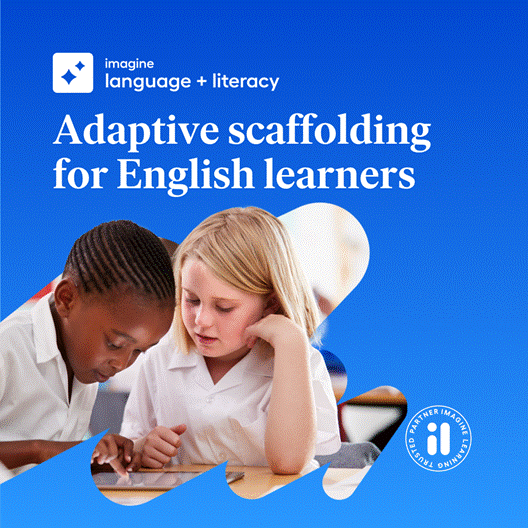
Students who are developing English can still classify, compare, predict or explain if supported with pictures, audio, vocabulary banks, broken text and speaking practice opportunities. What needs to be adjusted is the approach, not the elimination of important concepts. The scaffolding must also be gradually reduced: from full sample sentences to keywords, suggested questions and finally independent expression.
What criteria are used to monitor bilingual competence?
Vocabulary scores or number of correct sentences do not fully reflect the development of bilingual literacy. Schools should collect evidence from readings, discussions, written products, and classroom observations, then compare over time using a consistent checklist.
1. Understand the concept: Explain ideas correctly and differentiate related concepts, even when your ability to express yourself in English is still developing.
2. Understanding English in context: Grasp main ideas, infer the meaning of new words and process academic sentences without translating line by line.
3. Use vocabulary and structure: Use correct terminology, connecting words, and appropriate sentences to describe, compare, explain, or reason.
4. Communicate with evidence: Extract information from text, images, or data to support oral and written responses.
5. Degree of independence: The need for translations, sentence frames, audio and teacher suggestions decreases over time.
6. Transferability: Reuse language learned in another subject, another text or situation that has not been practiced before.
Criteria for selecting resources for bilingual classes
Not all bilingual resources support bilingual education effectively. Schools need to consider how resources develop capacity, not just the number of languages displayed.
1. Teaching language and literacy in parallel: Connect phonics, fluency and comprehension with vocabulary, language structures and communication.
2. Strong language-based support: Helps activate understanding and create a bridge to English, not just automatic translation of the entire content.
3. There is scaffolding according to level: Provide support for missing skills and allow support to be withdrawn as students progress.
4. Teaching language in context: Vocabulary and structure embedded in connected text, with direct instruction, practice, and opportunities for use.
5. There is assessment and progress data: Helps teachers identify whether students are having trouble with literacy, oral vocabulary, grammar or comprehension.
6. Identify the right role: Distinguish between core programs, supplementary programs and intervention tools; Don't expect one platform to replace the entire bilingual model.
Imagine Language & Literacy as additional support
Imagine Language & Literacy is an example for Grades PreK - 6 that develops language and literacy in parallel. Program materials describe instruction from conversational English phrases to advanced vocabulary and academic language; audio read by real people in 15 languages; and support based on language of strength. Personalized pathways and scaffolding support multilingual learners and students who need literacy reinforcement.
In a bilingual school, the platform should be seen as a supplement to the core curriculum, not a substitute for the teacher. The value lies in practicing language in context, developing literacy and generating data about skill groups.
A realistic pilot roadmap for schools
1. Choose a small range: Start with a grade or group that understands the lesson when explained in Vietnamese but has difficulty reading, speaking or writing in English.
2. Determine baseline: Collect a reading, a speaking sample and a written product; Record the level of translation, vocabulary and sentence frames students need.
3. Deployment in 6 - 8 weeks: Connect content goals to language goals, use native language intentionally, and monitor unscaffolding.
4. Compare the evidence: See if students read more independently, use words in new contexts, create full sentences, and rely less on translations.
5. Decision to expand: Only expand when teachers agree on how to use and the supplementary model is consistent with the existing bilingual curriculum.
Bilingual teaching is about building a bridge between understanding and language
Translation is a tool, but cannot be the entire method. When every English sentence is immediately replaced with Vietnamese, students may understand today's lesson but lack reading strategies and academic language for the next lesson. On the contrary, eliminating their mother tongue can make it difficult for children to access concepts.
A balanced approach is to use strong language to activate knowledge, then return students to English texts, speaking activities, writing and the use of evidence. As support is gradually withdrawn, the two languages develop literacy and academic ability.
Register for a free Trial account, demo book, quote:
Schools and teachers, please contact BooksVN, the designated distributor of Imagine Learning, in charge of countries including Vietnam, Philippines, Malaysia, Singapore, Hong Kong, Indonesia, India, Bangladesh, Cambodia, Laos, Japan and Taiwan through the following channels:
Website: www.booksvn.com Email: cs@booksvn.com
Mobile/WhatsApp: +84-915 920 514
Facebook: https://web.facebook.com/BooksVNeBooksachNgoaiVanchinhhang
Zalo OA: https://zalo.me/2230563715259512406


.svg)