













What Is Formative Assessment? Quick Checks That Help Teachers Adjust Instruction During the Week
What is Formative assessment?
Formative assessment is the process by which teachers collect evidence of learning while teaching and learning is taking place, interpret that evidence, and use the results to decide the next step. Therefore, formative assessment is often called assessment for learning - assessment to support learning - instead of just recording results after a learning period has ended.
A short quiz can be part of a formative assessment, but a “short quiz” by itself is not enough to constitute a formative assessment. Value only appears when teachers use the results to answer specific questions: how well students understand the standards just taught, which groups need reteaching, which individuals need additional support, and who is ready to move on to advanced tasks.
In other words, the score is not the end point. The full cycle needs to go from learning goals, collecting evidence, reading data, adjusting teaching activities and retesting after intervention. This is the foundation of responsive teaching and real-time feedback in the classroom.
A short quiz is not necessarily a formative assessment
In reality, many classes have exit tickets, mini quizzes or questions at the end of class but it is still difficult for teachers to adjust their lessons. The cause often lies not in the lack of testing but in the fact that the testing is not tied to a clear professional decision.
A quiz that only returns an overall score may indicate that the class averaged 72%, but it may not indicate which standards students are stuck on, which questions create a lot of misunderstandings, or which groups need to be retaught in a different way. When teachers cannot move from results to action, assessment easily becomes an additional task instead of a learning support tool.
An effective formative assessment needs to be designed backwards from the decision the teacher is about to make. Before assigning assignments, teachers should determine: if the majority of the class has not passed, what content will they reteach; If only a small group is having difficulty, how will we organize a support group; and if the student has mastered it, what is the next enrichment task?
Three data questions that need to be answered within the week
To make the data immediately usable, formative assessment should focus on three short questions that have a direct impact on the lesson:
1. Do students understand the standard just taught? Teachers need to look at the results for each standard or skill, instead of just looking at the average score of the entire lesson. A class with a pretty average score can still make the same fundamental error on an important standard.
2. Who needs to reteach and what needs to be reteached? Data needs to help distinguish the general gap of the whole class, the gap of a group, and the unique difficulties of each student. When the scope is properly defined, teachers can avoid re-teaching entire content to children who already understand it.
3. Who's ready to move on to advanced tasks? Formative assessment is not only used to detect weak students. The results also need to show that students have reached proficiency so that teachers can assign extension lessons, applied lessons, or more challenging content.
How to use formative assessment during a week of teaching
Formative assessment is valuable when placed at the right time in the teaching cycle. Teachers do not need to continuously check every class; more important is to choose “decision points” where the data can change the way teaching is done in the following days.
1. Before starting a new lesson or skill: uses a very short pre-check to determine background knowledge, identify misconceptions, and predict the level of support needed. The results can help teachers adjust the pace, illustrate examples or how to divide groups from the beginning.
2. Immediately after teaching a focused standard: gives a short quiz to confirm understanding. This could be an exit ticket, a few standards-aligned questions or a short operational task. The goal is not to generate more points but to decide the content of the next class.
3. After reteaching: takes another test of the same skill but uses a different question or context. If results improve, the team can get back on track; If not, teachers need to change strategies instead of repeating the same old explanation.
4. Before moving on to the next topic: confirms that the standards that play a fundamental role have reached the necessary level. For skills that are not yet strong, teachers can schedule spiral reviews or additional support instead of letting gaps accumulate in a later unit.
This arrangement makes formative assessment a part of pacing, not an activity outside of pacing. Each check-up is tied to a decision that can be made within the same week.
Read data by standard, proficiency category and item
A common mistake is stopping at the class average. For data to be truly actionable, teachers should read results according to at least three layers of information: standard, proficiency category, and item.
1. Standard-level data: See the average score or proficiency rate for each standard to know which skills are the bottlenecks of the whole class. If a standard has poor results across the board, that's a signal for a whole-class reteach or a remodeling exercise.
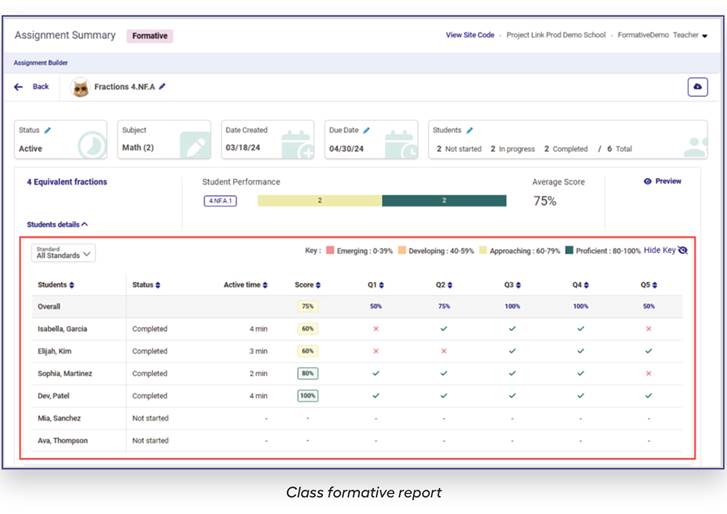
2. Proficiency category: see whether students are in groups such as Emerging, Developing, Approaching or Proficient. This distribution helps teachers visualize the scale of support needs, organize groups flexibly, and avoid using the same task for the entire class.
3. Item-level data: see which questions have a high error rate and which options students chose. Item analysis helps distinguish whether students do not understand the concept, misunderstand the process, misread the requirements or are caught up in a common distractor.
4. Completion and active time: checks whether the student has completed the assignment and whether the assignment time is unusual or not. A low score from work that is incomplete or done too quickly should be interpreted cautiously before a decision to intervene is made.
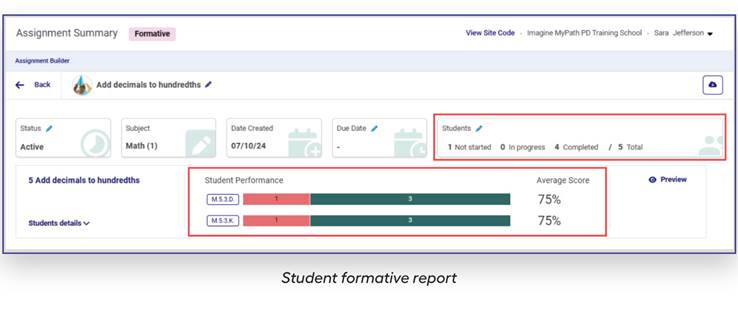
In the Formatives report of Imagine+ Assessment, teachers can view completion status, average score according to standards, number of students in each proficiency category and results for each item. This organization helps users go from the general picture of the class down to specific evidence before deciding to reteach, intervene or enrich.
From data to responsive teaching
Responsive teaching does not mean changing the entire lesson plan every time a low point occurs. Teachers need to determine the scale and cause of the problem, then choose the most appropriate level of adjustment.
1. If the majority of the class has not met the same standard: stop to briefly reteach the whole class, using demonstrations, examples, or other strategies. Then perform a new check to confirm the learning has changed.
2. If a group of students has the same vulnerability: organizes small-group instruction while other groups do independent practice or advanced tasks. Support content should closely follow the standard and type of errors that appear in item-level data.
3. If only a few students are having difficulty: delivers individual support, targeted exercises, or short conversations to determine the cause. Do not drag the whole class back to content that the majority have already mastered.
4. If the student has reached proficiency: move on to applications, explanations in many ways, open problems or tasks requiring transfer. Formative data needs to support both intervention and enrichment.
After each action, the teacher needs to schedule a check-in. Without a recheck, the school will know that a reteach has been held but will not know whether the reteach has made progress or not.
Keep assessments short, to the point, and don't interrupt pacing
Frequent reviews do not mean long tests or multiple tests. A good formative assessment needs to be short enough not to take up study time, but accurate enough to support a specific decision.
1. Only focus on one skill or group of related skills: the clearer the scope, the easier it is for teachers to interpret the results and determine next steps.
2. Keep the number of questions at a sufficient level: Imagine+ Formatives document says that each lesson usually has about 3-7 sentences depending on grade and purpose. The short structure helps teachers perform on-demand testing without breaking the rhythm of the lesson.
3. Write before decision rule: determines which threshold or outcome pattern will lead to whole-class reteach, small-group support, individual intervention, or enrichment. Don't wait until you get a score before thinking about what the data is used for.
4. Prioritize questions that generate clear evidence: Each item needs to be linked to the learning goal and limit measuring unrelated factors. When it is necessary to compare results between students, fixed-form assessment helps every student answer a standardized set of questions.
5. Do not assess if there is no time to act: if teachers cannot view results and adjust lessons in appropriate time, tests easily become additional work. “Real-time” lies in the speed of conversion from data to decisions, not just in the speed with which the system pays points.
How does Image+ Formatives help reduce exam time?
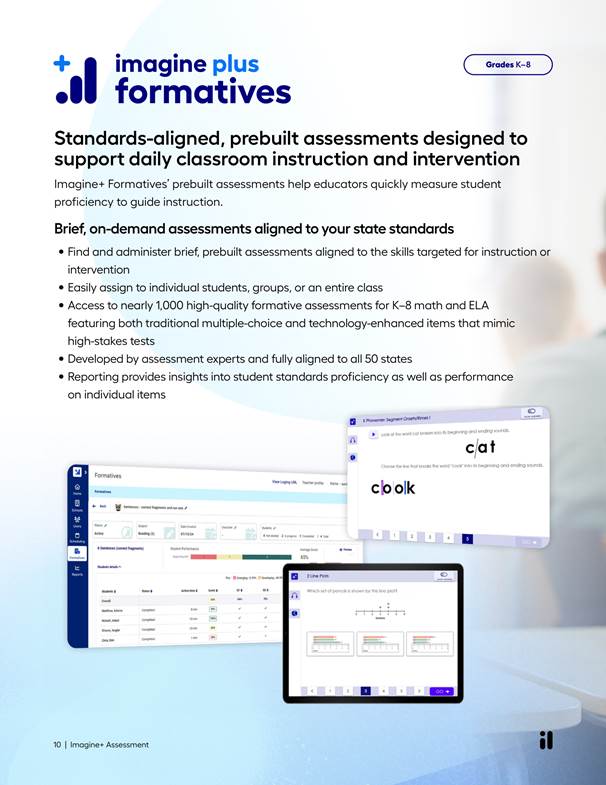
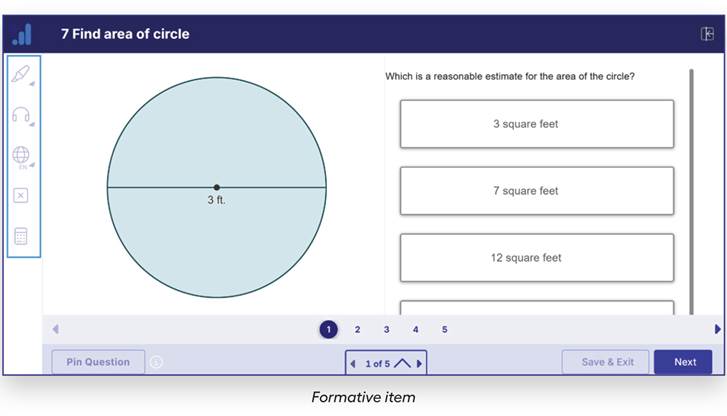
Imagine+ Formatives is a library of short, pre-built, standards-aligned assessments for Math and ELA Grades K-8. According to the implementation documents, the system has more than 320 formatives for Math and more than 575 formatives for ELA; The product brochure describes the total library at nearly 1,000 articles.
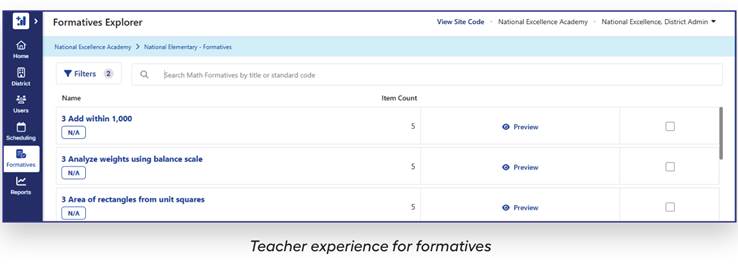
Teachers can search for lessons by subject, grade, standard or keyword; preview item content and associated standards; combine one or more formatives into assignment; Then assign to individual students, groups or the whole class. This process can reduce the time it takes to build a quiz from scratch and help the team maintain more consistent alignment standards.
The report section provides data on completion, average score according to standards, proficiency category and item-level performance. Teachers can use the results to identify skills that need reteaching, student groups that need support, and students who are ready for enrichment.
However, pre-built libraries do not replace pedagogical decisions. Tools only create value when teachers choose the right standards, set lessons at the right time, read data for purpose, and take the next step. Therefore, when viewing a demo, schools should evaluate not only the lesson creation interface but also the speed of going from a report to a specific reteaching plan.
Checklist: Does formative assessment really serve learning?
Teachers and professional teams can use the following questions to review current processes:
1. Is each formative assessment tied to a specific standard or learning goal?
2. Before assigning the lesson, has the teacher determined what decision will be made from the results?
3. Are results viewed by standard, proficiency category and item instead of just by total score?
4. Can teachers clearly identify who needs whole-class reteach, small-group support, individual intervention or enrichment?
5. Is the test short enough to not disrupt pacing and focused enough to produce reliable evidence?
6. Is data returned early enough for teachers to adjust lessons within the week?
7. After reteach, does the class have a recheck to confirm progress?
8. Does the professional team monitor whether assessment is improving instructional decisions or just increasing the number of scores and reports?
Effective formative assessment does not need to be long and does not need to appear in every class. It is important that each check-in helps the teacher better see the learning taking place and create a concrete action. When this process is maintained regularly, assessment becomes a natural part of teaching instead of a separate activity.
Register for a free Trial account, demo book, quote:
Schools and teachers, please contact BooksVN, the designated distributor of Imagine Learning, in charge of countries including Vietnam, Philippines, Malaysia, Singapore, Hong Kong, Indonesia, India, Bangladesh, Cambodia, Laos, Japan and Taiwan through the following channels:
Website: www.booksvn.com Email: cs@booksvn.com
Mobile/WhatsApp: +84-915 920 514
Facebook: https://web.facebook.com/BooksVNeBooksachNgoaiVanchinhhang
Zalo OA: https://zalo.me/2230563715259512406


.svg)