













Why Can Students Memorize Multiplication Tables but Still Struggle With Rapid Recall?
Many children can read the multiplication table fluently when asked in the correct order: 2 × 1, 2 × 2, 2 × 3... However, if the teacher suddenly asks 7 × 8, changes the presentation into 8 groups, each group has 7 objects, or puts multiplication into a word problem, children stop for a long time, count mentally or reason again from the beginning. Parents are often confused because their children have "memorized" but still respond slowly and inconsistently when taking the test.
The problem is not necessarily that the child has never memorized the multiplication table. What's missing might be automaticity - the ability to recall a learned result with high accuracy and almost without having to redo the entire calculation process. When automaticity has not yet formed, knowledge still exists but is not ready to be quickly retrieved in many different contexts.
Knowing the multiplication table on paper may not be able to recall it in math problems
Imagine a student who can read the entire 6 times table correctly in a familiar rhythm. When asked 6 × 7, the child remembers the answer because it appears immediately after 6 × 6. But if the question is separated from the series, changed to 7 × 6, or appears in the middle of a multi-step problem, the child must start tracing again: 6, 12, 18, 24, 30, 36, 42. The child does not completely forget the multiplication table; I'm relying on a "path" that's too long to find the answer.
This difference explains why some students do well when reciting or doing worksheets according to each table, but slow when the questions are mixed. Your knowledge also depends on the order, reading rhythm or familiar form of the lesson. When the context changes, the result is not recalled directly but must be reconstructed by spaced counting, iterative addition, or inference from a nearby calculation.
Teachers and parents can recognize this condition through some common symptoms:
• Children read the multiplication table in order quite well but answer slowly when asked randomly.
• Children often start from 1 × n or an easy calculation and then count forward to the desired result.
• With the same multiplication equation, sometimes children answer immediately but the next day they have to reason again from the beginning.
• Children slow down significantly when multiplication appears in word problems, fractions, or measurements.
• Results are easily confused between facts that are close together, such as 6 × 7, 7 × 8 or 8 × 9.
What is Automaticity in multiplication facts?
Automaticity is the ability to retrieve the multiplication facts learned accurately, consistently and almost instantly. This doesn't mean your child has to answer under pressure or in a race with you. The goal is to reduce the number of unnecessary processing steps, so that children can devote attention to the meaning of the problem, choose a strategy, and check the reasonableness of the answer.
1. Accurate and stable: The correct result does not appear just once in the test but is recalled correctly on many days and in many different question types.
2. Quick access: Children do not need to count everything, add too many times, or reread the entire multiplication table to find a single fact.
3. Flexible use: Children recognize the relationship between calculations, such as using 5 × 8 and adding 8 to find 6 × 8, and gradually recall the direct result.
Automaticity is the result of understanding, practice and reinforcement, not just speed. A child may use a reasonable strategy in the early stages, then through many correct retrievals, the path to the outcome becomes shorter and more stable. Speed, then, is a sign of mastery, not a goal that is forced from the start.
“Once remembered” and “can be retrieved immediately” are two different levels
“Remembered” is often proven by a correct reading, a high score on a test, or the ability to complete questions according to the table you just studied. But memory in familiar situations does not guarantee that children can retrieve the correct facts when the order is reversed, when multiple multiplication tables are mixed, or when attention is divided between a more complex problem.
In contrast, automatic retrieval does not eliminate conceptual understanding. Children still need to understand multiplication as equal groups, recognize commutation and the relationship between multiplication and division. Understanding concepts helps children develop strategies; automaticity helps familiar strategies and results be used with less effort. These two competencies should be developed in parallel.
Why do reciting and studying by heart not create lasting reflexes?
Reciting can help children become familiar with the sequence of results, while a cumulative study session can create a feeling of rapid progress. However, both forms can easily cause parents and teachers to confuse immediate performance of practice with sustained retrieval ability afterward.
1. Memory depends on order: When children always recite 6 × 1 to 6 × 10 in the same rhythm, the answer may be tied to the position in the series rather than to the individual calculation. Random questions lose this "fulcrum".
2. Concentrated learning creates a feeling of familiarity but little chance of recall: Repeat a fact many times within a few minutes to make children realize the answer they just saw. The ability to recognize is not the same as recalling results after a break.
3. One time test did not show durability: A good score immediately after class only reflects the state at that time. To know whether the facts are stable or not, you need to observe children on other days and in many types of tasks.
4. Errors without feedback may be repeated: If a child repeatedly mistakes 7 × 8 for 54 without being corrected immediately, the wrong answer may become familiar and compete with the correct result.
Therefore, the goal of learning the multiplication table is not just to "read it all at once" or complete a page of exercises. Children need to encounter facts again after breaks, have to retrieve them themselves instead of always looking for hints, receive feedback when they are wrong, and use the results in many different contexts.
Why do children still have to count or reason from the beginning?
Not all students who answer slowly have the same reason. Observing how your child finds the answer will help determine which areas need to be reinforced, instead of assuming that your child has to relearn the entire multiplication table.
1. Some foundational facts are not solid: If children are not yet familiar with groups of 2, 5, 10 or familiar doubles, more difficult fact-building strategies will also take a lot of time.
2. Fact is learned separately, no fact family has yet been formed: Children can remember 6 × 7 = 42 but cannot immediately connect with 7 × 6 = 42, 42 ÷ 6 = 7 and 42 ÷ 7 = 6. Each question is therefore considered a completely new knowledge.
3. The interval between training sessions is too long or too erratic: Children just remembered today but won't see that calculation again for many days, causing retrieval ability to stabilize.
4. The exercises always follow the same pattern: Practicing each table in turn creates familiarity but does not sufficiently prepare for situations where calculations are mixed or appear in real problems.
5. Time pressure appears before children have strategies: When children count backwards or compare speeds too early, they may quickly guess, lose accuracy and develop the feeling that they are "not good at Math".
Making an extra page of the multiplication table may not help children remember faster
Worksheet is still valuable when used for the right purpose. But if your child is relying on repetitive counting, assigning 50 more of the same sentences may just cause him or her to repeat the slow strategy 50 more times. A large number of lessons can also easily make children focus on finishing, instead of recognizing which facts are solid and which facts still need support.
Effective practice requires shifting the focus from "doing a lot at once" to spaced practice - distributed practice over many times; deliberate practice - Prioritize the correct weak fact group; and immediate feedback - give immediate feedback when the child is wrong. Each practice session can be short, but it must provide an opportunity for the child to actually recall the results, correct the strategy, and revisit that fact after a break.
The goal is not to turn the multiplication table into a speed contest. A good roadmap helps children gradually reduce their reliance on counting, respond more consistently and feel like they can improve. Speed comes after precision, understanding and deliberate repetition.
Distributed training roadmap to build automaticity
Teachers and parents can organize a short, steady and easy-to-follow route with the following steps:
1. Determine the starting fact group: Mix up the questions instead of reading them in order, observe which facts the child answers immediately, which facts have to be counted, and which facts are often mistaken. Don't just rely on the total score.
2. Select a fact family or subgroup to prioritize: You can start with tables 2, 5, 10, then move on to groups of 3, 4 or difficult facts like 6 × 7, 7 × 8, 8 × 9. Small range helps to respond and practice more accurately.
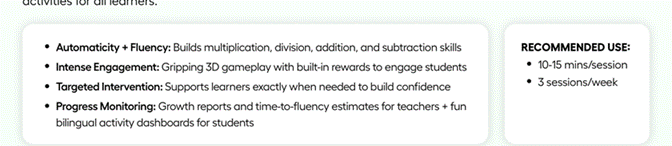
3. Short practice but repeated over many days: Instead of one long session, short sessions can be maintained. The Imagine Math Facts document recommends about 10-15 minutes per session and three sessions per week, suitable for station rotation models, after-class supplementary activities or at-home practice.
4. Mix known facts with learned facts: Some familiar sentences help children warm up and maintain confidence, while the target fact group is repeated purposefully. After a few days, it is necessary to bring back the old facts to check the maintainability.
5. Respond immediately and ask children to explain when necessary: If the answer is wrong or hesitates too long, remind the child of an appropriate number relationship, let the child try again and note the effective strategy. Feedback should help children shorten their path to the answer, not just inform them whether they are right or wrong.
How to monitor fact family to know if the child is really progressing?
For teachers, a simple spreadsheet can divide multiplication facts into groups: facts with 0-1, 2-5-10, doubles, 3-4, 6-7-8-9 and inverse facts related to division. For each group, the teacher records three states: stable recall, still needing support strategies, or frequent mistakes. This method is more useful than just looking at the total number of correct sentences in the whole lesson.
For parents, there's no need to turn tracking into a stress test. You can choose 5-8 facts at a time, ask in random order and record whether the child answers immediately, has to make an inference or answers incorrectly. After a few days, ask the same group again in a different situation, such as number cards, objects, games, or short math problems.
A fact should only be considered relatively proficient when the child answers correctly and consistently over many times of practice, regardless of order, and can use the results in new problems. When a fact family is strong, the practice time can be reduced and switched to maintenance review mode, giving the focus to the weaker group.
When should you use the multiplication table training tool on a digital platform?
Digital tools can be useful when teachers need to differentiate multiplication facts practice for many students at the same time or when parents want children to have a short, consistent schedule at home. However, an engaging experience is only valuable when the content stays true to automaticity and provides usable data.
• Does the platform tailor activities to weak calculus groups instead of assigning the same series of lessons to every student?
• Are the facts re-encountered over many training sessions, with appropriate levels of challenge, or do they only appear one time at a time?
• Does the child receive immediate feedback when they are wrong to avoid repeating ineffective answers or strategies?
• Teachers can view growth reports, identify missing pieces, and track time toward fluency.
• Does the game element maintain motivation for short practice sessions while keeping calculus as the central learning task.
How does Image Math Facts support multiplication facts training?

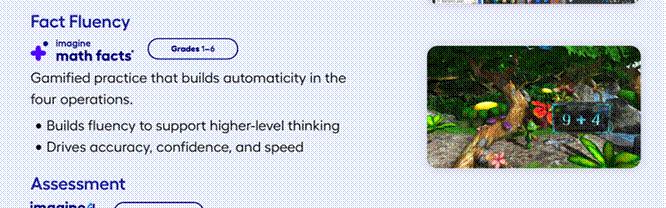
Imagine Math Facts is a gamified learning supplementary program for students Grades 1-5, focusing on building automaticity with addition, subtraction, multiplication and division. With the need to learn multiplication tables, the program creates an environment for students to continuously retrieve multiplication facts in 3D activities with goals, rewards and immediate feedback.
The appropriate point for the problem "memorized but not recalled quickly" is an activity designed to adapt to each learner. Instead of just asking the whole class to do the same worksheet, the system can focus on providing support when students need it, helping them practice the right areas of unstable skills and continue to advance when they reach a higher level of fluency.
For teachers, product documentation says Imagine Math Facts provides growth reports and time-to-fluency estimates; Students have a bilingual activity dashboard. These data can be combined with fact family observations to determine which groups need reteaching, which groups need more practice, and which groups can move to retention review.
Imagine Math Facts should be viewed as a supplement to teaching multiplication meaning and number strategies, not as a replacement for overall instruction. When used in short, regular sessions with clear goals, the program can help transform “remembered” knowledge into faster, more accurate retrieval and greater confidence in new problems.

Register for a free Trial account, demo book, quote:
Schools and teachers, please contact BooksVN, the designated distributor of Imagine Learning, in charge of countries including Vietnam, Philippines, Malaysia, Singapore, Hong Kong, Indonesia, India, Bangladesh, Cambodia, Laos, Japan and Taiwan through the following channels:
Website: www.booksvn.com Email: cs@booksvn.com
Mobile/WhatsApp: +84-915 920 514
Facebook: https://web.facebook.com/BooksVNeBooksachNgoaiVanchinhhang
Zalo OA: https://zalo.me/2230563715259512406


.svg)