













What Is the Science of Reading, and How Can Primary Classrooms Apply It?
Science of Reading is not the name of a textbook
Science of Reading is often translated as the science of reading. This is not a single set of books, applications, or methods. This concept refers to the body of evidence accumulated from many fields that explains how children learn to read, why some children struggle, and what teaching practices support most learners.
Therefore, the important question is not whether the curriculum is labeled Science of Reading, but whether the curriculum clearly teaches foundational skills, has a sequence, allows children to read text, and uses assessment to make adjustments. The science of reading provides principles; The teacher is still the one who converts them into appropriate lessons.
Why is this topic of interest in teaching English reading?
Many students remember familiar words or guess words from pictures but do not know how to process new words. Some children read correctly but slowly, having to pay too much attention to decoding so it is difficult to understand the content. Some students read the passage fluently but their vocabulary and understanding of sentence structure are still limited, so they cannot explain the main idea.
The science of reading helps teachers see reading as an interconnected system. Children need to recognize words more and more automatically while also understanding vocabulary, sentences, background knowledge and the meaning of text; Simply increasing the amount of reading or just practicing phonics is not enough.
Five core elements of teaching reading
1. Phonological awareness: Ability to recognize and manipulate sounds in speech, from rhymes, syllables to phonemes. Phonemic awareness focuses on phonemes, such as listening to cat including /k/ - /æ/ - /t/ and combining or separating sounds.
2. Phonics: Understand the relationship between letters and sounds. Students match grapheme with phoneme, match sounds, analyze spelling patterns and use that knowledge when encountering new words. The goal is to develop a decoding process, not memorize a word list.
3. Fluency: Ability to read accurately, with appropriate speed and intonation. As word recognition becomes more automatic, students can focus on meaning. Fluency is not about reading as quickly as possible, but about reading seamlessly and in clusters.
4. Vocabulary: Vocabulary helps students attach meaning to what they have decoded. Children need to know how words are used in sentences, related meanings and connections to background knowledge, not just remember a translation. Speaking vocabulary often precedes reading vocabulary in the early years.
5. Comprehension: Ability to construct meaning from text: connect sentences, recognize structure, make inferences, summarize, and use evidence. Comprehension depends on both the ability to read words and understand language.
The five elements should not be taught as five separate “subjects”.
The five elements help teachers observe each skill group, but the lesson must connect them. Phonics should lead to reading words, sentences and text that contain the sound patterns just learned. Reading comprehension lessons need to prepare vocabulary and sentence structure but still let students directly read the text.
What Works Clearinghouse recommends developing phonemic awareness, connecting sounds to letters, teaching decoding, and having students read connected text every day. Foundational skills make their way into writing; Text helps children use skills to understand.
What is direct, explicit, systematic and cumulative teaching?
Teach directly and explicitly: Teachers clearly state the goals, model them, let children practice with guidance and then move on to independence. Instead of waiting for children to discover for themselves that sh represents a sound, the teacher introduces, pronounces samples, guides how to combine and correct errors.
There is a system: Skills are arranged in scope and sequence from simple to complex. New lessons are based on previously learned knowledge, avoiding choosing separate sounds or word groups.
Cumulative: Students reuse old skills in new lessons. The text and activities continue to review known patterns so that word recognition ability is stable.
Feedback and corrections: Teachers analyze errors instead of just marking true - false. If the child cannot read sh, it is necessary to determine whether the child does not recognize sh, has not merged the sounds, or can read but does not know the meaning; Each cause requires different support.
What might a Science of Reading lesson cycle look like?
For example, Grade 1 lesson aims to read words with digraph sh and understand a short paragraph about a ship. The 30 - 40 minute cycle can connect sounds, letters, words, sentences and meanings.
Step 1 - Boot with sound: Students listen and identify /ʃ/ in ship, shop and fish, then combine or separate the sounds before looking at the words.
Step 2 - Connect sounds with letters: Teacher introduces sh, modeling two letters representing the same sound. Students read and write groups of purposefully selected words.
Step 3 - Match sounds and read words: Students point to each part, combine the sounds and then read the whole word. New words are interspersed with learned patterns to create accumulation, without requiring guessing words from pictures.
Step 4 - Practice in sentences: You read sentences like “The ship is in the shop.”, paying attention to accuracy, phrasing and punctuation; Some sentences are reread to develop fluency.
Step 5 - Read connected text: Students read a passage with many words that can be decoded using the knowledge they have learned. Questions about characters, events, and main ideas keep the activity moving toward meaning.
Step 6 - Expand vocabulary and comprehension: Words like captain or ocean are explained with pictures and examples. Students answer in full sentences or give evidence from the reading passage.
Step 7 - Quick check: At the end of the lesson, children read a few words and a new sentence. The results show whether the skill has been transferred or whether the child just remembers the activity they just practiced.
Common misunderstandings when applying Science of Reading
Just increase phonics duration: Phonics is essential but does not replace oral language, vocabulary, background knowledge and comprehension. Children can decode correctly but still not understand the sentence.
Using decodable text means only reading dry sentences: Decodable text helps children apply the letter-sound patterns they are learning. Children still need to listen to and discuss stories, informational books and content-rich texts to expand their language.
All students must walk at the same speed: The common sequence does not mean the same support. Some children need phonemic awareness, some children need fluency; Multilingual students may need additional vocabulary and language structures.
Technology can replace teachers: Digital platforms provide practice, feedback, and data, but teachers must still listen to students read, observe expressions, and facilitate discussions.
How to track progress using data?
The final score does not indicate where the student is stuck. Teachers should use a combination of short tests, observations, and reading samples to monitor each element.
Phonological awareness: Ability to recognize rhymes, separate and combine syllables and manipulate phonemes without depending entirely on writing.
Phonics and word recognition: Accuracy when reading familiar words, hypothetical words or new words with learned patterns; Spelling ability also provides evidence of letter-sound knowledge.
Fluency: Accuracy, automatic level, phrasing and expression when reading level-appropriate passages. Speed is only part of the picture.
Vocabulary and language comprehension: Ability to explain words, understand sentences, retell, answer inference questions, and connect text to background knowledge.
Comprehension: Ability to determine main idea, details, structure, cause-effect relationships, and use evidence from text.
Skill-based data helps reteach the right bottlenecks. Students who are slow because word recognition is not yet automatic need support, unlike students who read fluently but do not understand words and sentences.
Criteria for selecting tools suitable for Science of Reading
Do not choose a tool just because the phrase Science of Reading is on the brochure. The professional committee needs to see how the principles are translated into daily activities and what role the tools play.
1. Have a clear scope and sequence: Sound, letter, word and text skills are arranged in order and reviewed regularly.
2. There are direct, explicit and systematic instructions: Students are given clear instructions before practicing, not mainly guessing words or discovering rules on their own.
3. Connect skills with connected text: Phonics and word reading lead to meaningful reading of sentences, paragraphs, and text.
4. Develop both language and literacy: The tool does not stop at decoding but also supports vocabulary, comprehension, language structures and communication.
5. There are ongoing reviews: Data helps identify missing skill groups, adjust the roadmap and decide whether to re-teach or move on to the next content.
6. Suitable for deployment roles: Schools need to determine whether this is a core curriculum, a supplementary resource or an intervention tool; a platform does not replace an entire system of teaching reading.
Imagine Language & Literacy as an example of a complementary tool
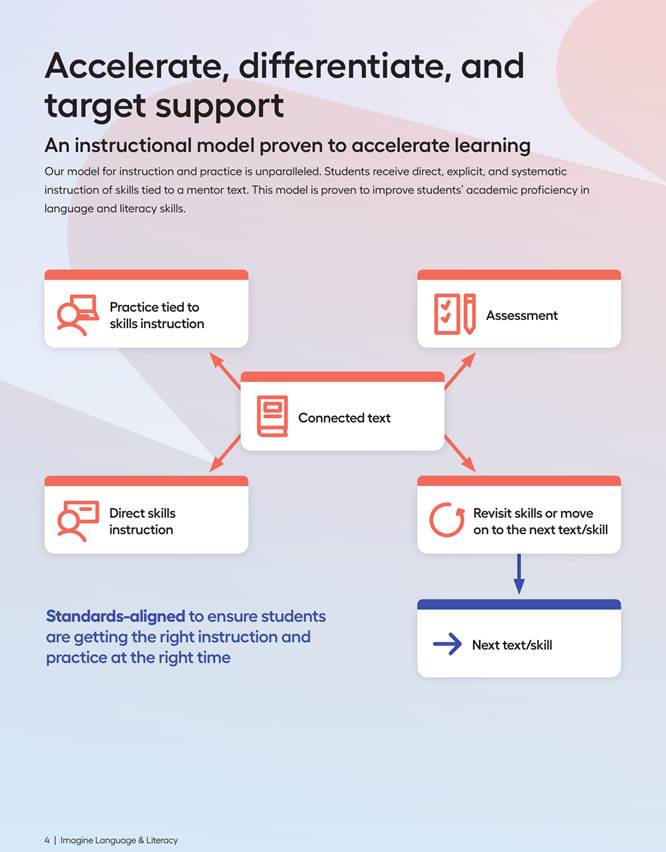
Imagine Language & Literacy's Grades PreK - 6 document describes parallel language and literacy development: phonological awareness, phonics, fluency, comprehension and vocabulary, language structures and communication. The model connects direct skills instruction, practice, connected text and assessment.
These characteristics can be contrasted with the criteria of direct, systematic teaching, linking skills to text and continuous assessment. Platforms are still complementary tools; Teachers need to organize reading aloud, discuss and build background knowledge.
A realistic pilot roadmap for elementary schools
1. Choose a clear set of skills and students: Choose Grade 1 to strengthen phonemic awareness and decoding, or Grade 3 to read correctly but fluency and comprehension are not stable.
2. Collect baseline before deployment: Record reading samples, word reading, vocabulary and comprehension to get a starting point by skill.
3. Unify the lesson cycle: Unified direct - guided practice - connected text - assessment, but flexible in speed and scaffolding.
4. Follow up in 6 - 8 weeks: Compare reading errors, automaticity levels, word comprehension, evidenced responses, and levels of support needed.
5. Evaluate both the data and the classroom experience: Only expands when students transfer skills to new texts, teachers can use reports and tools to supplement the current curriculum.
From research evidence to daily teachings
Science of Reading is valuable in helping teachers decide which sounds to teach, how children will combine words, what texts to use, what vocabulary to prepare, and what data indicates readiness to move forward. This is how to connect word recognition with language comprehension so that reading leads to understanding.
Schools should review the program according to the five elements, check scope and sequence and see if students read connected text every day. From there, the expert committee determines the areas that need to be strengthened with learning materials, training or pilots.
Register for a free Trial account, demo book, quote:
Schools and teachers, please contact BooksVN, the designated distributor of Imagine Learning, in charge of countries including Vietnam, Philippines, Malaysia, Singapore, Hong Kong, Indonesia, India, Bangladesh, Cambodia, Laos, Japan and Taiwan through the following channels:
Website: www.booksvn.com Email: cs@booksvn.com
Mobile/WhatsApp: +84-915 920 514
Facebook: https://web.facebook.com/BooksVNeBooksachNgoaiVanchinhhang
Zalo OA: https://zalo.me/2230563715259512406


.svg)