













Problem-Based Learning in Mathematics: Students Learn Better by Doing the Math
What is Problem-Based Learning in Mathematics?
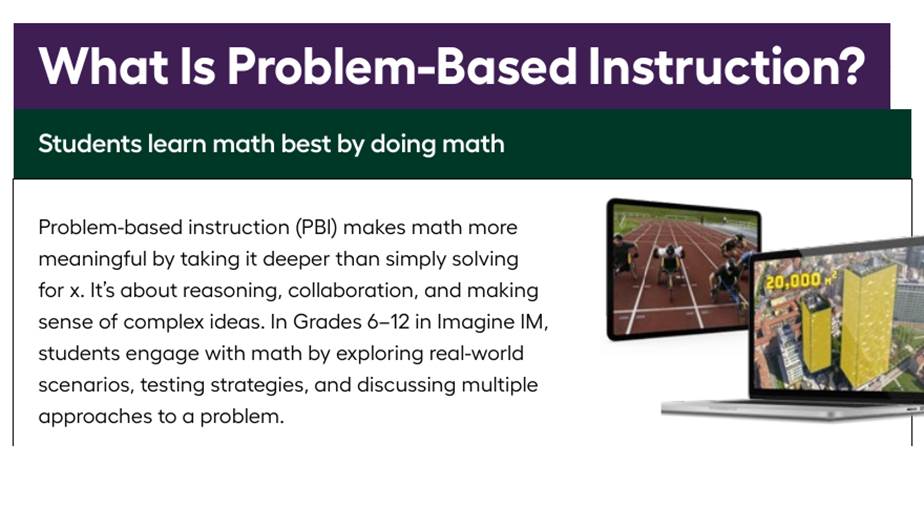
Problem-Based Learning - problem-based learning in Mathematics is a way to organize lessons starting from a problem worth thinking about. Instead of the teacher pre-introducing formulas and procedures, students are allowed to observe the situation, determine what to look for, try out many demonstrations, and explain why their strategy is reasonable.
The important point is not that students have to discover all knowledge on their own without support. Children directly do Math first, while teachers design tasks, monitor thinking, ask suggestive questions and synthesize ideas into clear knowledge. Thanks to this, the formula appears as a meaningful tool instead of a stream of symbols to be memorized.
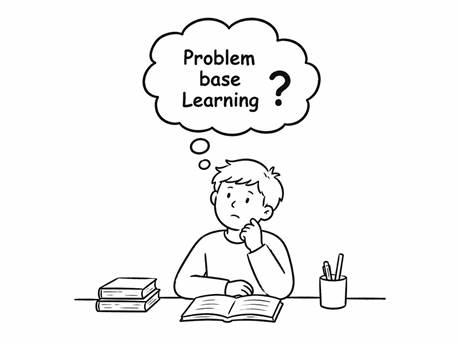
Are PBL and PBI the same?
PBL is often used to refer to problem-based learning - a student's learning experience. PBI is problem-based instruction - how teachers design and coordinate the learning process. In math class, the two concepts often go together: students learn by solving problems, and teachers create structure so that exploration leads to specific learning goals.
1. The lesson begins with a question or situation makes students think, not start by copying formulas.
2. Students have the right to choose their approach like drawing pictures, making tables, using models, trying numbers or writing expressions.
3. Many strategies were discussed for students to compare, connect and recognize general Math ideas.
4. The teacher observes and asks purposeful questions instead of solving problems immediately when students encounter difficulties.
5. Knowledge is clearly synthesized after the discovery process so that students not only have experience but also form the correct language, symbols and procedures.
6. Practice is still used but to reinforce understanding and flexibility, do not just repeat a sample format.
Problem-Based Learning in Mathematics is not synonymous with Project-Based Learning. A problem-based lesson can take place in one lesson or a series of short lessons, focusing on a specific concept. Students do not necessarily need to create a large product; The key thing is that students must use Math thinking to solve problems.
How is it different from the "model lecture - practice lesson" teaching method?
In the familiar model, teachers often explain the rule, do one or two examples, then ask students to do many similar problems. This method can help the class quickly complete the content and create accuracy with familiar lesson formats. However, students easily depend on the superficial signs of the sample test and get confused when the data, questions, or context change.
The difference in problem-based teaching is not to abandon the formula, but to change the order and role of activities:
1. The problem appears before the process: students have a reason to need a new concept or formula.
2. The thinking process is valued along with the answer: students must explain how to represent, select, and check results.
3. Mistakes become learning data: teacher uses incomplete understandings for the whole class to analyze and adjust.
4. Students' voices play a central role: children present, listen, criticize and connect many strategies.
The two ways of teaching do not necessarily exclude each other. Teachers can still instruct directly when necessary, especially in summarizing or practicing skills. The difference is that instruction is placed after students have experienced the problem, so the teacher's explanation has a basis for connecting to what they have just observed.
How does a problem-based lesson work?
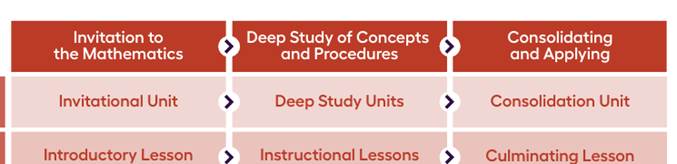
A PBI lesson usually has three rhythms: inviting students to step into the problem, letting them research deeply, then consolidating and applying. At the activity level, teachers can organize by launch - work time - synthesis to both create space for exploration while keeping clear academic goals.
The duration of each step may vary according to the task and class readiness. However, a familiar rhythm helps students know when to think for themselves, discuss and synthesize knowledge with the whole class.
Before class, teachers identify goals, predict strategies, identify misunderstandings, and prepare supporting questions. This design makes PBI different from just giving a difficult lesson and letting students figure it out on their own.
Stage 1: Invitation to the Mathematics
The first phase usually includes warm-up and launch. Warm-ups activate related knowledge, providing an opportunity for students to become familiar with a performance or routine that will be used. Launch introduces the context, clarifies the requirements, and ensures students understand what they need to discover without revealing the solution.
The introductory task needs to be accessible enough for many students to get started, but with enough depth to generate different strategies. Students should have the opportunity to use pictures, tables, models or their own language.
Teachers should avoid solving the entire sample or emphasizing keywords to make students guess the formula. Instead, you can ask: "What do you notice?", "What relationship is the problem asking to find?" or “How can you represent this situation?”.
Phase 2: Deep Study of Concepts and Procedures
During work, students try out strategies individually or in groups, record their thinking, and adjust when faced with conflicts. This is when students really do Math: make conjectures, test cases, find patterns, build models, and connect what they already know to new problems.
Teachers monitoring how students get started, the representations they are using, stuck points, and work can help the class see an important idea. Typical strategies are selected and arranged for discussion.
Deep study also includes process development and accuracy. After students realize the relationship, teachers help them express themselves using Mathematical language, symbols and methods more effectively. Thanks to this, procedural fluency is built from understanding instead of being separated from understanding.
Phase 3: Consolidating and Applying
The synthesis part is when the teacher connects ways of doing things, highlights similarities and differences, and names the concept or process that the lesson is aimed at. Students don't just hear the conclusion but need to explain how the general idea emerged from the strategies shared.
After synthesis, cool-down helps teachers check each student's understanding. Practice is intended to reinforce fluency and transfer knowledge to slightly different situations, while also providing data to inform decisions about reteaching, small group support, or extension.
Thanks to the cycle of encountering problems - building ideas - discussing - synthesizing - applying, students have the opportunity to deeply understand and transfer knowledge instead of just memorizing lessons in a short time.
Why does PBL help students understand concepts more deeply?
A concept is easier to understand when students see it solves a specific need. The formula is connected to the relationship you just observed, so the knowledge has more sticking points in memory.
Multiple representations - many ways of representation is especially important in PBL. A problem can be expressed in words, pictures, tables, graphs, physical models, or symbols. Switching between representations helps students recognize common structure and is not dependent on a single representation.
Explaining and defending methods forces students to clarify their thinking. When they hear a different strategy, they also see that the same concept can be approached from many directions.
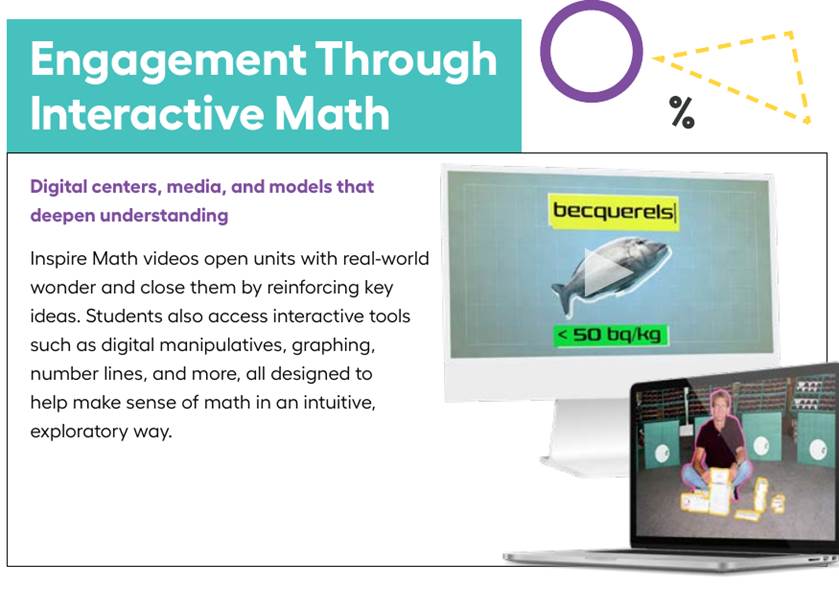
Numerical tools and interactive models allow students to change facts, try multiple cases, and observe what stays the same. However, technology is only valuable when associated with prediction, explanation and discussion, not just dragging and dropping to get answers.
How does PBL help long-term memory and knowledge transfer?
Students often remember longer when knowledge is associated with a meaningful sequence of actions: identifying problems, choosing representations, testing strategies, detecting errors and adjusting. These connections create more pathways to memory than just repeating the process.
Transferability develops when students encounter many variations of the same idea. Teachers help children name common structures to recognize familiar knowledge in new contexts.
Discussing Mathematics is not about making the classroom "noisier"
Math discourse is not intended to make students talk more but to help their thinking become visible. Students test arguments, compare strategies, and use Math language more accurately in a discussion with focused questions and clear listening rules.
Teachers can let students think individually, discuss in pairs and then share. Sentence frames, visual models, and Math Language Routines give many students a starting point. Some possible questions include:
1. What relationship or pattern do you see in this situation?
2. Why is this representation appropriate to the problem?
3. Are there any other strategies that lead to similar results?
4. In what ways are the two methods similar and different?
5. If you change a fact, how will the result or method change?
After the sharing, teachers need to clearly conclude the core knowledge. Synthesis turns many individual experiences into shared class understanding.
Common misunderstandings about PBL/PBI
Misunderstanding 1: PBL is for students to swim on their own. Teachers still prepare tasks, predict strategies, monitor and provide timely support in a clear structure.
Misunderstanding 2: Teachers are not given direct instruction. Teachers still explain and standardize knowledge, but choose times to connect instruction to experiences students have just had.
Misunderstanding 3: PBL is only suitable for good students. Tasks have multiple entry points, visual models, open-ended questions, and language support to help diverse students reach common goals.
Misunderstanding 4: Every problem must have a complex real-life context. The problem may arise from geometry, the laws of numbers, or a strange representation; the important thing is to create the need for argument.
The teacher's role is still decisive
In a problem-based class, the teacher is the one who designs and coordinates thinking: deciding when to wait, asking questions, providing scaffolding, or clarifying an idea. This role requires great expertise, not less importance.
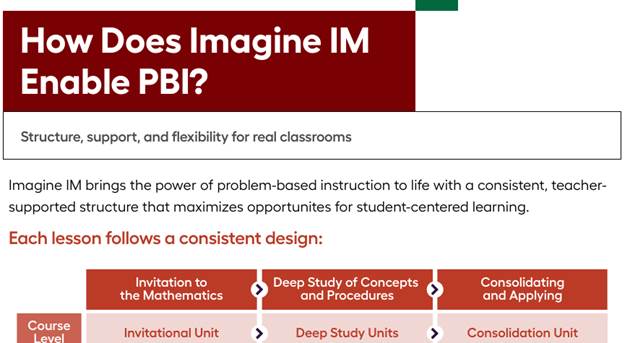
Imagine IM illustrates a structured problem-based flow lesson
Imagine IM is a K-12 Math program that can be referenced when learning about PBI. Lessons go from invitation to the mathematics, deep study of concepts and procedures to consolidating and applying; In each activity are launch, work time and synthesis.
Teacher Guide provides goals, pacing, guiding questions, scaffolds and Math Language Routines. Thanks to that, students have space to discuss and compare strategies, while the teacher still leads the class according to clear goals.
Schools should watch sample lessons to evaluate the depth of the problem, the position of teacher guidance, the quality of synthesis, and the use of assessment at the end of the lesson.
Register for a free Trial account, demo book, quote:
Schools and teachers, please contact BooksVN, the designated distributor of Imagine Learning, in charge of countries including Vietnam, Philippines, Malaysia, Singapore, Hong Kong, Indonesia, India, Bangladesh, Cambodia, Laos, Japan and Taiwan through the following channels:
Website: www.booksvn.com Email: cs@booksvn.com
Mobile/WhatsApp: +84-915 920 514
Facebook: https://web.facebook.com/BooksVNeBooksachNgoaiVanchinhhang
Zalo OA: https://zalo.me/2230563715259512406
|
|


.svg)