













Bilingual Students Understand the Math but Struggle With English: How Can We Assess Them Fairly?
An incorrect answer does not necessarily reflect weak Math ability
In a bilingual class, a teacher may encounter a student who operates correctly with the model, calculates correctly when given an explanation, but gets it wrong on a written test in English. I missed a keyword, misunderstood the request, or didn't know how to express the solution. If only looking at the final score, it is easy for schools to conclude that students are weak in Math when the real barrier lies in the language of the test.
This is a common challenge when assessing multilingual learners. A math problem may simultaneously require subject knowledge, reading comprehension skills, and academic vocabulary. When these three factors are combined into one score, it is difficult for teachers to know whether students are lacking math prerequisite skills, lacking English language proficiency, or having difficulty in both.
Fair assessment does not mean simplifying questions or lowering standards. The goal is to keep the Math concept that needs to be measured intact, while reducing language barriers that are not part of the goal. As a result, results more accurately reflect what students know and can do.
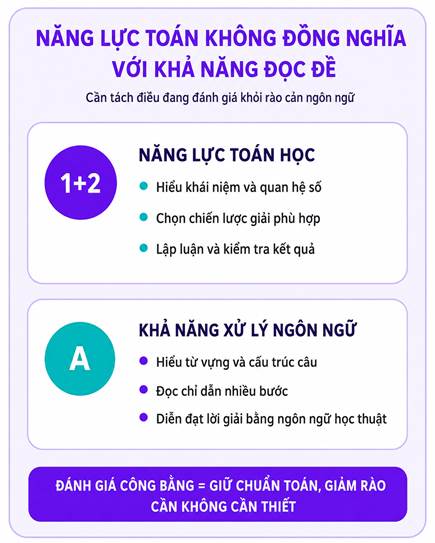
Distinguish between Math ability and the ability to read and understand the language of the test
Before choosing an ELL math assessment, teachers need to clearly determine what the test is measuring. A task that seems to only test Math usually contains at least three layers of requirements:
1. Math Ability: Do students understand concepts, recognize relationships between quantities, choose calculations, reason and check results? This is the target skill that needs to be kept intact.
2. Mathematics Language: Do students understand terms such as greater than, difference, product, remaining, estimate or at least? An unfamiliar keyword can cause the entire solution to go wrong even if you have a solid grasp of the calculation.
3. Academic language of the assignment: Can students follow long sentences, passive structures, multi-step instructions, or requests to “justify your reasoning”. This is a language load that can obscure subject knowledge.
Three classes of competencies are related but not identical. A student may understand division and fraction models but does not have enough English vocabulary to explain. On the contrary, a student who reads the questions very well may still lack core Math concepts. So the score is only meaningful when the teacher knows which part of the task produced the error.
A quick way to test is to ask students to express the same concept in many ways: manipulating samples, drawing diagrams, restating thoughts, choosing expressions and performing calculations. If Math results are consistent but reading or writing changes drastically, language barriers need to be considered before deciding to reteach subject content.
Risk of assessment in a language that obscures subject competencies
When the test uses only one language, the score may reflect English processing ability more than Math ability. The consequences are more than just a low point. Students may be placed in the wrong group, receive intervention for the wrong skills, lose the opportunity to access grade level content and gradually believe that they are "not good at Math".
For teachers, noisy data leads to wrong decisions: reteaching calculations students already know, ignoring vocabulary scaffold needs, or underestimating the rate of progress. For schools, the combined results can make the bilingual education program look ineffective even though the reason lies in the assessment tool not separating subject competency and language competency.
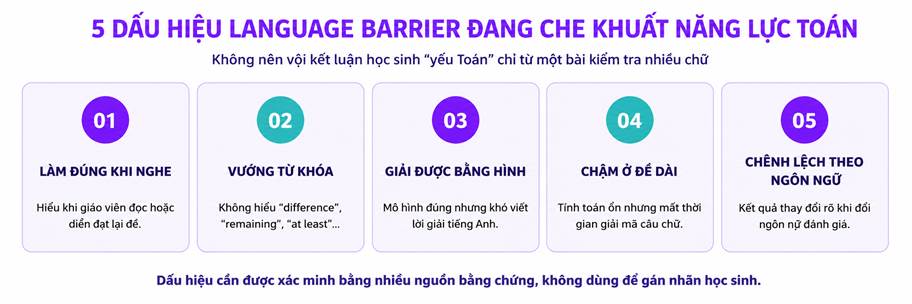
5 signs students understand Math but are having trouble with language
There is no single sign that is enough to conclude. However, the following symptoms help teachers determine when additional evidence is needed before labeling a “lost student” or engaging in learning intervention:
1. Students get it right when the teacher reads or rephrases the topic: When questions are said slowly, broken down or keywords are replaced with familiar expressions, you choose the right strategy. This change suggests that the barrier may lie in decoding the language.
2. The student calculated correctly but answered the question incorrectly: I perform calculations correctly but choose the wrong quantity, ignore conditions, or don't know how to compare, estimate, or explain. This is often a matter of understanding keywords and question structure.
3. Students demonstrate good understanding through pictures or operations: I built the correct model, arranged the objects properly or pointed out the relationship on the number line but could not write the solution in English. Visual evidence needs to be acknowledged rather than ignored.
4. Speed drops sharply in word problems: With pure calculation exercises, students complete it stably; When moving to a long topic, I read it over and over again, guessing the words or giving up. This difference suggests that language load is taking up the majority of processing time.
5. Results vary significantly depending on language or presentation: If the same skill is assessed in familiar language, audio or video and the student does significantly better, teachers need to separate conclusions about Math ability from English proficiency.
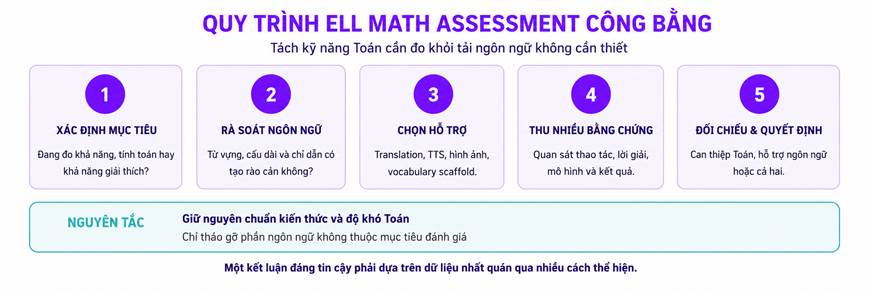
Fair assessment process for multilingual learners
A good process does not seek to “remove language” from Math, because students still need to develop mathematical language. Instead, the teacher determines which parts of the language are targeted for learning and which parts are just getting in the way of demonstrating knowledge.
1. Determine target skills before designing the test: Specify whether the test is measuring understanding of fractions, the ability to choose operations, reasoning or the ability to write explanations. When the goal is clear, the teacher decides which support does not change the construct to be measured.
2. Check the language load of the topic: Check rare vocabulary, sentences that are too long, many clauses, cultural contexts, and instructions with many steps. You can keep the Math difficulty level but write sentences more clearly, separate instructions, or add images that do not provide the answer.
3. Choose suitable accommodation: Translation, text-to-speech, bilingual glossary, vocabulary scaffold, extra time or relistening permission can help students access the topic. Support must be consistent with goals and documented to explain results.
4. Collect many sources of evidence: Combined written work with observations, short interviews, operations, diagrams and follow-up questions. When sources come to the same conclusion, teachers have a more solid basis for distinguishing Math needs and language needs.
5. Compare performance with and without support: If a student makes good progress when vocabulary support or TTS is turned on but still gets the same concept wrong, he or she may need both language and prerequisite skills intervention. If concepts are worked out consistently, reteaching General Mathematics may not be necessary.
How should translation, text-to-speech and vocabulary scaffold be used?
Translation is useful when the language of the test is not the assessment target and the school has a high-quality translation. However, translating each word may distort the meaning of Math terms or change the difficulty of the question. Therefore, the translation needs to be reviewed by someone who understands both the language and the subject content.
Text-to-speech helps students listen to the topic again, reduces the burden of decoding words and supports slow readers. This tool is appropriate when reading skills are not a primary construct. If the test is measuring word problem reading comprehension in English, enabling TTS should be considered and reported separately.
Vocabulary scaffold should explain the necessary keywords without revealing the strategy. For example, interpreting “remaining” as “remaining” may be reasonable; but pointing out that the word always requires subtraction turns the linguistic aid into a hint of the answer. Good Scaffold opens the way but still allows students to reason on their own.
• Maintain the data, concepts and thinking level of the Math problem.
• Only change your approach when the factor is not the skill being assessed.
• Record support used to compare results over time.
• Test your transferability with a new task, don't just rely on one correct attempt.
When applied consistently, these aids do not “easy” the test. They help make scores less dependent on an extra-target language barrier. At the same time, the data tells teachers where multilingual learners need to develop their academic English to gradually perform tasks more independently.
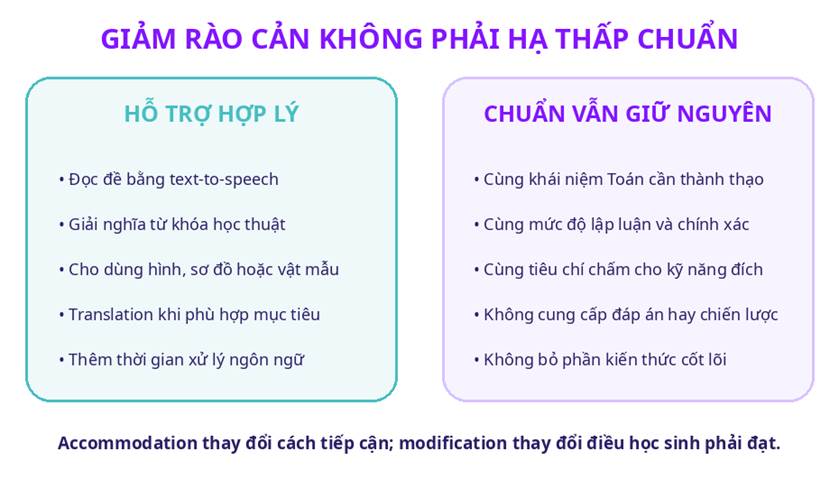
Reduce barriers but do not lower knowledge standards
In inclusive and bilingual education, the boundary between accommodation and modification needs to be clarified. Accommodation changes the way students access or demonstrate knowledge; Modification changes what students are expected to learn or the level of proficiency that is required. Fair evaluation prioritizes accommodation when goals can remain the same.
1. Keeping the same Math concept: Students can listen to the topic or use the glossary, but they still have to understand the same relationships, perform the same calculations, and achieve the same accuracy as their peers.
2. Keeping the same level of reasoning: Allowing speech, drawing or manipulation does not mean removing the reasoning requirement. Teachers still need to ask why, ask to show evidence and check to see if the solution can be applied to the new lesson.
3. Do not turn scaffold into pre-solved strategy: Images should only clarify the context; Vocabulary support only clarifies word meanings. If the support shows calculations or step-by-step sequences, the results no longer reflect the ability to solve problems on your own.
4. Reduce support as language ability increases: The long-term goal is to help students use mathematical English more and more independently. Teachers can move from full translation to glossary, from active audio to listening as needed, and then gradually decrease when the data shows the child is ready.
5. Report results on two axes when needed: A student may meet Math standards but still need language support to explain. Noting these two aspects helps parents and teachers avoid misinterpreting a composite score as a general ability.
Schools also need to agree on policies: what support is allowed in regular testing, benchmark assessments and key assessments; Who is responsible for checking translation quality; How is the data recorded? Consistency makes results across classes, grades, and school years comparable.
Technology can provide multiple language options and automate some reporting, but cannot identify every case on its own. Teachers still have to look at their work, ask them how they think, and compare it with the language students use every day before deciding on learning intervention.
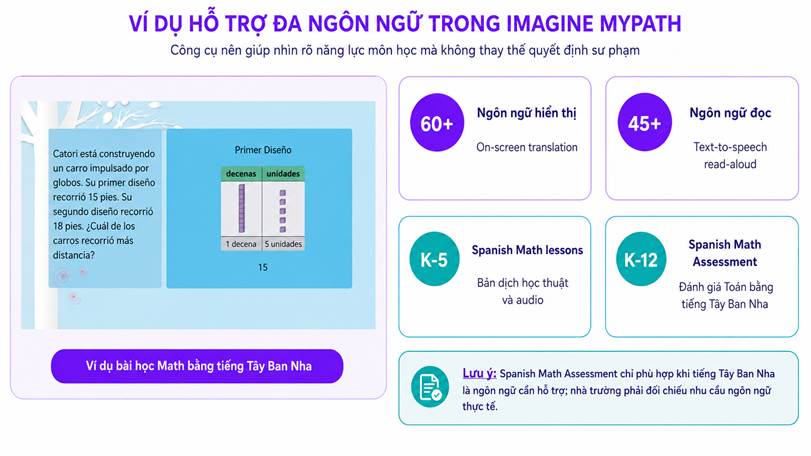
How does Image MyPath support multilingual learners in Math?
Imagine MyPath is a personalized learning program for Reading and Math K-12. According to product documentation, the platform has on-screen text translation in more than 60 languages and text-to-speech read-aloud in more than 45 languages. These options can reduce the language barrier in the learning process when used appropriately for the goal.
For Math, MyPath has K-5 lessons in Spanish with academic translation and audio by native speakers. The platform also offers Spanish Math MyPath Assessment K-12, to help teachers observe Math proficiency with less interference from English barriers in cases where Spanish is the appropriate language for the student.
Assessment results can be used to place students on an Individual Learning Path and track progress by domain. When combined with classroom data, teachers have more basis to identify which Math skills children lack, where they need language support, and which content should be assigned for reinforcement.
However, Spanish Math Assessment is not a universal solution for all multilingual learners. Appropriateness depends on the student's language, proficiency level, school program, and assessment goals. MyPath should be seen as an international example of how digital platforms reduce barriers, while the final decision remains with teachers and schools.
Checklist for selecting a Math assessment platform for bilingual classes
Before implementing an ELL math assessment tool, schools can use the following questions to see if the platform helps measure competencies more fairly or just translates the interface:
• Does the tool clearly separate the Math skill to be measured and the language of the question?
• Is the translation constructed and reviewed according to the academic context, rather than a mechanical word-for-word translation?
• Do students have text-to-speech, replay access, and vocabulary support at the right points?
• Is it possible to assess in student-appropriate language when it does not change the course objectives?
• Does the report allow viewing results by domain, skill, student, and group to determine intervention needs?
• Can teachers combine numerical data with direct observations, interviews, and assignments?
• Does the platform clarify language support limits and allow schools to test coverage before rolling out widely?
BooksVN can support schools in reviewing language needs, registering for the Imagine MyPath pilot and building a checklist to evaluate the Math platform for bilingual classes before making a decision.
Register for a free Trial account, demo book, quote:
Schools and teachers, please contact BooksVN, the designated distributor of Imagine Learning, in charge of countries including Vietnam, Philippines, Malaysia, Singapore, Hong Kong, Indonesia, India, Bangladesh, Cambodia, Laos, Japan and Taiwan through the following channels:
Website: www.booksvn.com Email: cs@booksvn.com
Mobile/WhatsApp: +84-915 920 514
Facebook: https://web.facebook.com/BooksVNeBooksachNgoaiVanchinhhang
Zalo OA: https://zalo.me/2230563715259512406


.svg)