













From Conversational English to Academic Language: The Gap That Holds Students Back
Speaking naturally may not be learned in English
Many students in bilingual schools can converse with friends, understand familiar instructions, and respond quite naturally in English. However, when entering Science or Math class or having to read an informational text, students begin to lose their breath. Students understand individual words but do not grasp the requirements; know the content but cannot express it; or give very short answers despite having ideas.
This gap often lies in academic language - the language system used to receive knowledge, think and express understanding in school. Conversational English helps children join the conversation; Academic language helps students follow lectures, read and understand documents, solve tasks and demonstrate what they have learned.
Academic language is not just about “difficult” words
Academic English for children is not simply about learning more long words. Academic language includes vocabulary, sentence structure, and organization of ideas appropriate to tasks such as describing, comparing, explaining causes, summarizing information, or arguing with evidence.
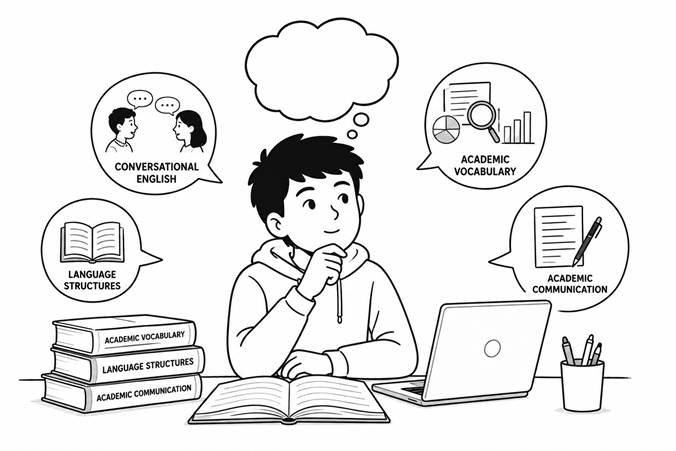
1. Conversational English - English for communication: Language used in familiar situations such as “Can I borrow a pencil?” or “Let’s play together”. Facial expressions, objects, gestures, and context help listeners guess.
2. Academic vocabulary - academic vocabulary: Includes technical words such as habitat, fraction, evaporation and words used in many subjects such as compare, evidence, identify, represent, result.
3. Language structures - language structures: Includes passive sentences, subordinate clauses, long noun phrases and connecting words indicating cause - effect or comparison - contrast.
4. Academic communication - academic communication: Ability to ask questions, present processes, respond to opinions, and write answers with evidence.
Why is it difficult for students to follow Science and Math lessons?
In everyday communication, sentences are often short, the topic is familiar and the speaker can make adjustments immediately when the other person does not understand. In the classroom, information is compressed into problems, text, diagrams, and explanations. Students must simultaneously understand new concepts, process new language, and remember tasks. When academic language is not enough, a child's true thinking ability can be obscured by limited expression ability.
In Science, a child may observe correctly but not understand or use absorb, nutrients, therefore and evidence. In Math, students may calculate correctly but confuse "increase by" with "increase to", do not understand "at least" or do not know how to answer "Explain how you know". The bottleneck sometimes lies not in subject knowledge but in the language used to access and express that knowledge.
Gap 1: Wide vocabulary but not enough depth
Many students remember the Vietnamese meaning of a word but do not know how the word works in context. Knowing that “evidence” is “evidence” is not enough; They need to identify evidence in the text, using “evidence shows that...” and distinguish evidence from opinion. Academic vocabulary needs to be linked to concepts, for example, word families and usage in sentences.
Teachers do not need to turn each reading into a long list to memorize. You should choose a few important words to understand the content, can be reused in many subjects and help students perform tasks. Each word needs to be encountered again through listening, speaking, reading and writing to move from “recognition” to active use.
Gap 2: Knows grammar but cannot handle academic sentences
Grammar exercises often separate one knowledge point. In real text, many structures appear at the same time. Students must find the main verb in the middle of a long noun phrase, determine which pronoun stands for the object, understand what relationship the linking word is signaling, and distinguish main information from supplementary information.
Instead of just asking for the name of the structure, the teacher should clarify its function. Passive sentences often emphasize the process or result; because, therefore and as a result organize cause-effect relationships; Whereas and in contrast express differences. Understanding function helps students apply structure to reading and writing.
Gap 3: Have ideas but lack the language to speak and write
A student might point to the graph and say “this one is bigger,” while the task requires comparing results and explaining differences. If children have not been taught patterns like "The data shows that...", "Both..., but..." or "One possible reason is...", children can easily answer too briefly or be silent even though they understand the content.
Speaking activities should be a preparation step for writing. Students need to listen to a good model, practice sentences with friends, replace words in sentence frames and gradually create independent sentences. When language is practiced verbally first, teachers can easily recognize that students lack concepts or just lack expression.
Teach academic language in the context of readings
Vocabulary, structure, and communication should be organized around the same text or topic. Students don't learn vocabulary in one activity, grammar in another activity and then be expected to connect it all themselves when taking the test. The reading can become a mentor text for students to observe how language conveys knowledge and try to use it again.
1. Before reading: Determine content goals and language goals. Choose a small group of keywords, use pictures or examples, and state clearly whether students need to describe, compare, explain, or reason.
2. While reading: Stop at sentences containing important structures, divide sentences into clusters of ideas and clarify connecting words. Teachers can read the sample or have students match the pronoun with the noun it replaces.
3. After reading: Have students practice speaking in pairs before writing. Sentence frames are the initial scaffolding, then are gradually withdrawn so that students can organize their own sentences.
4. In the next post: Bring words and structures back into new contexts. Reusability shows that language has become a learning tool, rather than temporary memorized knowledge.
Example of integrating vocabulary, comprehension and communication
With the reading about how plants transport water, the content goal is to explain the role of roots and stem. Vocabulary includes absorb, transport, nutrients and survive; The central structure is the passive voice and cause-effect; The communication task is to explain the process with evidence from the text.
Teachers can use images to predict, read the short passage, clarify "is absorbed" and "is transported", then have students arrange the steps. Students practice saying "First..., then..., because..." before writing. Such a lesson simultaneously develops content, vocabulary, structure, reading comprehension and academic communication.
Scaffolding does not mean lowering requirements
Students who are developing academic language still need to access grade-appropriate ideas. What should be adjusted is the way of participation: images, audio, vocabulary illustrations, sentence breakdown, step questions, sentence frames, pair discussion or support with students' strong language.
Scaffolding needs to be gradually withdrawn. If students always fill in one word in the form, they may complete the activity but not master the language. Teachers should monitor the process from repeating a sample sentence, replacing an element, combining two ideas to choosing the appropriate structure.
Monitor academic language using what criteria?
Individual vocabulary test scores do not fully reflect the ability to use English to learn. Schools should collect evidence across multiple tasks and compare over time using a consistent checklist.
1. Understand academic requirements: Distinguish between identify, describe, compare, explain and justify; know the product to create.
2. Understanding words in context: Explain or infer meaning and use the correct word when the topic changes.
3. Handling complex sentences: Identify main ideas, clauses, connecting words and relationships between parts of sentences.
4. Oral presentation: Describe, compare, or explain using full sentences instead of a few words.
5. Use evidence: Cite information from text, images, or data to support the answer.
6. Organized writing: Connect ideas clearly and use vocabulary and structures appropriate to the task.
7. Reduced dependence on support: Switch from full sentence frames to short suggestions and independent expressions.
8. Transfer between subjects: Reuse language in Science, Math or new text.
When digital learning materials teach language in context
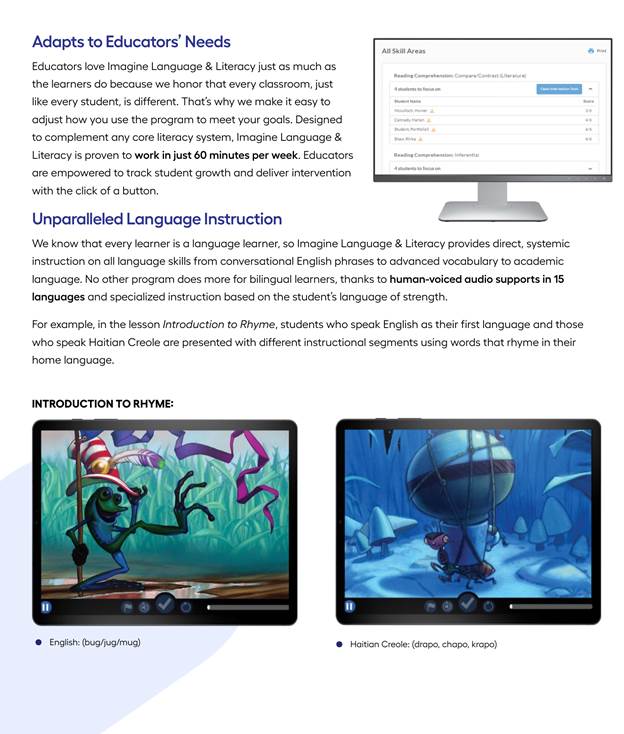
In a class with many levels, it is difficult for teachers to manually design a separate route for each student. Digital learning materials are only truly valuable when they do not separate language from literacy, allow students to practice around text, and provide data that is specific enough for teachers to know where to provide support.
Imagine Language & Literacy is an example for Grades PreK - 6 that develops language and literacy in parallel. According to the program materials, activities range from conversational English phrases to advanced vocabulary and academic language; At the same time, it combines comprehension and vocabulary, language structures and communication with foundational reading skills. Personalized pathways and scaffolding help students receive the right level of support.
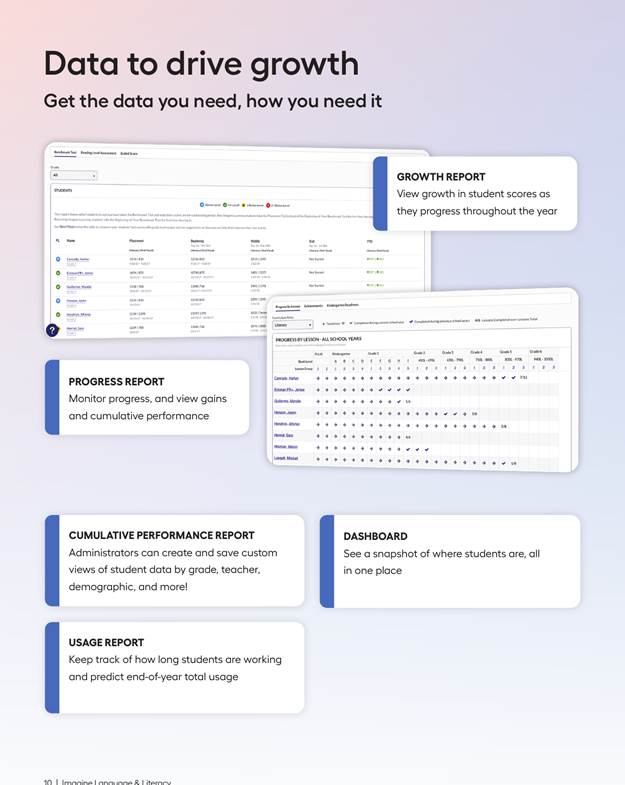
The important point is not the "learn quickly" message, but the series of instructions, practice with text, assessment, content adjustment and progress reporting. The data helps the professional team distinguish between students who only recognize good words, are having trouble with comprehension or sentence structure, and which supports can be gradually withdrawn.
A realistic pilot roadmap for bilingual schools
1. Choose a small range: Starts with a good communication grade or group but has difficulty reading informational text and presenting answers.
2. Determine baseline: Collect a speaking sample, a writing sample and a reading task with vocabulary and academic structure; Use short, consistent rubrics.
3. Cyclical deployment: For 6 - 8 weeks, focus on describe, compare, explain and justify; connect vocabulary, structures, reading, speaking and writing around the content being learned.
4. Compare the evidence: See if students understand tasks faster, use words in the right context, reduce reliance on sentence frames and transfer language to other subjects.
Academic language gaps need to be seen early
Children communicating naturally in English is an advantage, but it is not the end of the bilingual path. As learning requirements increase, academic language determines whether students can understand the text, keep up with the subject, and express their thinking. Simply increasing the number of communication classes or assigning more vocabulary lists can hardly solve this gap.
The solution starts with purposeful language teaching in context: choosing valuable words, clarifying structure, speaking before writing, asking for evidence, and monitoring levels of independence. When vocabulary, comprehension and communication are developed together, English becomes a learning tool.
Checklist, demo, pilot and how to register
To receive an academic language monitoring checklist, discuss pilot roadmaps or register for the Imagine Language & Literacy demo, schools can contact BooksVN through the following channels:
Facebook: https://web.facebook.com/BooksVNeBooksachNgoaiVanchinhhang
Zalo OA: https://zalo.me/2230563715259512406
Contact us
|
Website: https://www.booksvn.com |
Email: cs@booksvn.com |
Mobile / WhatsApp: +84 915 920 514 |


.svg)