













Making English a Second Language in Schools: Where Should Primary Schools Begin?
English as a second language is not just about increasing the number of classes
Decision No. 2371/QD-TTg dated October 27, 2025 approving the Project "Introducing English as a second language in schools in the period 2025 - 2035, with a vision to 2045" has created a great direction for Vietnamese education. For elementary schools, the problem is not just increasing classes but helping students gradually use English in studying, communicating and school activities.
When English only appears in a certain number of classes, students can do sample assignments but have few opportunities to use the language outside of class. The English as a second language model needs to create purposeful situations such as listening to instructions, asking questions, reading to find information, presenting a project or communicating with friends. Schools should start from a suitable ecosystem instead of immediately switching all subjects to English.
Three elementary school foundations need to be built in parallel
1. Listening - speaking and practical communication skills: Students need to understand familiar instructions, respond, ask questions, express needs, and engage in short interactions. In elementary school, language should be associated with specific situations, images, actions, stories, songs and collaborative activities instead of just learning discrete lists of words.
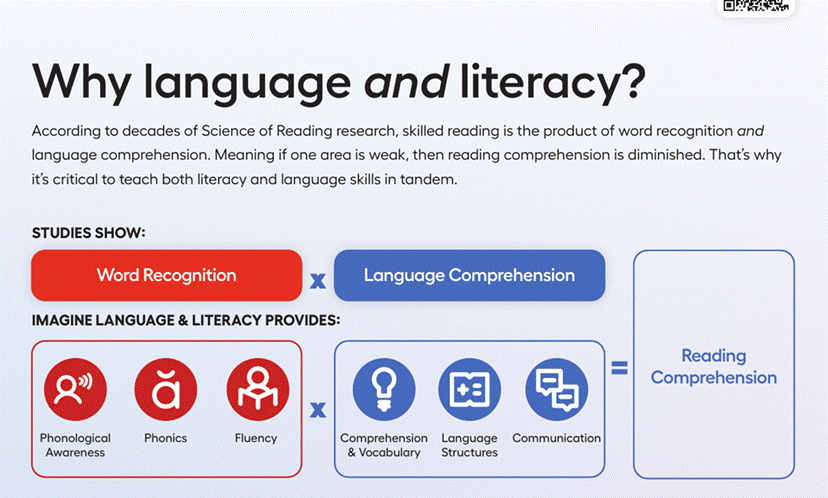
2. Literacy foundation: Reading English requires students to recognize sounds, understand the relationship between letters and sounds, decode words, read fluently and gradually understand the content. Phonological awareness, phonics, fluency, vocabulary and comprehension need to be organized in a clear progression, especially during PreK to Grade 2.
3. Academic language: When reaching higher grades, students need to know how to describe, compare, explain causes, present processes and use vocabulary from topics such as science, mathematics or social studies. This is a bridge to help students move from "learning English" to "using English to learn".
PreK - Grade 2: create habits of using English and building literacy foundation
In the early elementary years, children need to develop a sense of security when listening and using English, and be systematically guided to enter the reading process. The goal is not to learn a lot of difficult words or complete long grammar lessons.
1. Build routines in English: Teachers can start with greetings, taking attendance, changing activities, asking permission, choosing supplies, describing the weather or responding emotionally. When the same set of language is repeated in real contexts, students gradually understand without needing to translate each sentence.
2. Expand oral language through stories and interactions: Comics, short videos, songs, role-playing activities and games help children hear many natural sentence patterns. Teachers should encourage children to answer with words, phrases and complete sentences, instead of waiting until they say "completely correct" before participating.
3. Teach reading in a clear progression: Students need to practice recognizing and manipulating sounds, learn letter-sound relationships, combine sounds to read words, recognize common words and read appropriate short texts. Reading practice should go along with understanding meaning, not turning phonics into mechanical pronunciation activities.
4. Watch for small signs of progress: At this stage, schools can observe children's ability to follow instructions, number of words and structures actively used, level of engagement, sound recognition skills, decoding accuracy, and ability to retell simple content. Small but continuous data is often more useful than a long test at the end of the term.
Grade 3 - Grade 6: transition from learning English to learning in English
From Grade 3 onwards, texts become longer, vocabulary is more abstract and learning requirements also change. Students do not just "learn to know English" but need to use language to gather information, explain ideas, discuss and create products. This is the stage when schools can expand English into interdisciplinary activities but still need to choose the appropriate level.
1. Read to learn: Students should have access to stories, informational readings, and short texts about science, the environment, history, or life. Teachers guide students to identify main ideas, find evidence, understand text structure, make inferences and summarize in their own language.
2. Developing academic language: Language patterns such as “I agree because…”, “The evidence shows…”, “First…, then…”, “In contrast…” help students participate in structured discussions. When used repeatedly in many subjects and tasks, children gradually have the tools to express their thinking instead of just answering with a few words.
3. Write with purpose: The roadmap can go from writing sentences and short paragraphs to describing, explaining, summarizing, project reporting or stating opinions. Writing should be linked to content students have read, heard or experienced so that they have ideas and vocabulary before writing.
4. Create space for use outside of class: An English library, reading festival, club, bilingual bulletin board, project introduction or some routine in STEM class are reasonable extensions. The school does not need to switch all activities to English at once; It is important that students have more opportunities to use real language and feel that English is useful.
How to measure progress so you don't just chase scores?
An English as a second language program needs to answer two questions: where students are progressing and what support they need next. Vocabulary or grammar test scores alone will not fully reflect language ability. Schools should track data in four groups:
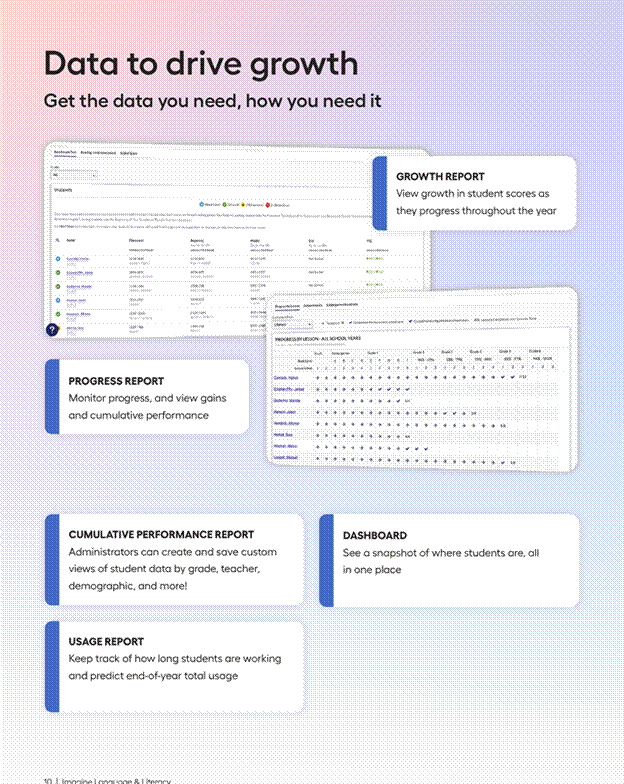
1. Level of participation and exposure opportunities: Do students participate regularly, is the study time consistent, and do they actively speak, read, or complete tasks? Usage data is only meaningful when placed next to performance quality and engagement.
2. Language and literacy skills: Monitors listening comprehension, vocabulary, language structure, communication, phonological awareness, phonics, fluency and reading comprehension. Separating by skill helps teachers know whether students are having trouble with decoding, vocabulary, or content comprehension.
3. Growth over time: Beginning, midterm and final results should be placed side by side to observe growth, not just placing students in a fixed level. A child who starts low but makes steady progress needs to be viewed differently from a child whose current scores are high but is barely growing.
4. Transferability: Do students use the words and structures they have learned when reading new texts, giving presentations, doing projects, or communicating outside of practice? This is an important sign that English is becoming a learning tool instead of knowledge just used for homework.
The role of digital learning materials, adaptive learning and differentiated teaching
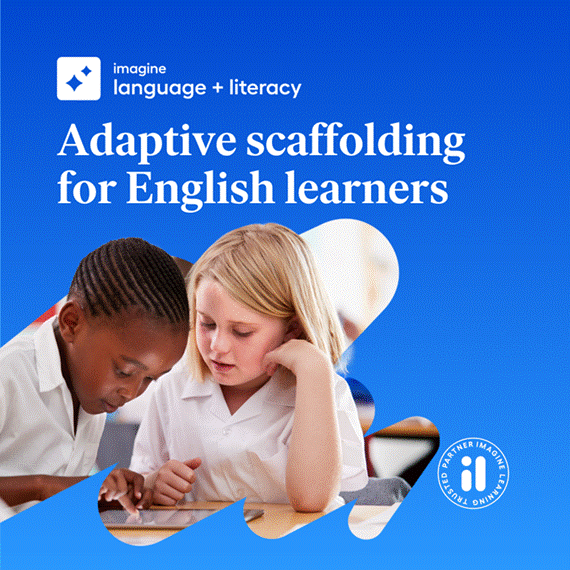
The major difficulty when expanding English in primary schools is the level gap. In the same class, there are students who read English stories quite naturally, while some students are still recognizing sounds or do not understand basic instructions. If teachers have to prepare a separate itinerary for each child, the workload will quickly become overwhelming.
Digital learning materials are only truly useful when they have a clear scope and sequence, know how to adjust activities according to results, provide scaffolding at the right time and help teachers see skill gaps. A suitable platform should develop both language and literacy, tie assessment to learning activities, have easy-to-read reports and allow content to be assigned to groups or individuals.
Imagine Language & Literacy is an example of a foundation for Grades PreK - 6 that combines language development with literacy skills. According to the product documentation, the program organizes activities according to a personalized roadmap, using direct, explicit and systematic instruction, and adjusts the level of support based on learning outcomes. Skill groups include phonological awareness, phonics, fluency, comprehension, vocabulary, language structures and communication.
A realistic pilot roadmap for schools
1. Choose a small but meaningful scope: You can start with one or two grades, a group of students who need to strengthen their English, or several classes representing a variety of ability levels. The scope of the pilot should be diverse enough for schools to see real problems, but not so broad that it is difficult to support teachers.
2. Determine baseline and goals: Before starting, it's important to know where students are in terms of listening, speaking, reading, vocabulary, and foundational skills. Pilot goals should be specific, such as increasing the ability to follow instructions, improving decoding, expanding academic vocabulary, or increasing the percentage of students achieving reading comprehension goals.
3. Design regular duration: A remedial program is often more effective when students work in short, steady sessions, rather than in one long, irregular session. The school needs to determine which periods the platform is used, who supervises, how to handle student absences, and when teachers view reports.
4. Prepare teachers before opening an account: Teachers need to understand the goals of the program, how to read the dashboard, how to identify students who need support, and how to connect digital lessons with classroom activities. An initial training session should include support throughout the implementation process, beyond the login process.
5. Evaluate pilots using multiple data sources: After an appropriate period, the school should see the level of use, progress according to skills, speaking - reading - writing products, teacher feedback and operational ability. Pilot results should lead to specific decisions: expand, adjust duration, add training or change target student groups.
Where should elementary school start?
The right starting point is not the slogan “100% English” or a thicker class schedule. Schools need to build listening and speaking capacity, literacy foundation and academic language; Divide goals according to PreK - Grade 2 and Grade 3 - Grade 6; At the same time, create more context for using English in real activities.
When students listen, speak, read and write in a continuous process, English gradually becomes a tool to explore content and present ideas. Digital and adaptive learning materials can support scaling, but success still depends on clear goals, teacher capacity, and how data is translated into action.
Register for a free Trial account, demo book, quote:
Schools and teachers, please contact BooksVN, the designated distributor of Imagine Learning, in charge of countries including Vietnam, Philippines, Malaysia, Singapore, Hong Kong, Indonesia, India, Bangladesh, Cambodia, Laos, Japan and Taiwan through the following channels:
Website: www.booksvn.com Email: cs@booksvn.com
Mobile/WhatsApp: +84-915 920 514
Facebook: https://web.facebook.com/BooksVNeBooksachNgoaiVanchinhhang
Zalo OA: https://zalo.me/2230563715259512406
|
|


.svg)