













One Classroom, Seven Ability Levels: How Can Teachers Support Every Learner?
One lesson, many starting points
In the same 5th grade Math class, some students are ready to solve multi-step math problems, but there are also students who are still not sure about the multiplication table or do not understand the meaning of fractions. During reading time, some children can analyze the author's point of view, while others have to stop to decode words and determine the main idea. Sitting in the same class, their starting points may be many years apart.
This is characteristic of a multi-level class. The gap lies not only in the test scores but also in the skill gaps - skill gaps has accumulated over the years. When a prerequisite skill is missing, students may struggle with the current lesson despite remaining diligent and motivated.
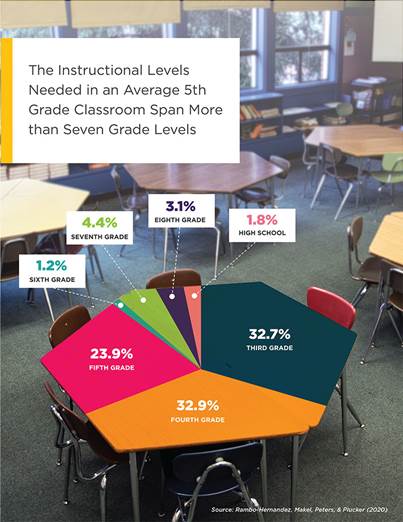
A study shows that learning levels in an average 5th grader can span more than seven levels. This number helps visualize the challenge teachers are facing: the same grade-level goal, but students need very different pathways of support to reach that goal.
Why does teaching "one lesson for all" easily make three groups suffer?
A common lesson plan is still necessary to ensure the whole class is working towards Grade 5 knowledge standards. The problem arises when every student has to learn the same content, at the same pace, at the same level of support, and at the same type of exercises. In the context of classrooms with large differences, this organization often creates three simultaneous pressures.
1. Weak students find it increasingly difficult to keep up: Children below grade level usually do not lack effort; They lack one or more foundational skills necessary to understand new lessons. If teachers simply re-teach grade-level content in the same way, students may temporarily remember the operation but still not be able to address the root cause of the difficulty.
2. Good and good students lack challenges: When most of the time is spent explaining basic knowledge, proficient students easily fall into a state of waiting, do routine work, and lose interest. The classroom may therefore be "stable" in appearance but not yet create an appropriate level of growth for each child.
3. Teachers are overloaded because they have to break everything down themselves: To compensate for the difference, teachers often create many worksheets, divide them into groups, grade them, and record progress using many different tables. When the number of students is large, differentiated instruction can easily become a mass of manual work that exceeds the actual preparation time.
The most serious consequence is not a low test score, but the weak student's belief that he or she is "incapable of learning". When children are constantly assigned tasks that are too difficult, the feeling of failure can turn into avoidance, loss of confidence or complete dependence on the teacher.
Differentiated instruction does not mean preparing a lesson plan for each student
Differentiated teaching - differentiated instruction - is often misunderstood as teachers having to create 25 or 30 separate lessons. In fact, effective differentiation starts with a common goal, then adjusts the approach, level of support, practice time, and how students demonstrate understanding.
An easy-to-implement structure might include three layers: the whole class learns a central goal; groups receive different scaffolds or tasks according to needs; Each student receives additional training in the correct missing skills. Thanks to that, teachers still maintain the consistency of the program but do not force all students to go at the same pace.
The important point is that the student group must be flexible. A child may need help with fractions but does well in geometry; A child reads slowly but has very good reasoning ability when listening to text. Therefore, there should not be fixed labels of "weak group" or "good group". Teams need to be formed by skill and change as the data changes.
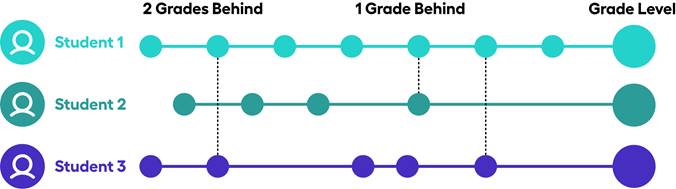
5-step process to not leave students below grade level
Differentiated teaching will be less emotional when teachers and schools agree on a process from assessment to intervention. The process below can be applied to Reading, ELA and Math, and is suitable for the data-driven instruction, learning recovery or MTSS/RTI models that many schools are interested in.
1. Input assessment to know where students are: The total score is not enough to decide the intervention content. Teachers need to look at each domain or skill: is the student having difficulty with reading fluency, vocabulary, text analysis, number sense, calculation or algebraic thinking? A short assessment that breaks down competency domains is often more useful than a long test that only returns a general score.
2. Identify the prerequisite skills really needed for grade-level lessons: The goal is not to force students to retake the entire program from previous years. The learning acceleration approach prioritizes foundational skills that directly unlock Grade 5 content. For example, before learning to add fractions with different denominators, students need to understand equivalent fractions and common multiples; You don't have to redo every 3rd and 4th grade Math topic.
3. Group students by need, not by ability label: After identifying gaps, teachers can form small groups according to the skills that need to be re-taught. Groups should be flexible enough for students to be transferred once they have achieved mastery. This approach helps small-group instruction be more focused and prevents a student from being kept in the support group for a long time just because of the results of a previous test.
4. Assign appropriate roadmap and scaffold: Students may work toward the same standard but need different amounts of instruction. Some students need video, audio, graphic organizer, samples or supported practice; Some students only need short practice sessions to confirm proficiency; Once established, students can move on to application, explanation, or extension tasks.
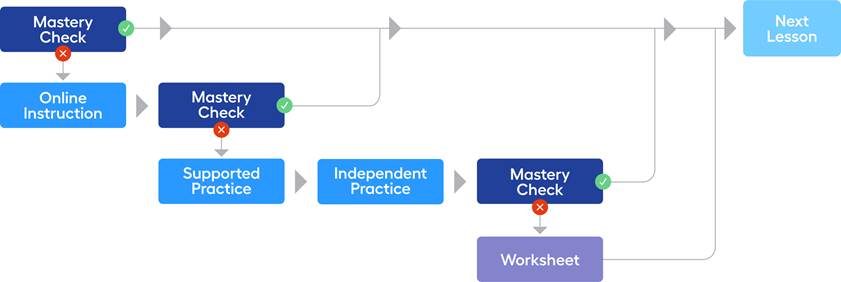
5. Monitor progress and make continuous adjustments: Differentiation does not end after assignment. Teachers need formative assessment, mastery checks or exit tickets to know how much students have understood. Once a child is proficient, the roadmap should allow for transitions rather than forcing him or her to repeat content. When a child continues to struggle, the data must be clear enough for the teacher to know which skills to reteach.
Organize a differentiated lesson that the teacher can still control
One class period does not need to turn into many small classes taking place at the same time. Teachers can organize in three stages to both keep common goals and create space for individualized support.
1. Part 1 - Mini lesson for the whole class: Teachers introduce goals, model thinking, and connect new knowledge to grade-level content. This section should be short, clear, and focused on "what students need to understand", instead of trying to address every gap right away in the general lecture.
2. Leg 2 - Flexible group practice: A team works directly with teachers on prerequisite skills; a training group with scaffold; a group that performs independent or extended tasks. The content may be different but still related to the lesson's objectives.
3. Step 3 - Quick check and decide on the next step: Exit ticket or formative assessment helps determine who can move on to new content, who needs more practice, and who needs a different form of explanation. This data should be used immediately for the next class session, not just saved for a final report.
The above organization puts the teacher in the right role: the one who designs goals, observes the learning process and makes professional decisions. Technology, if used, should take care of the parts that can be automated such as analyzing results, recommending skill sequences, assigning practice and synthesizing progress; It should not be a substitute for teachers understanding their students.
Content must be appropriate for both academic level and age
A challenge that is rarely mentioned is that students below grade level may need lower skill content but do not want to learn with a child-sized interface or images. An 8th grader who struggles with elementary reading skills is still a teenager with interests, maturity levels, and esteem needs appropriate to his or her age.
So personalization isn't just about adjusting difficulty. Content needs to be age-appropriate: skills are scaffolded at a student-accessible level, but the presentation, themes, images, and control of the experience are still age-appropriate. This is an important factor to maintain student engagement and avoid the feeling of "learning backward".
What data really helps teachers make decisions?
A dashboard with many metrics does not necessarily create data-driven instructions. Reports are only valuable when they answer the questions that teachers must decide every day. Data can be grouped into four layers of information:
• Engagement: Is the student actually active on the system, or just logged in? Is study time enough and regular?
• Progress: How many lessons have students completed, where are they on the learning path, and are they on track?
• Achievement: Which skills or standards have been mastered, which skills have not been achieved and need to be reteached?
• Growth: After a period, how has the overall level and each domain changed? Is the gap with grade level standards narrowing?
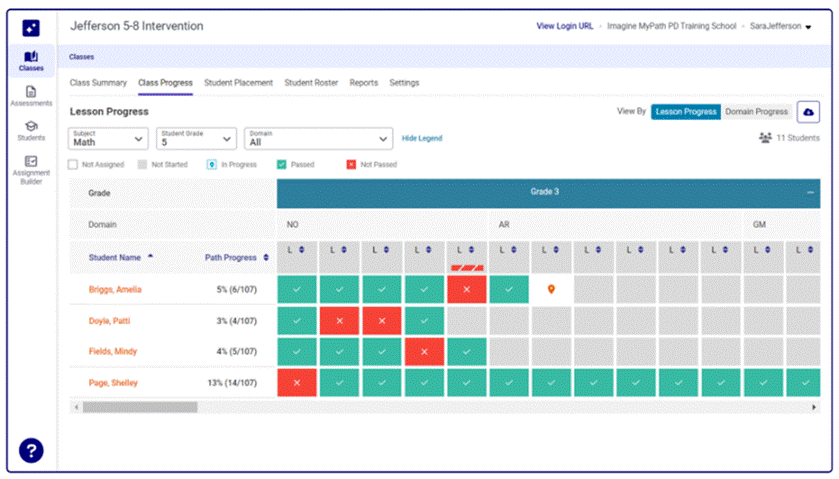
When data is presented to grade levels, groups, and individual students, teachers can quickly identify groups that need support instead of manually checking each lesson. Schools also have a basis to evaluate intervention effectiveness, allocate resources and communicate with parents using more specific evidence.
Criteria for selecting multi-level classroom support tools
Not all "personalization" platforms solve the right problem for teachers. Before implementation, schools should check at least the following criteria:
1. Flexible input assessment: Is the integrated assessment fast enough to not take up too much study time or can it use existing data from the school's assessment system?
2. Analysis by domain and skill: Does the platform only return a general level or identify different strong and weak students in each content domain?
3. Prioritize essential skills: Does the roadmap focus on prerequisite skills needed for grade-level lessons or does it require students to relearn all previous knowledge in linear order?
4. Adaptivity during the learning process: Does the system check mastery and adjust as students progress, or is the roadmap created once and then kept the same?
5. Age-appropriate content: Do students who study below standards have access to lessons that are at the right skill level but still appropriate for their age and maturity level?
6. Actionable Data: Does the report indicate which students need support, which skills need re-teaching, and which resources can be delivered next?
7. Teachers still retain the right to decide: In addition to the automatic roadmap, can teachers preview and assign additional lessons, formative assessments, or printable resources for individuals and small groups?
Where can Image MyPath help in this process?
Imagine MyPath is an example of a personalized intervention platform for Reading and Math K-12. The system can use MyPath assessments or data from several assessment partners to determine a starting point, then create an Individual Learning Path according to each student's needs.
Instead of requiring students to relearn entire content from previous grade levels, Smart Sequencer prioritizes the prerequisite skills needed for success at grade level standards. Mastery Checks in the lesson help the roadmap continue to adjust: students who have mastered can move on, while students who have not yet achieved receive additional instruction, supported practice or resources for teachers to intervene.
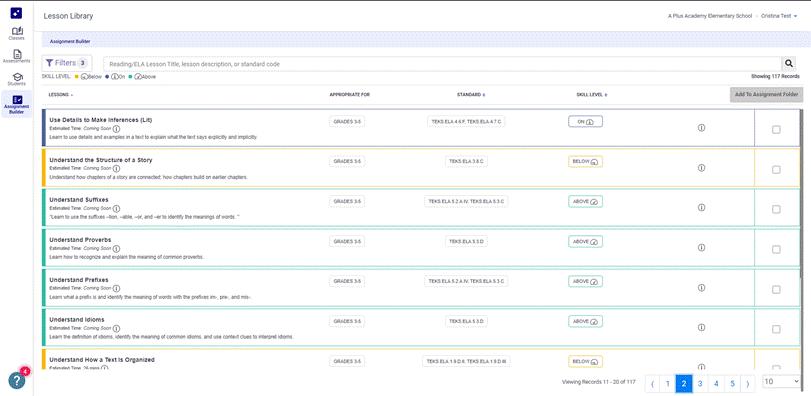
It is worth noting that MyPath does not just automatically assign assignments. Reports on usage, progress, achievement and growth help teachers identify students in need of support; Assignment Builder allows teachers to find, preview and assign additional lessons, formative assessments or printable resources to individuals, small groups and the entire class. Thus, technology reduces manual classification and tracking, while teachers still decide on goals, how to organize classes, and when to intervene.
MyPath is suitable for schools to include in their survey list when they are looking for solutions for learning recovery, intervention, differentiated instruction or want to support students below grade level without separating them from the overall learning goals of the class.
Quick checklist before choosing an intervention platform
Before watching the demo, schools can use the following questions to avoid choosing a tool that only has many exercises but lacks a clear intervention process:
• At what level does the platform determine skill gaps: overall score, domain or specific skill?
• Can proficient students skip unnecessary content?
• Does the roadmap change according to the learning outcomes in each lesson?
• Does subpar content preserve an age-appropriate experience?
• Can teachers assign individual resources to individuals and small groups?
• Does the report help immediately identify content that needs reteaching?
• Will the school measure success by usage, mastery or growth after each stage?
BooksVN can provide a checklist to evaluate the intervention platform and advise on how to organize the MyPath pilot according to the target student group, duration of use, and data to track. This is an appropriate step before the school decides to deploy on a large scale.
Register for a free Trial account, demo book, quote:
Schools and teachers, please contact BooksVN, the designated distributor of Imagine Learning, in charge of countries including Vietnam, Philippines, Malaysia, Singapore, Hong Kong, Indonesia, India, Bangladesh, Cambodia, Laos, Japan and Taiwan through the following channels:
Website: www.booksvn.com Email: cs@booksvn.com
Mobile/WhatsApp: +84-915 920 514
Facebook: https://web.facebook.com/BooksVNeBooksachNgoaiVanchinhhang
Zalo OA: https://zalo.me/2230563715259512406


.svg)