













Students Study English for Years but Still Struggle With Reading Comprehension: Why?
Being able to complete a grammar lesson is not the same as reading comprehension
Many students have studied English for many years, memorized vocabulary and done grammar exercises but are still confused by a new paragraph. They recognize many familiar words, but do not grasp the main idea, do not understand the relationship between sentences and easily become disoriented when the question changes its expression.
This does not necessarily mean the child lacks effort. Reading comprehension does not arise automatically from memorizing rules. Some children read each word too slowly so they cannot keep the meaning; Some children pronounce quite fluently but lack vocabulary, do not understand complex sentences or do not know how to use background knowledge to reason.
Reading comprehension is created by two pillars
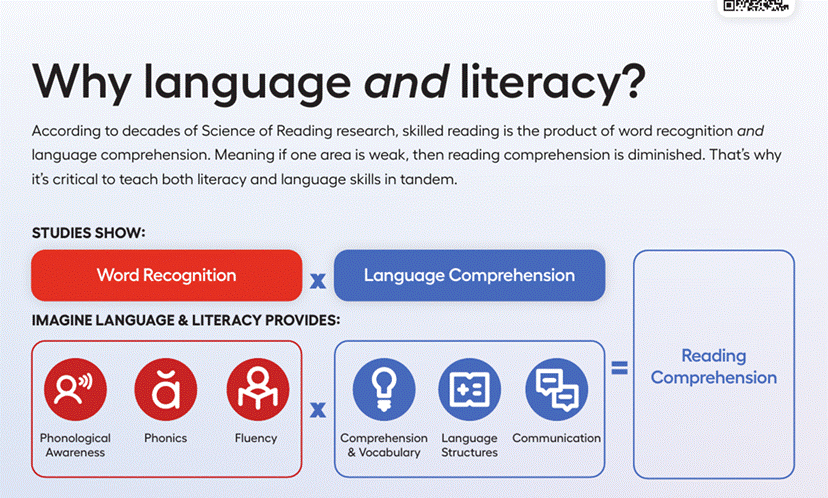
According to the framework in Imagine Language & Literacy, reading proficiency comes from a combination of word recognition and language comprehension. When one component is weak, reading comprehension is also limited. Therefore, literacy skills and language competence need to be developed in parallel.
1. Word recognition - identify and decode words: Students connect written words with sounds, combine sounds, recognize letter patterns and read accurately and automatically. This foundation includes phonological awareness, phonics and fluency. If each word still requires a lot of effort, students will hardly have enough attention to understand the entire sentence.
2. Language comprehension - understand language: Students need to understand vocabulary, sentence structure, speech and text content, and connect information with existing knowledge. Children can read every word correctly but still not understand if their vocabulary is narrow or they are not familiar with academic language.
The two pillars are not interchangeable. Reading quickly but not understanding does not mean reading proficiently; Understanding well when listening but not being able to decode written words on their own also makes students dependent on the reader or audio.
Block 1: Weak phonics causes students to guess words
Phonics helps students connect letters, letter groups and sounds. When this foundation is not sure, children often guess words based on the first letter, picture or context; Read the same word multiple ways, omitting the last sound or just recognizing the word you've memorized. This group needs to practice recognizing sounds, combining and separating sounds, spelling patterns and applying rules to new words, instead of just being assigned long reading lessons.
Block 2: Lack of fluency disrupts the understanding circuit
Fluency is the ability to read accurately, with appropriate speed and pauses. Students who read too slowly can easily forget the beginning before reaching the end of the sentence; Reading quickly but skipping punctuation or not self-correcting errors also breaks the flow of meaning. Teachers can use a suitable paragraph to observe the continuity, punctuation and retelling ability, then practice reading samples, reading in clusters and repeating reading.
Block 3: Vocabulary exists but not deep enough
Students can remember the Vietnamese meaning of many words but still do not understand when the word appears in a new context. Reading comprehension requires recognizing word forms, nuances, accompanying phrases, and relationships to topics, not just a single meaning.
For example, knowing “cause” is not enough to understand “cause a change”, “the main cause” or the cause - effect relationship. Vocabulary should be taught in sentences, images and speaking and writing activities so that students can meet, connect and actively use it.
Block 4: Not understanding sentence structure and connecting words
A long English sentence can contain subordinate clauses, pronouns, passive voice, and many layers of information. Students who can complete the selected test may not be able to identify the subject - main verb, cause - effect relationship or the object that it, they, which are replacing. Teachers need guidance on dividing sentences into meaningful clusters, recognizing connecting words, and monitoring how sentences connect instead of translating each word in order.
Distinguish between students who have trouble decoding or understanding language
1. Signs that lean towards word recognition: Students understand significantly better when teachers read; Slow self-reading, often guessing words, skipping or inverting sounds, difficulty reading new words. Phonological awareness, phonics, accuracy and fluency should be tested.
2. Signs that favor language comprehension: Students read quite fluently but cannot recite; difficulty understanding words in context, complex sentences, “why” questions, or content that must be inferred. Need to strengthen oral language, vocabulary, language structures and background knowledge.
3. Signs of difficulty on both sides: Students both read incorrectly and have limited understanding when listening. The roadmap needs to be coordinated but break tasks into small steps, such as practicing a sound pattern in a suitable text and developing language through read-aloud stories, pictures and conversations.
Checklist for quick diagnosis for teachers
1. When teachers read aloud, do students understand significantly better than when they read on their own?
2. Can students read new words based on the letter-sound patterns they have learned, or only recognize familiar words they have memorized?
3. Do students read accurately from multiple syllables, final sounds, and easily confused letter groups?
4. After a short sentence or paragraph, can students retell it in their own words without looking at the text?
5. Can students explain vocabulary in the context of the lesson, instead of just stating a memorized Vietnamese meaning?
6. Can students identify the subject, main action, connector, and object the pronoun is replacing?
7. Does the student distinguish between directly written information and conclusions that need to be inferred from evidence?
8. Do results vary by text type? Good reading of stories but weak reading of science text may reflect gaps in academic vocabulary, information structure, or background knowledge.
Intervention must go to the right blockage point
1. If the difficulty lies in decoding: Teaching directly, with a system of phonological awareness, phonics, sound combinations, spelling patterns and multi-syllable words; Use appropriate text for children to apply instead of guessing.
2. If the difficulty lies in fluency: Incorporate sample reading, paired reading, cluster reading, repeated reading and feedback on accuracy, speed, and breaks. The goal is to free up attention for the comprehension process.
3. If the difficulty lies in the language: Develop listening - speaking, vocabulary and structures around the same topic as the reading; Build background knowledge before reading and ask students to summarize and explain evidence after reading.
4. If the class has multiple levels: Keep the general content goal but adjust the scaffolding. Some children need audio, images and model sentences; Other groups can read independently or do deeper analysis tasks.
The role of digital learning materials and progress data
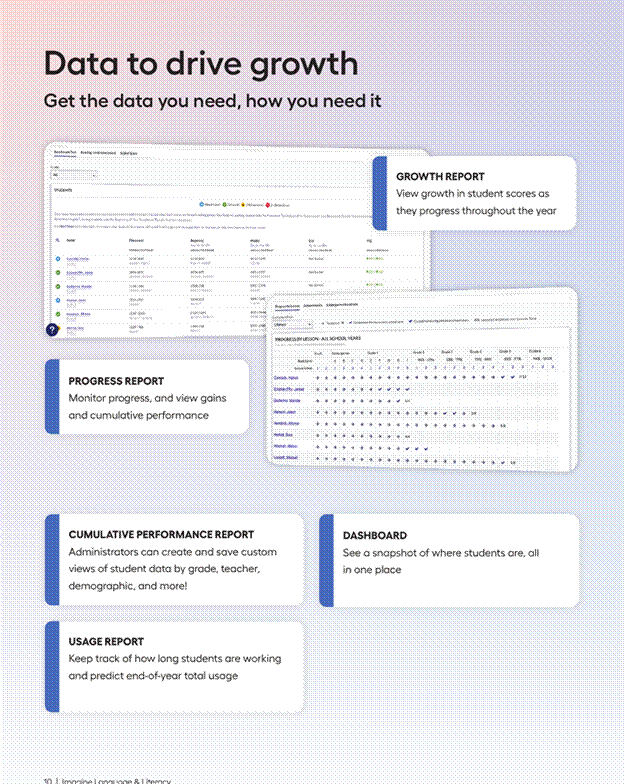
In a large class, it is difficult for teachers to continuously monitor each small skill. Digital learning materials can help when there is a clear scope and sequence, lesson feedback based on results and reports showing what students are learning, where they are progressing, and what support is needed. Technology does not replace teachers, but makes observations more frequent and systematic.
Imagine Language & Literacy is an example of a Grades PreK - 6 platform that develops language and literacy in parallel. According to the product documentation, the program teaches directly, clearly and systematically phonological awareness, phonics, fluency, comprehension and vocabulary, language structures and communication. Personalized roadmaps with adaptive scaffolding support students according to their starting point.
The noteworthy point is not in the message of "learning quickly", but in the ability to observe many components that make up reading comprehension. Teachers can combine lesson data, benchmarks, progress and classroom observations to distinguish between children who cannot read words and children who can read but do not understand language, and then choose the right support for the cause.
A realistic pilot roadmap for the professional team
1. Select a grade or group of students does grammar relatively well but reading comprehension is low so teachers can observe deeply.
2. Determine the baseline according to two pillars by short tests of decoding, fluency, listening comprehension, vocabulary and structure.
3. Flexible grouping: group needs to reinforce decoding, group needs to develop language comprehension, and group needs to support both.
4. Combines direct teaching, guided reading, and personalized learning materials at regular intervals; track with multiple pieces of evidence instead of just one total score.
The number of years of education does not determine reading comprehension ability
Learning English for a long time does not guarantee that students have fully developed literacy. If the learning process is mainly memorizing words, doing grammar exercises and practicing question forms, students may have a lot of discrete knowledge but have not yet formed a proficient reading mechanism.
Improving reading comprehension starts with two questions: do students recognize words accurately and automatically and do they have enough language to understand what they just read? By properly diagnosing bottlenecks, teaching missing skills, and monitoring progress in each component, reading comprehension can develop sustainably.
Register for a free Trial account, demo book, quote:
Schools and teachers, please contact BooksVN, the designated distributor of Imagine Learning, in charge of countries including Vietnam, Philippines, Malaysia, Singapore, Hong Kong, Indonesia, India, Bangladesh, Cambodia, Laos, Japan and Taiwan through the following channels:
Website: www.booksvn.com Email: cs@booksvn.com
Mobile/WhatsApp: +84-915 920 514
Facebook: https://web.facebook.com/BooksVNeBooksachNgoaiVanchinhhang
Zalo OA: https://zalo.me/2230563715259512406


.svg)