













Students Understand the Method but Calculate Too Slowly: Math Fact Fluency May Be the Missing Link
In many elementary classes, there are students who do not really "lose their roots" in Mathematics. When the teacher asks how to solve, the students still know whether to add first or multiply first, know how to choose the appropriate calculation and can explain each step. However, the time to complete the lesson is much longer than that of their friends because they have to stop at almost every basic calculation.
This condition is often described simply as students calculate slowly. But the reason does not necessarily lie in the ability to understand the lesson. Another possibility is that the student is not developed enough math fact fluency - the ability to perform or retrieve basic calculations accurately, relatively quickly and flexibly. When this foundational part takes a lot of effort, it will be difficult for students to devote enough attention to the more complex requirements of the problem.
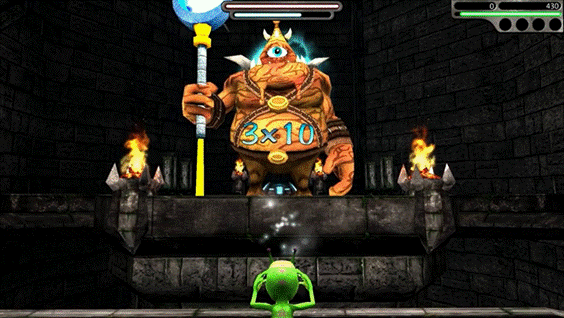
Students know the process but still can't make it on time
A student can understand very clearly how to solve a two-step problem. I know I have to find the total number of objects first, then divide them equally among the groups. However, if you still have to count each unit to calculate 8 + 7 or recite the division table over and over again, much of your time and attention will be spent on calculations that should already be familiar.
This explains why some students get it right when given extra time but often leave the test unfinished, lose track of steps, or make mistakes in seemingly simple places. You do not lack methods; They are having to implement the method with a "processing cost" that is too high.
Teachers and parents can recognize this condition through some common symptoms:
• Students often use their fingers, cross lines or count from 1 for calculations they have learned a long time ago.
• I understand the sample test but it takes a lot of time when the data changes.
• I do each individual calculation well but easily forget the steps in multi-step problems.
• I regularly recheck basic results like 6 × 7 or 15 - 8.
• Results are correct but speed is unstable; The same calculation sometimes gives a quick answer, sometimes you have to start over from the beginning.
What is Math fact fluency?
Math fact fluency can be understood as proficiency with basic addition, subtraction, multiplication and division. Fluency isn't just about responding quickly. A truly fluency student needs to combine three factors: accuracy, effectiveness and flexibility.
1. Exact: Students consistently give correct results, not depending on guessing or luck.
2. Effectiveness: Students do not have to perform a long series of operations for each basic calculation.
3. Flexible: Students can use relationships between numbers, such as using 10 + 4 to find 9 + 5, instead of just memorizing it mechanically.
When accessing basic calculations is almost automatic, this ability is often called automaticity. Automaticity does not mean that students must be forced to answer under stress. The goal is to help students no longer have to devote too many cognitive resources to background information that has already been practiced and understood.
Understanding concepts and reflecting on calculations are two different abilities
In teaching Mathematics, understanding the nature is always important. Students need to know why multiplication can be represented by equal groups, why division involves distribution or measurement, and why strategies such as splitting numbers or making whole numbers by tens are effective. However, conceptual understanding does not automatically guarantee that students will quickly retrieve all basic results.
On the contrary, memorizing results without understanding the relationship between numbers also does not create sustainable Math capacity. Therefore, conceptual understanding and math fact fluency should not be placed on opposite sides. Students need to be able to form the meaning of calculations, use reasonable strategies, and then have enough opportunities to practice so that the strategies become more concise and effective.
How does basic calculation speed affect more difficult Math content?
When students have to stop for a long time at each small calculation, difficulties do not only appear in addition, subtraction, multiplication, and division exercises. The impact often spreads to many other contents of the elementary math program and subsequent school years.
1. Multi-step problem: Students must remember the goal of the lesson, track intermediate results and choose the next step. If a basic calculation takes too long, it's easy to forget what you're dealing with or miss a step.
2. Fraction: Finding equivalent fractions, simplifying, converting or performing calculations with fractions is often based on multiplication and division relationships. An unstable multiplication table will make each operation slow and prone to errors.
3. Measurement and unit conversion: Students need to integrate their understanding of units with multiplication, division, or addition. Slowness can cause students to lose their logic even though they understand how to convert.
4. Solving math problems with text: Reading comprehension, identifying facts, choosing calculations, and checking plausibility all require concentration. When basic calculations take up too much attention, students have less “space” to analyze language and reasoning.
Therefore, math fact fluency is not a separate goal from Mathematical thinking. This is part of foundational numeracy - foundational arithmetic competencies that help students approach complex concepts without constantly being pulled back to basic operations.
Why do students calculate slowly even though they have learned that calculation?
Not all students who calculate slowly have the same problem. Observing how children generate answers will help teachers choose the right type of support rather than just increasing the number of exercises.
1. Still depends on step counting: Students have not moved from counting strategies to more effective strategies such as separating numbers, using known calculations, or recognizing inverse relationships.
2. Knowledge has not been consolidated regularly enough: They once did it correctly in a lesson, but the gap between practice sessions was too long, causing their retrieval ability to be unstable.
3. Practice without feedback: If a student repeats an incorrect result many times without immediate correction, the error may become a habit or cause him or her to lose confidence in his or her strategy.
4. Exercise is too long and monotonous: When having to complete the same calculation page, students easily get tired, follow inertia or focus on "finishing the lesson" instead of improving their calculations.
5. Time pressure too early: Speed tests can provide information for teachers, but if used as a form of pressure before students have a solid strategy, it can easily stress them out and reduce their accuracy.
Assigning more worksheets may not help children calculate faster
When seeing students slow, a familiar reaction is to assign more calculations of the same type. This can be helpful if the student already understands the strategy and just needs reinforcement. However, if you are still counting by units or have not recognized relationships between numbers, repeating dozens of questions may just repeat the same slow calculation.
Effective fluency training should be aimed at the quality of each workout is more than just counting the number of completed sentences. Students need a challenging task, short enough in duration to maintain focus, immediate feedback when they make mistakes, and the opportunity to see that calculation again in subsequent sessions. This is also the reason concepts such as spaced practice, mastery learning and immediate feedback is increasingly receiving attention in the design of training activities.
The goal is not to turn class into a speed contest. The goal is to help students gradually use shorter strategies, reduce the number of unnecessary steps, and create a sense of success as they see progress.
The math fact fluency training path is short, steady and has immediate feedback
A suitable route does not need to take up too much time in Math class. Teachers or parents can organize according to the following steps:
1. Determine starting point: Observe which groups of calculations students have accessed stably, which groups still have to be counted, and which types of errors frequently appear. Don't just look at the total score.
2. Prioritize a specific skill group: Instead of practicing all calculations at the same time, you can focus on addition through 10, the 6-9 multiplication table or the relationship between multiplication and division depending on the student's needs.
3. Practice for short periods of time but evenly: A reference schedule is 10-15 minutes at a time, about three sessions per week. The short duration helps students stay focused and is easier to maintain as a habit than a long practice session.
4. Respond immediately and explain the strategy: When students make mistakes, we need to help them realize their mistakes and try a more effective calculation method, instead of just displaying the correct answer or asking to start over.
5. Monitor both accuracy and response time: Progress can come in many forms: using your fingers less, answering more consistently, reducing the amount of hesitation, or completing more steps in a math problem.
What should teachers and parents watch for?
For teachers, useful data is not just the number of correct sentences. Knowing which math groups students are slow in, how response times are changing, and which skills have plateaued will help group support more accurately. This is how data-driven instruction is used on a small scale: data serves the decision to reteach, practice more, or move on to new content.
For parents, signs of progress can be observed right in daily activities. Children avoid Math problems less, no longer have to start counting again at each calculation, can explain a strategy briefly, and complete the problem without exhaustion. These changes are just as important as responding a few seconds faster.
Both schools and families should also avoid comparing speeds between students. Fluency needs to be monitored according to each child's progress. A student who moves down from a whole counting strategy to counting on, then moving to separating numbers, is making clear progress even if he or she is not yet at the speed of the whole class.
When should you use digital fluency training tools?
Digital tools can be useful when teachers need to create multiple individualized practice opportunities without being able to sit next to each student the entire time. However, not every activity that has visuals or rewards is automatically effective. Schools should consider a number of criteria:
• Does the content properly focus on the basic addition, subtraction, multiplication and division that students need to reinforce?
• Is the level of practice adjusted to each student's ability instead of assigning the same series of questions to the whole class.
• Do students receive immediate feedback to correct errors and continue practicing in the right direction?
• Teachers can track progress, identify missing skills and estimate time to fluency.
• Is the experience engaging enough to keep the practice short and steady, but still keeping the math the focus?
How does Image Math Facts support fluency practice?

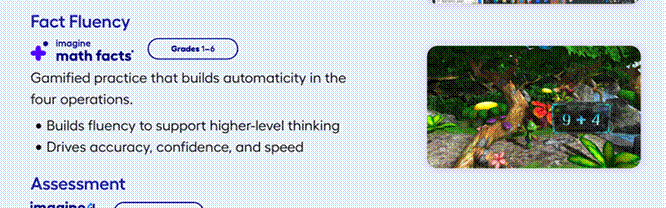
Imagine Math Facts is an example of a supplementary program specifically designed for building automaticity and math fact fluency in students Grades 1-5. The program focuses on the four basic operations of addition, subtraction, multiplication and division, and uses a 3D game environment, rewards and instant feedback to turn repetitive practice into a goal-oriented experience.
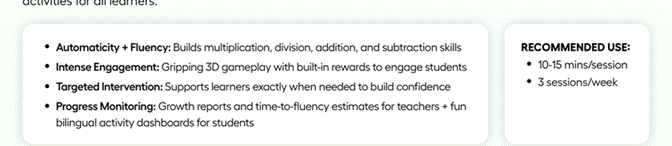
The notable point is that the program does not just provide a stock of questions that are the same for all students. According to Imagine Learning's product documentation, activities are designed to be adaptive, supporting timely intervention and allowing students to progress to proficiency at their own pace. By demonstrating fluency at a higher level, students can also unlock new levels in the game.
For teachers, the system provides growth reports and time-to-fluency estimates to track progress. Students also have a bilingual activity dashboard. The recommended implementation in the flyer is short sessions of 10-15 minutes, three times per week, suitable for station rotation models, after-class supplementary activities or at-home practice.
Imagine Math Facts should be seen as a supplement to conceptual teaching activities, not a tool to replace the entire Math curriculum. When combined with strategy explanations, visual models, discussions, and contextualized problems, adaptive practice tools can help students reduce the time they spend on basic calculus, thereby better focusing on reasoning and problem solving.

Register for a free Trial account, demo book, quote:
Schools and teachers, please contact BooksVN, the designated distributor of Imagine Learning, in charge of countries including Vietnam, Philippines, Malaysia, Singapore, Hong Kong, Indonesia, India, Bangladesh, Cambodia, Laos, Japan and Taiwan through the following channels:
Website: www.booksvn.com Email: cs@booksvn.com
Mobile/WhatsApp: +84-915 920 514
Facebook: https://web.facebook.com/BooksVNeBooksachNgoaiVanchinhhang
Zalo OA: https://zalo.me/2230563715259512406
|
|


.svg)