













Teachers Spend Hours Grading Writing: How to Shorten Feedback Time Without Sacrificing Quality
Why is grading papers becoming a burden?
In many subjects, especially English Language Arts, Social Studies and subjects with essays, grading essays is not just about reading and scoring. Teachers must also check the level of subject matter, argument structure, use of evidence, accuracy of knowledge, language and each student's unique support needs. When a class has dozens of students and each student submits multiple drafts, teacher workload can increase very quickly.
The biggest problem is not in the number of minutes spent on each lesson, but in the response delay. If students receive feedback after a week or two, they have often moved on to a new topic and no longer clearly remember how they were thinking while writing. At that time, feedback for students can easily become an explanation for a finished score, instead of a tool to help them correct their work and improve.

What effect does slow feedback have on learning?
Feedback is most valuable when students are still connected to the task they just completed. A focused, timely comment can help students realize the gap between their current draft and their learning goals. On the contrary, when teachers are overloaded and have to prioritize "grading", both teachers and learners lose the opportunity to use writing as a learning process.
Common signs of prolonged marking time include:
1. Students only look at the scores without reading the comments carefully.
2. Teachers repeat the same type of feedback on multiple writing assignments.
3. The second draft does not significantly improve upon the first.
4. Students who need support the most have to wait the longest for responses.
5. Teachers have to bring homework home or spend most of the weekend grading.
6. It is difficult for the professional team to maintain consistent grading criteria and feedback quality across classes.
Reducing teacher load does not mean shortening comments at all costs. A more appropriate goal is to eliminate repetition, create a good enough starting point, and reserve teacher expertise for decisions that technology cannot replace.
Which parts of the job need teachers, and which parts can be supported by technology?
To use AI grading responsibly, schools should separate the grading process into two groups. Part that requires teacher expertise includes understanding lesson objectives, considering student context, assessing depth of thinking, identifying progress and deciding on the appropriate level of support. Part that may be supported by technology mainly involves repeating tasks, synthesizing information and creating initial comments based on the assignment.
The five classes of jobs can be visualized as follows:
1. Read and navigate: technology can highlight content that needs attention, but teachers determine whether students have properly met the requirements of the task.
2. Initial response: the system can suggest comments based on the writing; The teacher checks for accuracy, tone and appropriateness.
3. Evaluate the quality of thinking: teacher examines arguments, evidence, connections between ideas, and misunderstandings that are not directly expressed through language errors.
4. Personalized support: teachers decide which students need open-ended questions, examples, small group reteaching, or advanced challenges.
5. Score decision: rubric, school policy and teacher professional assessment remain the final basis.
This division helps avoid two extremes: either the teacher does all the work manually, or gives too much decision-making authority to the tool. Technology should act as a teaching assistant creating drafts of feedback, while the teacher remains responsible for the content sent to students.
When designed properly, the new process does not reduce the quality of grading. In turn, teachers have more time to focus on texts that require deep reading, communicate directly with students, and monitor whether the feedback actually leads to progress.
3-layer feedback process: faster but not superficial
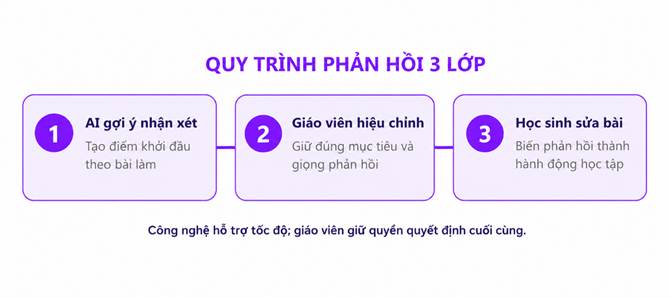
An easy model to apply is the 3-layer feedback process. Each layer has its own role and forms a loop from the original work to the improved version.
Grade 1 - Auto-suggested comments: tool reads the writing and suggests some possible comments. This is just a starting point to reduce the time spent redrafting common feedback, not a final conclusion about the quality of your work.
Grade 2 - Corrective teacher: Teachers compare learning objectives and rubrics, correct inaccurate content, add suggestive questions, remove unnecessary comments or rewrite in their own voice. In this step, comments are transformed from “linguistically reasonable” to “useful for the right student”.
Grade 3 - Students correct lessons: students need to take a specific action after receiving feedback, such as adding evidence, rewriting a thesis statement, improving paragraph organization, or explaining an idea more clearly. Without the editing step, even detailed feedback may not create learning impact.
Schools can start with short writing tasks to familiarize teachers with the process, then expand to long essays. The most important thing is to clearly stipulate which types of comments can be automatically suggested, which types require teachers to write themselves, and which cases need to be discussed directly with students.
Checklist evaluates a tool to support essay grading
Not all text creation tools are suitable for educational environments. A typical AI application may write comments fluently but does not fully understand lesson objectives, school grading procedures, or student data security requirements. Therefore, before applying, the professional team should evaluate the tool according to a unified checklist.
Stick to learning goals: comments must be related to the task, rubric and skills being evaluated. Customizable: teachers need to be able to edit, shorten, expand or remove suggested content. Data security: student work and information must be handled in an environment consistent with school policy.
Teachers retain the right to decide: tools should not automatically send comments or decide scores without a teacher's check. In addition, the system should be located right in the grading workflow so that teachers do not have to copy assignments across multiple applications, which is both time-consuming and increases data risk.
How does Image EdgeEX Grading Assistant help?
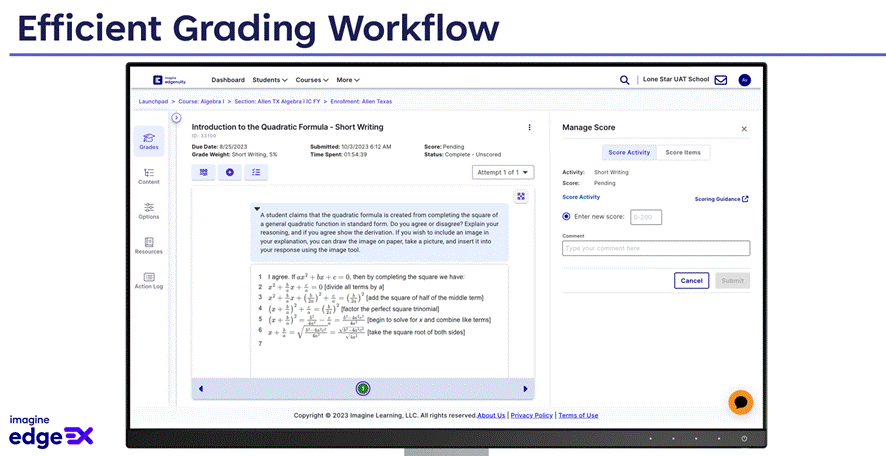
In Imagine EdgeEX, Grading Assistant is designed as a collaboration tool with teachers during the grading process of short writing. The system can create AI-suggested comments right on the grade management screen, helping teachers have a draft of comments to review instead of starting from a blank page.
Teachers can lengthen or shorten the prompt, add their own comments, delete inappropriate content, or completely rewrite it before submitting. This design is consistent with the human-in-the-loop principle: AI supports speed, while teachers control accuracy, tone, and final decisions.
The tool can also highlight some unusual feedback, such as content that makes no sense to bypass the task or language that shows signs of concern, for teachers to take a closer look at. These alerts do not replace professional judgment, but can help teachers identify early work that needs to be prioritized for reading and support. 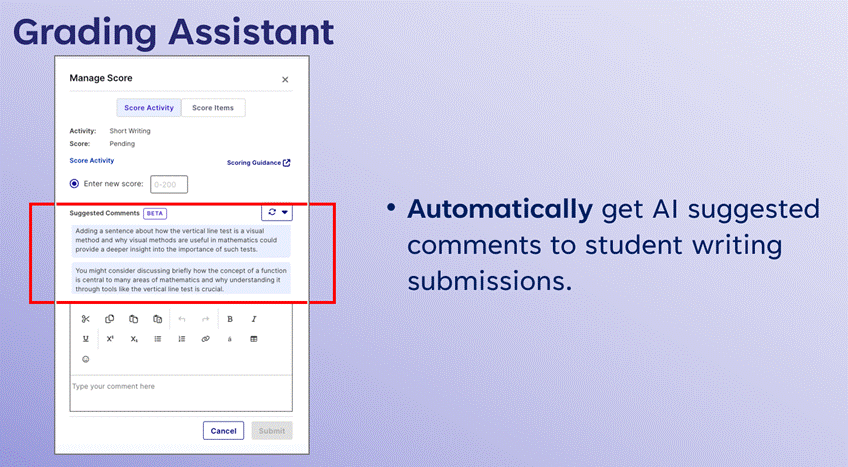
The teacher is still the final decision maker
The strength of an AI grading solution in schools does not lie in generating as many comments as possible. The real value is helping teachers move faster through repetition while still maintaining their professional voice. Good feedback should reflect the goal of the lesson, what students have accomplished, and a next step that is clear enough for them to take.
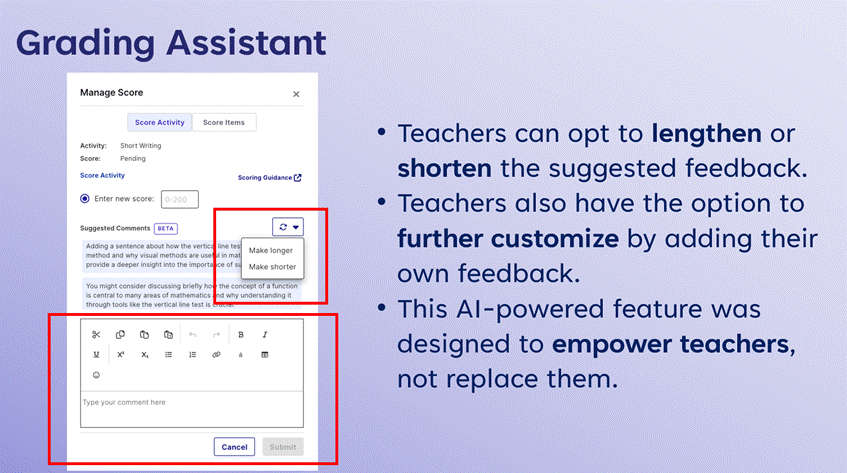
Therefore, teachers should view suggested comments as drafts. Before submitting, three questions can be checked: Is this comment correct for the assignment? Do students understand what they need to do next? Does the tone encourage students to keep trying? If only one of the three answers is "not yet", the teacher needs to correct it.
Editing rights also help the professional team build a culture of consistent feedback without losing the individual teacher's style. Schools can agree on common principles, such as prioritizing actionable feedback, avoiding judgmental language, and always tying feedback to learning criteria, while teachers remain flexible for each class and each student.
What indicators should schools measure effectiveness?
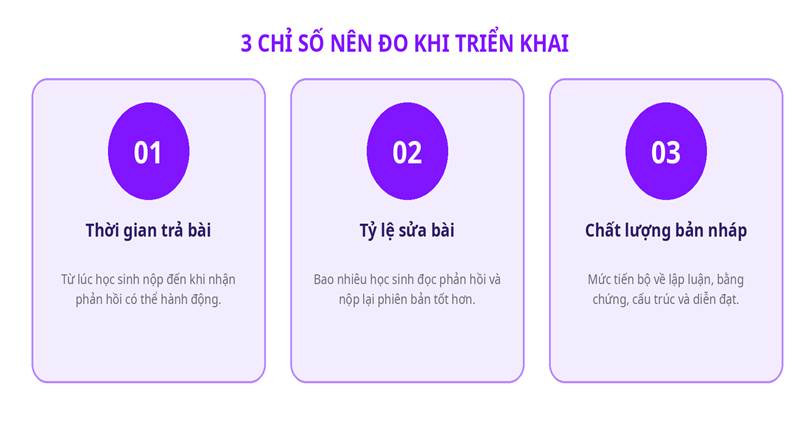
Implementing technology is only meaningful when it creates observable change. Instead of just measuring the number of papers graded, administrators and subject leaders should track both the rate of feedback and the extent to which students use the feedback to improve.
Return time: measures the time between when a student submits and when actionable feedback is received. Percentage of students correcting their work: tracks the number of students who read comments and submit new versions. Draft quality after feedback: compares improvements in argument, evidence, structure, and language.
Can add a short survey on teacher workload: how much time teachers spend on each group of lessons, which parts of work still cause congestion, and whether they feel the feedback is more personalized or not. If time is reduced but students are not editing or the quality of drafts is not increasing, the school needs to adjust the process, not just expand the number of accounts.
How to implement testing in a specialized team
A small pilot is often more effective than applying it all at once. The school can choose a subject, a grade level and a form of short writing with clear rubrics. During the first two to four weeks, teachers use the same 3-grade feedback process and record grading times to create a comparison baseline.
Before starting, the professional team should agree on the goal: reduce the time to return assignments, increase the rate of students correcting assignments or improve the quality of feedback. After each week, teachers look at some sample papers together, discuss which comments are useful, which parts need a lot of editing, and which situations should not use automatic suggestions.
The school board also needs to clarify the principles of using AI in assessment, data access rights, and teachers' responsibilities when approving feedback. Training should not just focus on software manipulation but should help teachers understand when to trust, when to check, and when to ignore suggested content altogether.
After the pilot phase, schools can compare before and after data, get student feedback and decide whether to expand to other subjects or lesson types. A step-by-step implementation helps schools evaluate Imagine EdgeEX in their real-life context, rather than just based on a list of features.
Register for a free Trial account, demo book, quote:
Schools and teachers, please contact BooksVN, the designated distributor of Imagine Learning, in charge of countries including Vietnam, Philippines, Malaysia, Singapore, Hong Kong, Indonesia, India, Bangladesh, Cambodia, Laos, Japan and Taiwan through the following channels:
Website: www.booksvn.com Email: cs@booksvn.com
Mobile/WhatsApp: +84-915 920 514
Facebook: https://web.facebook.com/BooksVNeBooksachNgoaiVanchinhhang
Zalo OA: https://zalo.me/2230563715259512406


.svg)