













Teaching Mathematics Bilingually: Helping Students Understand Concepts, Not Just Translate Terms
What is Bilingual Math Teaching?
Bilingual Math Teaching is a process that helps students develop their understanding of Mathematics and the ability to use language to describe, explain, compare and defend solutions. In bilingual math or English-medium instruction - EMI classes, the goal is not only to remember the names of operations in English but also to understand the ideas behind the symbols, models, and problems.
A student can read numerator, denominator or proportional relationship correctly but still does not understand the relationship between the quantities. On the contrary, a child can explain correctly in Vietnamese but cannot express himself fluently in English. Therefore, teachers need to separate language difficulties from mathematical thinking difficulties before deciding how to support them.
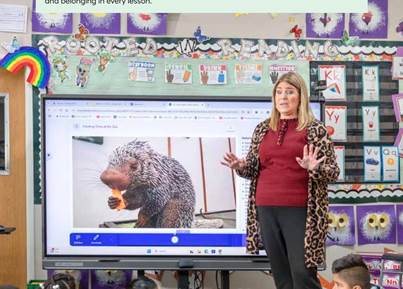
Why is word-by-word translation often not enough?
In many bilingual Math classes, teachers write an English term, put the Vietnamese meaning next to it, and then ask students to memorize it. This method is useful in the identification step, but is not enough for students to understand the concept or apply it when data and context change.
The language of Mathematics does not exist as discrete words. Meaning depends on images, symbols, relationships between quantities and how words are used in sentences. For example, difference can refer to the result of a subtraction, the difference between two values, or the difference in data. Just translating it into "brand" still doesn't tell students how to think.
1. Translate the word correctly but don't understand the relationship: students recognize increase or decrease but cannot determine which quantity changes and what the change is compared to.
2. Understand the symbols but don't understand the topic: students can perform calculations when looking at expressions, but are confused when the same idea appears in a word problem.
3. Depends on keyword: you see more, less or total and then choose the calculation out of habit, even though the structure of the problem is not appropriate.
4. Increased processing burden: students have to translate the entire sentence before doing Math, causing working memory to quickly overload.
The important question is not how many English Math vocabulary students have memorized, but whether they can connect language with ideas, representations and reasoning.
Teach meaning first, then attach language
A useful principle is to start with meaning - the mathematical meaning to be formed, then connect that meaning to the correct model, notation, and language. Vocabulary is still taught clearly, but appears in a contextual system so it is easier to understand and remember.
1. Start from mathematical situations and ideas
Instead of opening the lesson with a list of terms, teachers can present a situation, image or data for students to observe. Children can describe what they notice using simple Vietnamese, English, gestures or drawings. The first goal is to clarify Mathematical relationships before asking for complete English sentences.
2. Let students manipulate the visual model
Number line, tape diagram, array, area model, graph or manipulatives help students see structure that words may obscure. The model also creates a common reference point for teachers to ask “what quantity does this part represent?” then support students in moving from short sentences to more academic expressions.
3. Connect the model to the symbol
Mathematical symbols are very concise but can easily become mechanical operations if they appear too early. Teachers should ask students to explain what each number, sign, or variable represents in the model and situation. When meaning, model, and symbol are connected, the formula is no longer a rule that escapes understanding.
4. Name ideas in complete sentences
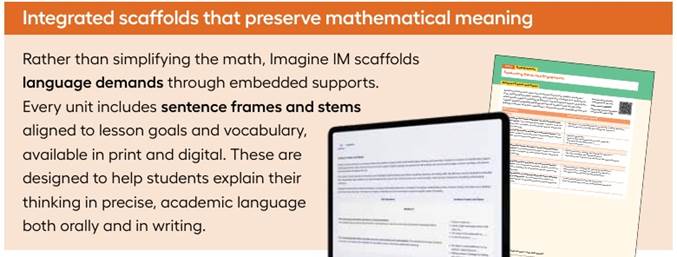
After students have something to say, the teacher introduces or standardizes academic language. Sentence frames like “The two ratios are equivalent because…” or “I represent ___ with ___ because…” help students present reasoning. Sentence frames are only temporary scaffolding and need to be gradually reduced as students become more confident.
Multiple representations help students see concepts
In bilingual math, multiple representations - multiple representations - both support Math understanding and reduce dependence on a single language channel. Students who are not yet fluent can still demonstrate understanding through models, tables, graphs, symbols, or manipulation of materials.
Teachers should ask students to intentionally switch between representations and explain what stays the same. It is this connection process that helps students recognize the structure of Mathematics instead of just memorizing the form of a lesson.
1. Actual situation: creates reasons for concepts to emerge and connects lessons to student experiences.
2. Visual model: clarifies structures or relationships before students have to deal with long English sentences.
3. Tables, graphs and symbols: helps organize data, generalize and represent ideas more accurately.
4. Spoken and written language: allows students to explain choices, compare approaches, and defend conclusions.
An effective question is “In what ways do these two representations show the same idea?”. That question forces students to connect meaning, not just read the name of each ingredient.
Build a bridge from home language to academic English
Family language and Vietnamese are resources to help students think, activate background knowledge, and try to express complex ideas before moving on to academic English. If asked to use only English too early, many students may stay silent even though they actually understand the lesson.
Language bridges need a purpose. Students can discuss initial ideas in their strongest language, then use keywords, sentence frames and models to restate them in English. This is controlled translanguaging: familiar language supports thinking, while the final product is still aimed at academic English.
1. Activate background knowledge: allows students to explain experiences or ideas in Vietnamese before reading the English problem.
2. Set up two-way glossary: write terms with the same picture, example, non-example and usage in a sentence, not just write an equivalent meaning.
3. Compare structure: indicates when Vietnamese and English express the same mathematical relationship differently.
4. Switch gradually to academic English: from natural sentences to more precise sentences while still protecting students' reasoning.
Parents can still support their children in Vietnamese through questions about models, solutions and predictions. Strong conceptual understanding will create a foundation for students to use Mathematical English more accurately.
Mathematical Language Routines help language develop while learning Math
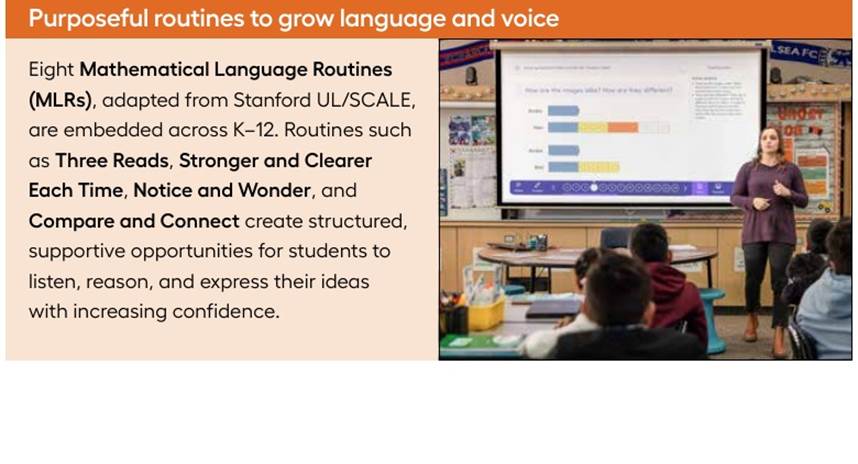
Mathematical Language Routines - MLRs are activity structures that help students listen, speak, read and write about Math during the problem-solving process. Language is not separated into a separate vocabulary section but appears when students really need to describe and clarify reasoning.
1. Notice and Wonder
Teachers show pictures, graphs or situations and ask “What do you notice?” and “What do you wonder?”. Open-ended questions allow students to start with language at their current level, while also helping teachers identify background knowledge and words that need support.
2. Stronger and Clearer Each Time
Students present an idea, listen to your expression or response, then speak or write more clearly. Each round not only corrects the grammar but also makes reasoning more accurate. Students are not asked to immediately create a perfect answer.
3. Compare and Connect
Teacher chooses two ways of performing and asks “What is the same?”, “What is different?” or “How are they connected?”. When connecting tables to graphs or models to expressions, students both develop conceptual understanding and use vocabulary in a purposeful argument.
Teaching English Math vocabulary in context
Vocabulary needs to be taught clearly but priority should be given to words that have high value for learning goals. A lesson does not need to introduce every new word. Teachers should choose core terms, relationship descriptors, and sentence structures that students really need to explain.
A word is considered learned when students can recognize it in many contexts, connect with models, distinguish it from similar concepts, and use it themselves in sentences. Therefore, word walls are only useful when frequently reused in speaking, writing and feedback.
1. Associate words with pictures and symbols: parallel example with picture, identification mark and non-example.
2. Teach words in phrases: Students need to know increase by, increase to or is proportional to, not just the word increase.
3. Clarifying polysemous words: table, mean, product or difference have different life meanings and mathematical meanings.
4. Do not fix all errors at once: prioritises errors that change meaning or make reasoning difficult to understand.
The goal is not for students to pronounce like native speakers, but to use language accurately enough to clarify Mathematical thinking.
Tests conceptual understanding separate from minor language errors
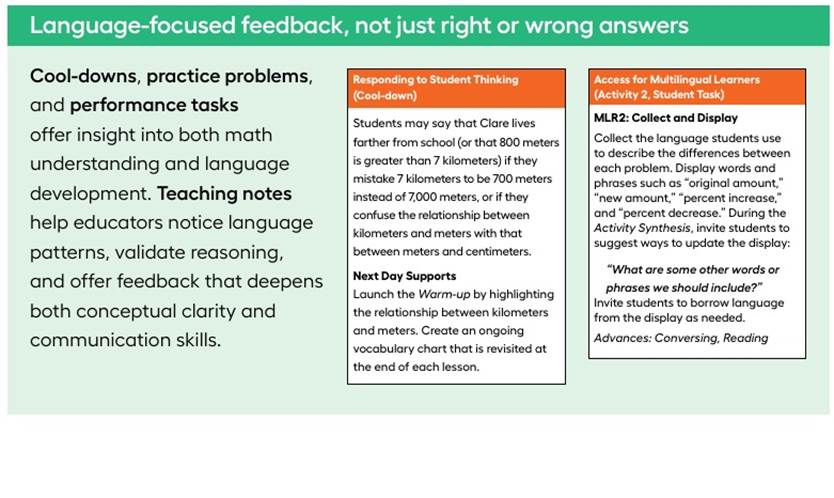
A short answer with incorrect articles or incorrect grammatical structure can still demonstrate good conceptual understanding. If Math scores are too much influenced by English fluency, teachers risk underestimating students' true abilities.
Fair assessment does not mean eliminating language requirements. Teachers need to separate two questions: how well students understand Math and how well they are using language to express that understanding. The two types of data are equally important but need to be responded to separately.
1. Allow many ways to express: Students can use models, symbols, tables, words, annotations, or written sentences to demonstrate reasoning.
2. Separating Math and Language criteria: rubric should have separate sections for accuracy, representation, reasoning and mathematical communication.
3. Read reasoning before grammar: a conjugation error should not obscure the student's correct recognition of the pattern.
4. Two-layer response: confirms the thought is valid, then suggests a word or sentence frame to express it more clearly.
Lesson flow sample for a bilingual Math class
An effective bilingual math lesson needs to create time for students to both do Math and develop language. The teacher does not need to stop the lesson to translate every sentence but places support at the right time in the lesson flow.
1. Launch - open lesson: introduces context with images, real objects, or short sentences; clarify requirements but do not explain the strategy in advance.
2. Explore - explore: students solve tasks using multiple representations; glossary, sentence stems and partner talk are used when needed.
3. Discuss - discussion: teachers choose a number of ways for students to compare, ask questions and borrow language from each other.
4. Synthesize - synthesis: the whole class names ideas, connects models with symbols, and standardizes academic language.
5. Check for understanding: students complete short tasks; Teachers read conceptual, reasoning, and language data separately.
This structure helps prevent English from becoming a "control gate" before students can access Math. Students can enter the task by observing and modeling, then develop language when they have ideas to express.
Common misunderstandings when teaching bilingual math
A bilingual math program can fail if the school only changes the language on the slides but keeps the teaching style the same. Four common misunderstandings include:
1. Use English as much as possible: the amount of English is not as important as students understanding the task and having the opportunity to use meaningful language.
2. After translating, it's differentiated: translation only partially addresses; Students still need visual models, scaffolds, and appropriate questions.
3. Students do not speak correctly, meaning they do not understand: Teachers need to look at the model, notation, and reasoning before drawing conclusions.
4. PBL is not suitable for English learners: Open tasks remain accessible when there is context, multiple representations, and routines that support communication.
What needs to be reduced is not the depth of Mathematics but unnecessary language barriers. Good scaffolding helps students participate in the same learning goal, not creating an easier lesson separate from the class.
Imagine IM illustrates how to integrate language into Math lessons
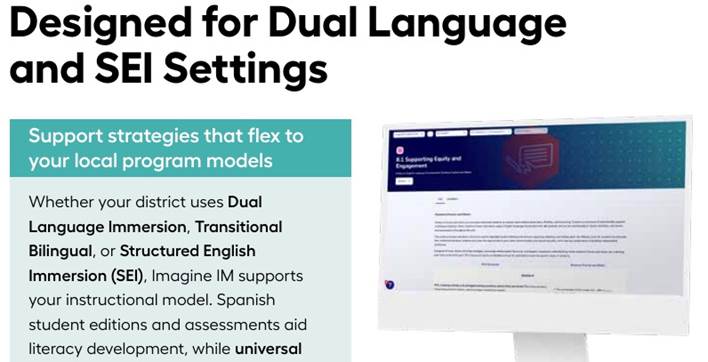
Imagine IM can be seen as a reference case of language-rich math instruction. The program integrates visual supports, sentence frames and Mathematical Language Routines in a problem-based structure, so that language and content develop together instead of being separated into two parts.
Routines such as Notice and Wonder, Stronger and Clearer Each Time and Compare and Connect create structured opportunities for students to observe, listen, speak and clarify reasoning. Teacher notes also help teachers pay attention to language patterns, validate valuable thinking, and provide feedback to increase both conceptual clarity and communication.
Imagine IM's English-Spanish resource set demonstrates a design principle worth considering: bilingual support requires synchronization between student content, assessment, print, digital and family resources. However, this is not a document that can be transferred as is to the Vietnamese - English class.
Adjusted for Vietnamese context - English
When implementing in Vietnam, schools need to build their own language bridge based on how students use Vietnamese and English. Glossary, sentence frames, examples and common errors should reflect these two language systems, rather than just translating from Spanish documents.
The professional team can start from a unit, identifying learning goals, core vocabulary and three or four sentence structures students need. Teachers then unify visual models, MLRs, and assessment criteria so that language is used consistently across classes.
Role of schools, teachers and parents
Teachers need to understand both the learning progression of Math and the language demands of each task. The team leader or curriculum coordinator should create time for teachers to view student work together, distinguish conceptual misconceptions from language errors, and build a shared scaffold.
Schools should not judge the quality of EMI classes solely by the percentage of teachers who speak English. More important indicators are whether students engage in problem solving, use multiple representations, explain reasoning, and progress in academic language over time. Parents can help by encouraging their children to explain ideas in their strongest language before restating them in English.
Register for a free Trial account, demo book, quote:
Schools and teachers, please contact BooksVN, the designated distributor of Imagine Learning, in charge of countries including Vietnam, Philippines, Malaysia, Singapore, Hong Kong, Indonesia, India, Bangladesh, Cambodia, Laos, Japan and Taiwan through the following channels:
Website: www.booksvn.com Email: cs@booksvn.com
Mobile/WhatsApp: +84-915 920 514
Facebook: https://web.facebook.com/BooksVNeBooksachNgoaiVanchinhhang
Zalo OA: https://zalo.me/2230563715259512406


.svg)