













What Is a Pacing Guide? Staying on Schedule Without Rushing Through the Curriculum
Pacing Guide?
Pacing Guide is a guide to distributing content, duration and learning goals according to each week, unit or stage of the program. This document helps teachers visualize the learning flow, estimate the number of lessons needed, and coordinate progress between classes of the same grade.
However, pacing is not a rigid schedule that requires every class to be on exactly the same page on the same day. A good pacing guide should both protect the curriculum's flow of knowledge and allow teachers to make adjustments based on understanding, practical gaps, and disruptions during the school year.
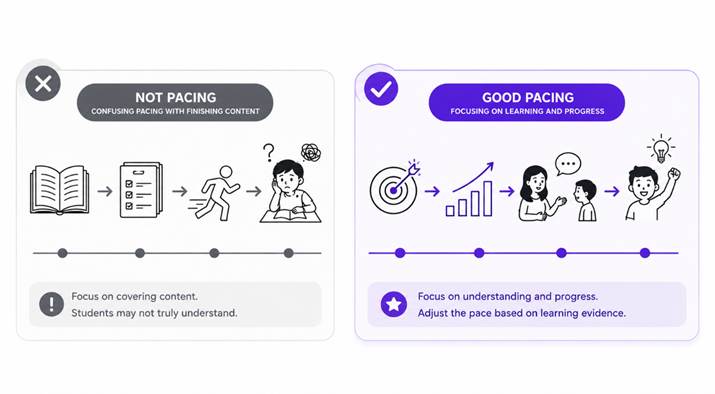
Pacing is not synonymous with running through the pages of a book
As the pressure to complete a program increases, progress can easily be interpreted as pages taught or activities completed. Teachers may try to move quickly to meet the schedule, but students have not had time to understand the core ideas, have not been discussed, or have not had the opportunity to demonstrate what they have learned.
Curriculum pacing should answer the question “What understanding do students need to form during this time?”, instead of just asking “how many lessons are left to go through?”. The difference is visible in four points:
1. Pacing by target: time is allocated around learning goals and student progress, not around page numbers.
2. Pacing according to knowledge: teachers recognize which lessons lay the foundation for the following lessons and which sections are mainly used for extension or additional practice.
3. Pacing has data: decide to move forward, consolidate, or adjust based on learning evidence rather than common sense.
4. Pacing has flexibility: classes may differ in support but still aim at the same goal and maintain program coherence.
Therefore, completing enough activities does not necessarily mean keeping on schedule. A class may go slower in one lesson but move faster in the next lesson because students already understand the foundation and don't need to re-teach it many times.
Why are classes often slower than planned?
Pacing guide is built on a number of assumptions about class duration, weekly schedule, student readiness level and implementation conditions. In reality, if just one of these factors changes, progress can deviate from the original plan.
Classes are often slow, not necessarily because teachers have poor time management. The cause may come from gaps in prerequisite knowledge, level differences, time spent on academic language, school activities or shortened school weeks.
Four common situations include:
1. Students do not have the necessary background knowledge: the teacher must stop to clarify a concept from the previous unit.
2. Discussion lasted longer than expected: students have many strategies that are worth exploring or need more time to express.
3. Teachers try to complete all components: includes similar practice sessions or activities that can be selected according to class needs.
4. School week interrupted: exams, events, holidays or changes in the schedule cause the loss of part of the scheduled classes.
The important thing is not to try to make up for all the lost minutes. Teachers need to determine which parts of the lesson create core understanding and which parts can be shortened, transferred to homework, or used in support groups.
Four components cannot be cut when shortening is required
When class is behind schedule, randomly cutting an activity can disrupt the flow of the lesson. A good pacing decision should protect at least four components: learning goal, core task, synthesis, and check for understanding.
1. Learning goal - learning goal
Learning goal helps teachers know what students need to understand or do after the lesson. If the goal is not clear, teachers can easily spend a lot of time on interesting but not essential parts, while the part that sets the stage for the next lesson is overlooked.
Before condensing, teachers should rewrite the goal in a short sentence and ask: which activity provides the best evidence that students are making progress toward this goal? Sections that do not contribute directly can be reduced in duration or moved to additional selections.
2. Core Task - where students actually do Math
Core Task is the task that brings out the important Mathematical ideas of the lesson. This is often where students analyze situations, try out demonstrations, compare strategies, or build connections between concepts.
When short of time, teachers can reduce the number of similar examples but should not replace the entire task with a quick lecture on the process. If students just watch the teacher do it, the class may save a few minutes that day but lack data about how they are thinking.
3. Synthesis - the moment of connecting and naming knowledge
Synthesis is not a conclusion that can be skipped when time is almost up. This is when the teacher picks up some of the student's strategies, connects them to the learning goal, and clarifies the correct language, symbols, or procedures.
A short but purposeful synthesis is often more effective than trying to present all the solutions. Teachers can choose two ways to express important differences, ask students to compare and then finalize the connection to carry over to the next lesson.
4. Check for understanding - evidence to decide the next step
If there is no check for understanding, the teacher only knows that he has finished teaching but does not know what the students have learned. A question at the end, cool-down or short product helps determine whether the class can continue, needs additional warm-up or needs small group support.
This test should focus on the learning goal, be short enough to read quickly and open enough to reveal thinking. The goal is not to get another score but to create data for the next day's pacing decisions.
What parts can be shortened without losing depth?
Shortening does not mean making the lesson shallower. Teachers can reduce time spent on repetitive sections or change the organization, as long as students still have access to the core task, participate in synthesis, and leave evidence of learning.
Some options that are generally safer include:
1. Reduce the number of practice sentences with the same structure: choose sentences that represent different levels or errors.
2. Shorten the whole class sharing part: choose two or three strategies in advance that serve the goal instead of listening to the entire group.
3. Move a practice section to independent time: homework, station or support session, if students have enough foundation to do it.
4. Combining warm-up with processing the previous day's data: both activates knowledge and corrects a specific misconception.
5. Canceling non-essential expansion activities for that day: save it for the group that needs more challenges or use it when the schedule allows.
On the contrary, you should not cut out the only part for students to explore concepts and then keep many sample practice sentences. This approach may help move quickly on paper but increases the risk of students memorizing the procedure without understanding the underlying relationships.
Use cool-down data to adjust the next day
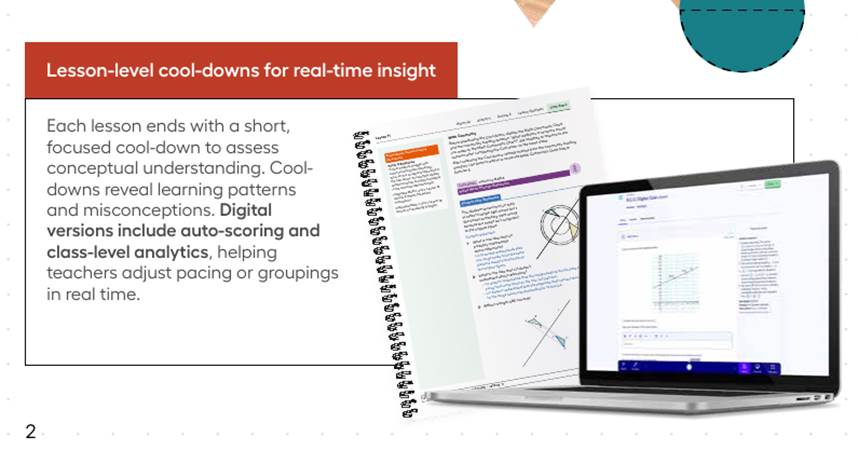
Cool-down is a short task at the end of the lesson to test an important learning goal. When designed properly, it gives teachers a snapshot of the class's level of understanding and helps avoid two extreme reactions: reteaching the whole thing or skipping ahead.
Teachers can quickly classify answers into four groups:
1. Understood and clearly expressed: students are ready to move on, perhaps taking on extended tasks or assisting you in discussions.
2. Understands the idea but has a small calculation error: no need to re-teach the entire lesson; Can be treated with warm-up or short feedback.
3. There is a reasonable strategy but not yet completed: needs more scaffold, time or a connection example before new post.
4. Misconception about core concepts: needs targeted intervention for the relevant group or adjustments to the opening statement the following day.
Categorizing in this way helps pacing reflect true needs. If the majority of the class has grasped the goal, the teacher can go ahead and support small groups. If most people have the same core misconception, stopping to clarify is a decision on schedule, not behind schedule.
Framework for making decisions when class is behind schedule
Instead of asking "how can I make up for it all?", teachers and professional teams can use four questions to choose appropriate actions: which goals were not achieved, how many students were affected, how important is this knowledge for the next lesson, and at what point can support be provided.
Scenario 1: Most of the class has achieved the learning goal
Teachers should follow the pacing guide, and use warm-ups, feedback or small groups to handle errors from some students. Holding the entire class back for a few individual mistakes can waste time from students who are ready.
Situation 2: Many students partly understand but lack certainty
You can spend the first 10-15 minutes of the next class to reconnect ideas with a short task, then move on to a new related lesson. This "bridge" method both consolidates and does not separate support from the program circuit.
Situation 3: Misconception touches prerequisite knowledge
If a misunderstanding will prevent students from accessing the next lesson, teachers need to protect time to handle it. However, reteaching should focus on the correct source of errors, using different representations or diagnostic questions instead of repeating the entire lesson in the same way.
Scenario 4: Late because the school week was interrupted
When classes are missed due to events or holidays, the professional team should review the learning goals of the entire section or unit. You can combine similar practice sessions, reduce extension activities, and keep tasks that lay the foundation for the next assessment or unit.
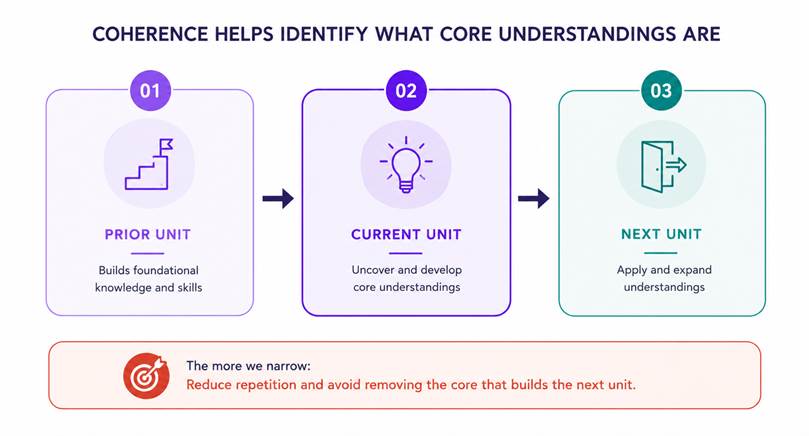
Unit dependency and coherence help know what not to abandon
Not all lessons have the same role in the curriculum. Some introductory performances or concepts will be used continuously in later lessons; Some exercises mainly reinforce, expand or create additional practice opportunities.
Unit dependency and coherence tools help teachers see that connection. When adjustments are needed, schools can prioritize learning goals to create a foundation, keep representations that will be reused, and avoid cutting a link that causes students to have difficulty in the following unit.
This also helps classes in the same block to be flexible without losing consistency. Teachers can vary in the number of examples, student grouping, or practice duration, but still cover the same progression and key checkpoints.
Imagine IM illustrates how pacing is tied to goals and data
Imagine IM is a K-12 Math program that can be referenced when building curriculum pacing. Teacher Guide provides unit overview, learning goals, lesson pacing, core activities, synthesis and cool-down, helping teachers see the structure of the lesson instead of just the page number.
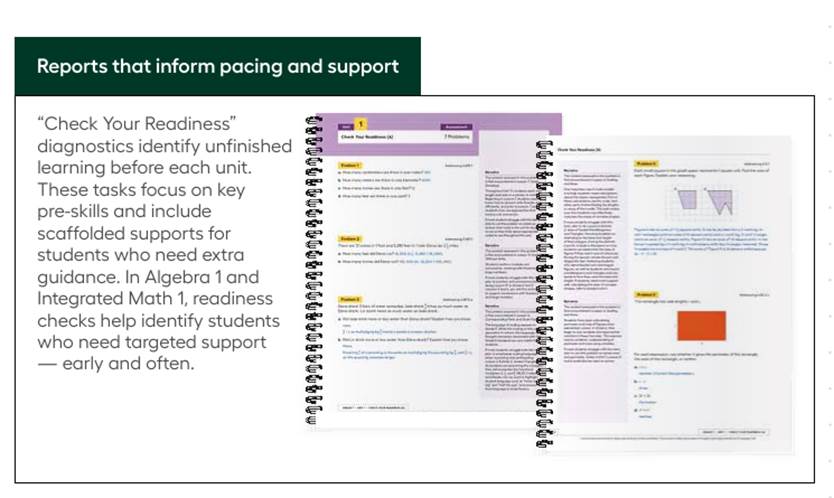
Cool-downs and assessments in the program create evidence for teachers to adjust pacing or grouping. Digital reports can assist in viewing results by assignment and standards, while unit documents help identify prerequisites, section goals, and learning threads that need to be protected.
The important point is that the tool does not replace the teacher's decision. Teachers still need to read students' presentations, see if errors come from concepts or calculations, and choose support appropriate to the classroom context.
Role of the professional team and program management
Pacing will hardly be effective if each teacher handles it alone or is judged solely by which lesson they have reached. The professional team should agree on core learning goals, assessment checkpoints, and the scope of flexibility allowed for adjustment.
Short meetings can focus on three things: where the class is in the unit flow, what data shows students are ready, and what supports can be shared across classes. This exchange is more useful than simply comparing page numbers or requiring all acceleration classes to be the same.
For interrupted weeks, program administrators should make grade-level decisions about prioritizing content, avoiding individual teachers cutting out different sections and losing coherence between classes.
Register for a free Trial account, demo book, quote:
Schools and teachers, please contact BooksVN, the designated distributor of Imagine Learning, in charge of countries including Vietnam, Philippines, Malaysia, Singapore, Hong Kong, Indonesia, India, Bangladesh, Cambodia, Laos, Japan and Taiwan through the following channels:
Website: www.booksvn.com Email: cs@booksvn.com
Mobile/WhatsApp: +84-915 920 514
Facebook: https://web.facebook.com/BooksVNeBooksachNgoaiVanchinhhang
Zalo OA: https://zalo.me/2230563715259512406


.svg)