













What Is Credit Recovery? Helping Students Earn Missing Credits Without Delaying Graduation
Credit recovery?? This is a roadmap for students who have failed a required subject or semester, helping them retake the correct missing knowledge, assignments, and assessments to qualify for credit. Students still must meet output standards and be supervised by the school; Credit recovery is not a form of reduced standards or automatic passing of the course.
Credit recovery is not "study quickly to get enough points"
Imagine an 11th grade student who has completed most of the program but failed a semester of Math because of extended absences, a transfer, or personal difficulties. If you have to retake the entire course from the beginning, you may lose another semester, conflict your schedule with other required subjects, and gradually lose motivation. But if only allowing a short test to receive credit, it is difficult for the school to ensure that students actually meet the output standards.
In practice, credit recovery creates a targeted path between the above two options: students focus on missing content, assignments, and assessments; demonstrate mastery; and verified by the teacher, counselor or school before credit is granted. The goal is to return students to the appropriate graduation pathway, not to repeat the entire course or skip the learning outcomes.
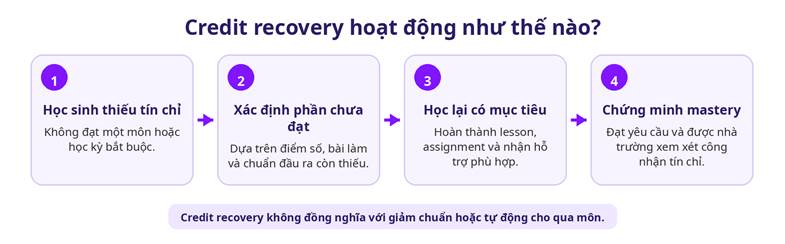
Situations where students may need credit recovery
Students lacking credits are not always due to lack of ability. A student may understand most of the content but not complete enough work because of health problems, mid-year school transfer, program differences, family pressure, or a period of unstable school attendance. Therefore, before placing a student in a credit recovery program, counselors and teachers need to review the school's academic results, participation history, completed courses, and graduation requirements.
Commonly considered cases include:
1. Students do not pass a required course or semester and are at risk of lacking credits to advance to the next grade or graduate.
2. Students transfer schools, programs, or countries and have some credits that are not fully recognized.
3. Students have to miss school for a long time but have mastered a significant part of the course content.
4. Students have completed many units but are still missing some important knowledge standards, assessments or assignments.
5. Senior-year students need to recover a specific credit to return to the correct graduation pathway instead of extending the entire pathway.
6. Students need more flexible schedules due to sports, arts, health or family responsibilities, but must still meet the same learning outcomes as other students.
Credit recovery should not be assigned automatically just because of a low final score. Schools need to clearly identify what students lack, what they have achieved, the reasons for their unsatisfactory results, and what type of support is needed. Correct classification from the beginning helps avoid two risks: forcing students to re-learn too much unnecessary content or skipping too quickly when background knowledge is still lacking.
Why repeating the entire course is not always the right choice?
Retaking an entire course may be necessary when students have not met most of the learning outcomes or do not have sufficient evidence of learning. However, for students who have completed many parts of the course, this model can easily create a waste of time. Students have to go back to lessons they already know, while the knowledge that really needs support is lost in a long course.
Four common risks when applying the full course re-study model for all cases include:
1. Time-consuming and causes schedule conflicts: a full course may take the place of a required, elective, AP, CTE or college preparatory activity. For senior students, being late for just one subject can affect their graduation plans.
2. Reduced motivation to study: Having to repeat already understood units can easily make students feel like they are "back to the starting line". When content is no longer relevant to current needs, engagement often declines before students reach the knowledge that needs recovery.
3. Not resolving blanks correctly: low scores can come from specific skills, missed assessments or missing required products. Repeating a full course does not automatically help schools identify and accurately address these gaps.
4. Increased pressure on teachers and counselors: schools must arrange additional classes, monitor class schedules, handle subject conflicts, and support a student for a longer period of time, even though the actual content area requiring intervention may be narrower.
5. At risk of delayed graduation: If a student can only retake the course in the next semester or school year, an unearned credit can extend the entire graduation pathway. This affects not only the class schedule but also the student's college, career and psychological plans.
A good credit recovery program does not remove rigor. Instead, the program focuses time on standards students have not met, uses pre-tests or previous data to determine starting points, and then requires students to complete the lessons and assessments necessary to demonstrate mastery.
Schools also need to accept that not all students are suitable for the shortened pathway. If data shows that background knowledge is too weak, participation levels are unstable, or students need more direct interaction, a full course, parallel support class, or intensive intervention plan may be a safer choice.
Criteria of a serious credit recovery program
Credit recovery only creates value when the school can still control quality. An online courseware platform with a convenient interface but lacking learning outcomes, monitoring or academic integrity can help students complete quickly without ensuring the ability to continue learning in the next course.
Clear output standards: content must comply with standards, course objectives or credit requirements applied by the school. Teachers and counselors need to know what courses a student is recovering from, what units are required, and what evidence is accepted for credit.
Pre-test has a purpose: the entrance assessment should help students demonstrate the knowledge they have mastered and identify content that needs to be re-learned. Pre-testing should not be a single “shortcut”; Important skills still need to be tested using a variety of appropriate activities and assessments.
Mastery before completion: completing the number of study minutes or opening all the lessons is not enough. Schools should set a passing threshold, require completion of important assignments and review the quality of work before granting credit. For articles, projects or labs, teachers still need feedback and approval.
Monitoring and academic integrity: the program needs to allow tracking of progress, study time, pending assignments, assessments and unusual signs. Depending on policy, schools may combine plagiarism checking, lockdown browsing, proctoring, direct testing or short interviews to confirm the substance of learning.
Flexible class schedule but not lax progress
An advantage of online credit recovery is that students can study at a more suitable time frame than traditional classes. However, "study at any time" can easily turn into "later" if the course does not have a clear start date, target date and checkpoints. Students who are missing credits are often also the group that need more structure and reminders, not less.
Schools should divide completion goals into weeks: number of lessons to be learned, assessments to be completed, assignments to be submitted and teacher check-in time. Dashboards can help keep track of how students are on schedule, how many days behind, or if any activities are blocking their path. Counselors also need to see the target date to coordinate schedules and graduation plans.
Flexible study schedule requires specific support. When students are behind in progress, teachers can re-teach a skill, adjust pacing appropriately, open additional retakes after students have reviewed, prioritize grading pending assignments, or make short exchange appointments. If the cause is due to devices, family schedules, or health, counselors and parents need to be involved instead of just sending more automated alerts.
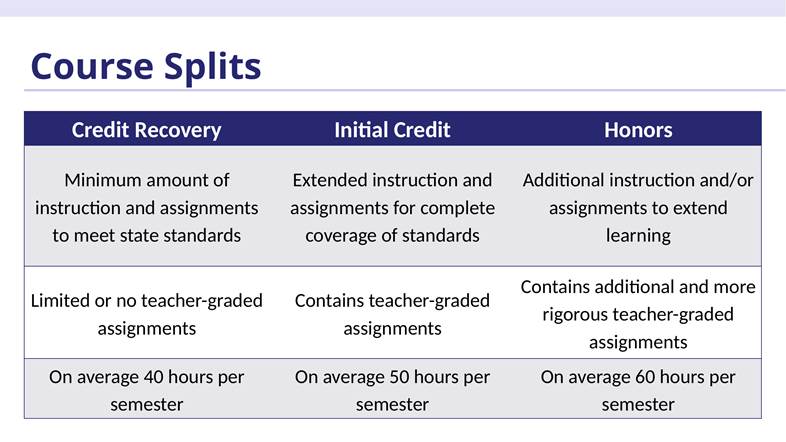
How is Course split Credit Recovery in Imagine Edgenuity used?
Imagine Edgenuity offers course split versions for several core courses, including Initial Credit, Credit Recovery and Honors. The Credit Recovery version is designed to focus more on the amount of instruction and assignment needed to meet standards, rather than requiring students to repeat the entire experience of an Initial Credit course.
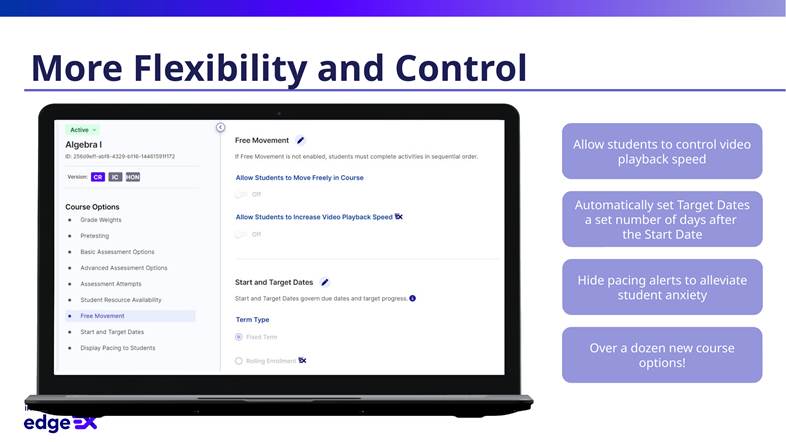
Depending on the school's configuration and policies, pre-testing can help students prove they have mastered content and focus on missing lessons. Teachers and administrators can still manage target dates, number of assessments, passing threshold, course options, lessons to be graded, and customized content. Progress and engagement reports help determine whether students are studying regularly, stuck, or just logging in without actually working.
This should be seen as an example of how online courseware supports the credit recovery process, not a tool that automatically determines whether a student is eligible for credit. The school still needs to determine entry criteria, output standards, assessment monitoring, teacher responsibilities and completion confirmation process before updating learning records.
Mastery is more important than speed of completion
The message "study quickly to graduate on time" may be attractive, but if speed becomes the main goal, the program easily loses its educational meaning. Students need enough time to re-understand concepts, practice, receive feedback, and demonstrate that they can use the knowledge in new exercises or situations.
Schools can design mandatory checkpoints before each important assessment. For example, students must complete guided notes, achieve a certain score in practice, revise their writing after feedback, or discuss with the teacher when they fail many times. These checkpoints are not intended to slow the student down, but rather help prevent “clicking and finish” and provide an opportunity to intervene before the student continues to accumulate space.
Mastery also needs to be understood according to the nature of each subject. With Math and Science, it could be the ability to solve problems and explain processes. With ELA and Social Studies, the quality of argument, evidence, and writing should be considered. Therefore, completion rate should always be read in conjunction with assessment results, teacher-graded work and other evidence of learning.
What metrics should schools measure credit recovery effectiveness with?
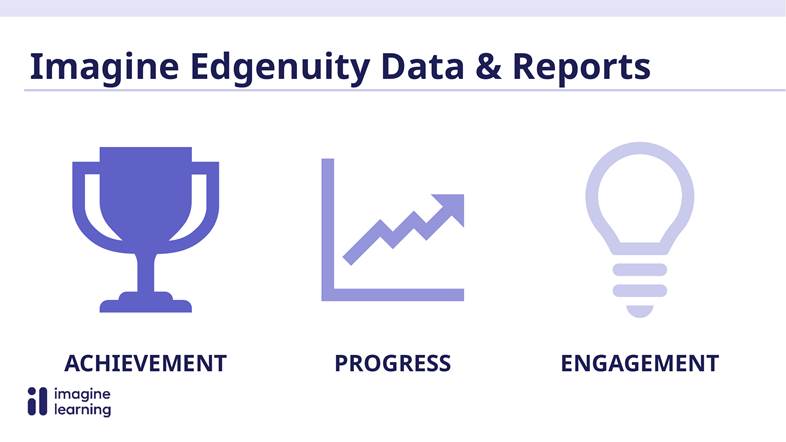
Credit recovery should not be evaluated solely by the number of credits granted. Schools need to read three groups of data simultaneously: achievement - what students achieve; progress - where the student is going; and engagement - whether students actually participate in learning or not.
Credits earned: track the number of students recovering in the right subjects, in the right semester and in accordance with graduation requirements. It is necessary to distinguish completed credits from credits that are just registered or in progress.
Completion rate and study quality: see student course completion rate, average time, dropout rate, mastery level, assessment results and assignment quality. A program with a high completion rate but students continue to fail in the next subject needs to be reconsidered.
Ability to return to the right path: check whether the student can continue to the next subject, return to the standard schedule and graduate on schedule. Schools should also track attendance, engagement, intervention times, and student feedback to understand the reasons for success or failure.
How to implement credit recovery without becoming a shortcut
Before implementation, schools should develop clear regulations on who can participate, types of credits that can be recovered, entry criteria, passing threshold, required activities and who has the right to confirm completion. Counselors, subject teachers, and administrators need to use the same definition to avoid each student being treated differently.
A pilot can start with a small group of students and a few high-demand subjects. During the first four to eight weeks, the school monitors progress, teacher support time, pending assignments, academic integrity issues, and the rate of students returning on schedule. Pilot results help adjust target date, workload and retake policy before expanding.
Parents and students need to understand that credit recovery is an opportunity to restore learning, not a form of reduced standards. The plan should clearly state the check-in schedule, deadlines, responsibilities and consequences if behind schedule so the family can provide timely support.
Online courseware can provide content, pacing, reporting and control tools, but quality still depends on program design, teacher monitoring, counselor coordination and the school's academic decisions.
Register for a free Trial account, demo book, quote:
Schools and teachers, please contact BooksVN, the designated distributor of Imagine Learning, in charge of countries including Vietnam, Philippines, Malaysia, Singapore, Hong Kong, Indonesia, India, Bangladesh, Cambodia, Laos, Japan and Taiwan through the following channels:
Website: www.booksvn.com Email: cs@booksvn.com
Mobile/WhatsApp: +84-915 920 514
Facebook: https://web.facebook.com/BooksVNeBooksachNgoaiVanchinhhang
Zalo OA: https://zalo.me/2230563715259512406


.svg)