













What Is Imagine Assessment? A K–12 System That Reveals Each Student’s Learning Needs
What is Image Assessment?
Imagine Assessment, whose full name in the product literature is Imagine+ Assessment, is an assessment system designed to help schools determine where students are starting, how they are progressing, and in what skills they need support. Instead of simply generating an additional score, the system connects assessment data to teaching decisions such as differentiation, grouping, intervention, supplementation, and growth monitoring.
The system is built towards K–12 assessment and includes many types of tools to serve different questions. Imagine+ Screener focuses on early literacy screening for PreK–3; Imagine+ Diagnostic is an adaptive assessment for K–12 in ELA and Math; and Imagine+ Formatives offers short, standards-aligned assessments for K–8. Grade level coverage varies by tool, but data and management are organized in the same unified experience.
Why does the school have many tests but still lack a unified picture?
A school may be using placement tests, end-of-unit tests, midterm benchmarks, online practice exercises, and various forms of classroom observations. However, a large number of assessments does not mean that the school understands the students better. If each test uses a different scale, reporting method, and purpose, the data can easily become fragmented.
Teachers may know that a student scored 62% but still do not know whether he or she lacks background knowledge, has not mastered a specific standard, or is only having difficulty with one type of question. Administrators can receive many transcripts but it is difficult to compare between classes, grades and schools. Parents also often only see the end result without a clear story about the starting point, progress and next steps of support.
The core problem is not a lack of data, but a lack of actionable data - data that is specific enough, fast enough and tied to action. An effective assessment system needs to answer two groups of questions: where students are and how they are growing; At the same time, after the content just taught, how much do students understand and what should the teacher do next.
What types of assessments does a balanced assessment system include?
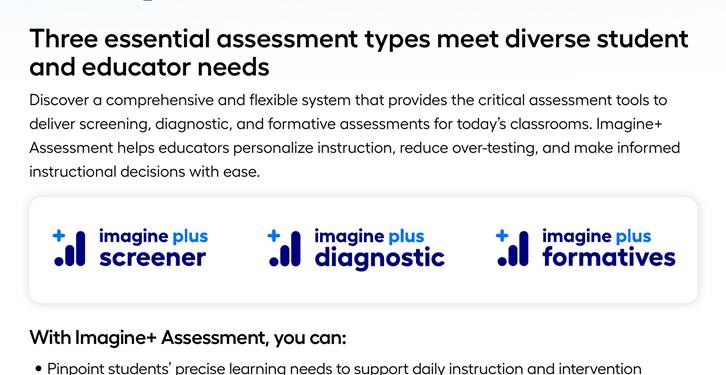
There is no single test that can serve all purposes. Screening, diagnosis, and routine assessment need to be used as complementary layers of data, rather than as substitutes for each other. Imagine Assessment organizes three main types of tools in one system:
Imagine+ Screener - early literacy screening: For PreK–3, this adaptive, gamified tool helps identify students at risk for reading difficulties or signs related to dyslexia. The report not only states the risk level but also points out the foundational skills that need attention for teachers to intervene early.
Imagine+ Diagnostic - adaptive diagnostic evaluation: For K–12 in ELA and Math. The Computer Adaptive Test adjusts the question set according to each student's feedback, thereby determining the level of readiness and results for each domain. Schools can use milestones throughout the year to measure growth, identify gaps and support placement.
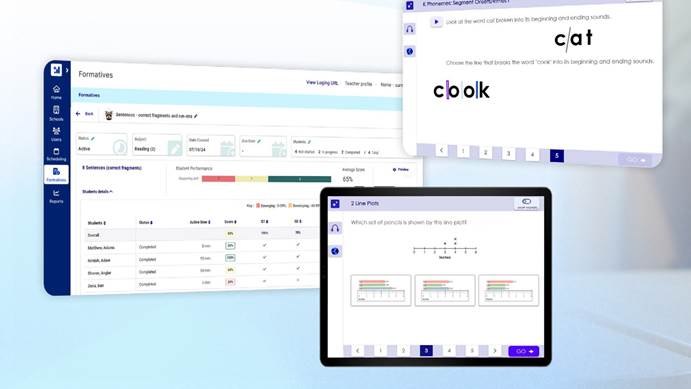
Imagine+ Formatives - regularly assessed according to standards: For K–8, includes short, pre-developed lessons that follow standards. Teachers can search by subject, grade, standard or keyword, then assign to each student, small group or the whole class to check understanding and decide whether to reteach or not.
In actual implementation, Diagnostics at the beginning of the year, mid-year and end of the year can become common benchmarks or interim milestones to monitor growth. Formatives are used flexibly between these milestones to test the skills just taught. Screener adds an in-depth layer of data for early literacy. This combination helps schools limit the situation where a test is expected to answer every question.
How is data turned into insight?
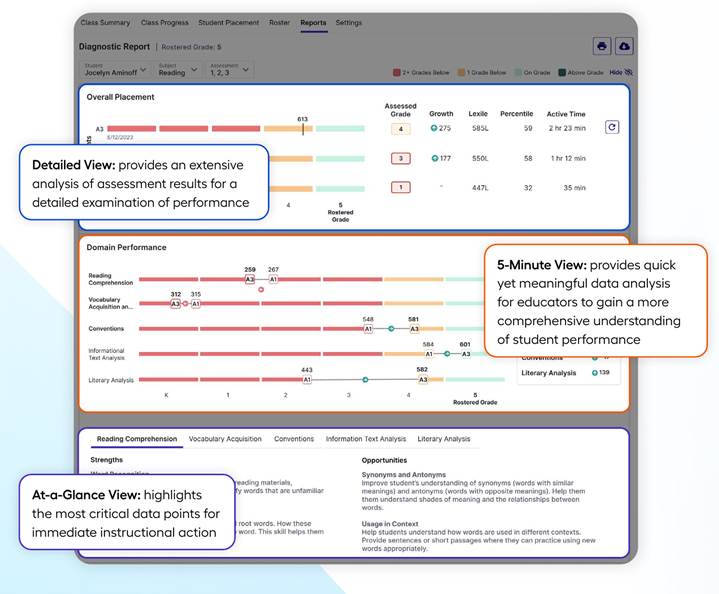
The strength of learning analytics is not in creating lots of charts, but in its ability to help users see what's important in the time they have. Imagine Assessment designs the report at three levels. At-a-Glance View highlights data that needs immediate attention; 5-Minute View provides deep enough analysis for teachers to adjust short-term plans; Detailed View allows for a closer look at performance across multiple metrics for intervention and longer-term planning.
For Diagnostic, the report can show overall placement, assessed grade level for each domain, scale score growth, Lexile or Quantile, percentile rank and rapid guessing warnings. For Formatives, teachers can track completion status, average score, proficiency level according to standards, and results for each item. Thanks to that, a low result can be analyzed into a specific problem instead of stopping at a general comment that the student is "weak".
View data at the student, class, school and system-wide levels
The same assessment data needs to serve many different roles. Teachers need to know which students must receive support this week. The technical team leader needs to see which domain is the bottleneck at many layers. Administrators need to monitor trends by grade and evaluate whether programming, pacing, or intervention activities are making an impact.
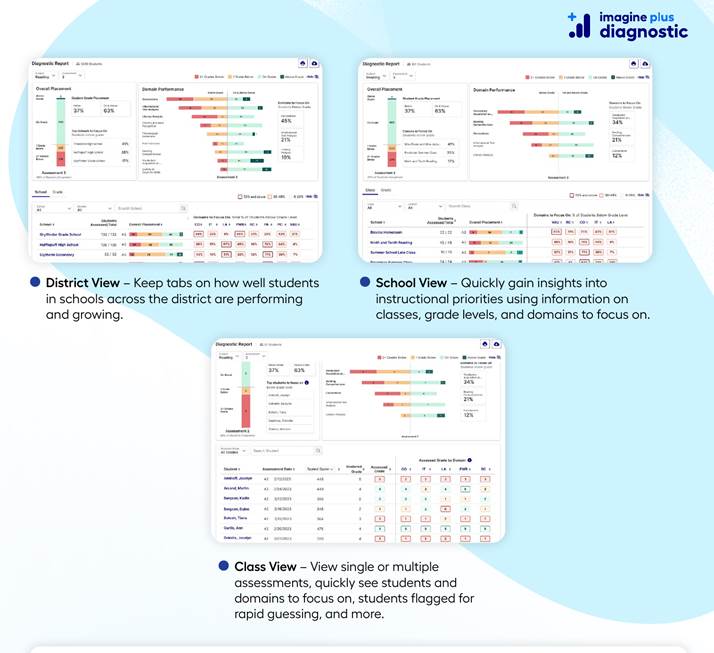
Imagine+ Diagnostic provides reporting at the student, class, school, and district levels. At the student level, data shows overall levels, individual domains, growth and areas of focus. At the grade level, teachers can quickly identify students and domains that need priority, and detect cases of working too quickly. At the school or system-wide level, leaders can compare trends across grades, classes, and units to identify professional priorities.
This multi-level structure helps form a common data language. Instead of each department using a separate report, the school can go from the overall picture down to each student using the same measurement logic. This is an important foundation for data team meetings to focus on solutions, and helps communicate with parents to have more evidence about the growth process, not just scores at a time.
What situations does Image Assessment support during the school year?
An assessment system is only valuable when the data is used in specific situations. With the combination of Screener, Diagnostic and Formatives, schools can exploit data for the following purposes:
1. Determine the starting point and readiness level of students before starting a new program or school year.
2. Detect vulnerabilities by domain, standard or platform skill instead of just looking at the total score.
3. Flexibly divide into groups for reteaching, intervention, additional practice or enrichment according to actual needs.
4. Monitor whether students are progressing after a period of support and adjust the plan when results have not changed.
5. Use the beginning, middle, and end of the year milestones to measure growth, identify trends, and evaluate program impact.
6. Create consistent comparative data between classes, grades, schools or the entire system to serve academic administration.
For example, if Diagnostic shows that a group of students have adequate reading comprehension but are weak in vocabulary, teachers do not need to put them in a general reading support group. Instead, the group can be designed according to the missing domain, then use a short formative to check again. This approach helps personalized learning become small, grounded, and trackable decisions, rather than just a slogan.
From assessment to personalized learning
Data does not automatically generate personalization. Value only occurs when the results lead to the next step of teaching: changing pacing, assigning a different activity, organizing small groups, selecting intervention content, or expanding a task for students who are ready. So the report needs to be clear enough for teachers to make decisions without having to spend hours processing spreadsheets.
Imagine Assessment can be used as a standalone product, and Diagnostic has the ability to support placement and adjustment of learning paths in some Imagine Learning programs such as Imagine MyPath and Imagine Language & Literacy. When schools use these solutions, domain-based assessment data can help connect assessments to more relevant learning content. However, technology is still only a source of evidence; The teacher's professional judgment, classroom observations and each student's context still play a decisive role.
Formative assessment is especially important in this cycle. A short pre- or post-reteach assessment helps teachers know whether the strategy they just applied was effective or not. If results have not improved, the school can review teaching methods, duration, homework conditions or need for specialized support, instead of continuing to assign the same assignments.
Checklist: Is the current assessment system fast enough and specific enough?
Schools can use the questions below to review the system they are implementing. The more answers are "no", the higher the risk of checking a lot but still lacking insight:
1. Does each type of assessment have a clear purpose and answer a specific teaching question?
2. Are results returned quickly enough for teachers to adjust instructions within the appropriate time?
3. Does the report drill down to domains, standards or items, or just provide an overall score?
4. Can teachers easily identify students and prioritize skills without having to manually assemble multiple data tables?
5. Can data be viewed consistently at the student, class, grade, school, and system-wide level?
6. Does the system support assigning assessments to individuals, groups and the whole class to serve specialized instruction?
7. Are the beginning, middle and end of the year milestones connected to regular tests during the teaching process?
8. Does the school monitor completion, exam time and signs that affect the reliability of results?
9. After viewing the report, does the user know whether the next step is reteach, intervention, enrichment or continued pacing?
Imagine Assessment is an example of how multiple assessment purposes can be connected in one experience, from early screening to adaptive diagnostics to regular standardized testing. The most appropriate way to determine whether the system meets a school's needs is to look directly at a sample report, put the data into the real-life situation of a grade or group of students, and test how quickly the user can go from results to action.
Register for a free Trial account, demo book, quote:
Schools and teachers, please contact BooksVN, the designated distributor of Imagine Learning, in charge of countries including Vietnam, Philippines, Malaysia, Singapore, Hong Kong, Indonesia, India, Bangladesh, Cambodia, Laos, Japan and Taiwan through the following channels:
Website: www.booksvn.com Email: cs@booksvn.com
Mobile/WhatsApp: +84-915 920 514
Facebook: https://web.facebook.com/BooksVNeBooksachNgoaiVanchinhhang
Zalo OA: https://zalo.me/2230563715259512406


.svg)