













When ChatGPT Does the Assignment: Protecting Academic Integrity Without Policing the Classroom
What is academic integrity? That is the principle that students must honestly express the knowledge, thinking and products they create; Transparency about sources used and role of AI. In the context of ChatGPT, protecting academic integrity does not mean banning all AI tools. The goal is to ensure that students still read, analyze, verify, interpret, and take responsibility for their submissions.
ChatGPT does the homework for you: the problem is not in the tool itself
A student can use ChatGPT to request a re-explanation of a concept, suggest a research question, or receive feedback on the clarity of a draft. These uses can still support learning if students read, select, and correct their own work.
The problem appears when AI replaces the thinking that the assignment is supposed to measure: writing entire essays, answering assessments, creating arguments that students don't understand, fabricating sources or adjusting style to hide the use of AI. At that point, the school no longer knows whether the submission reflects the student's ability or the tool's ability.
So, the important question should not just be “Do students use AI or not?” but “What steps was AI used to assist with, what did the students do themselves, and were they able to explain their product?”
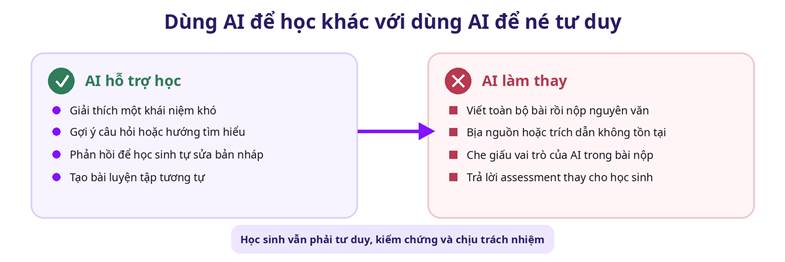
Using AI to learn is different from using AI to avoid thinking
An effective AI policy needs to help teachers, students and parents recognize this boundary with specific examples. The same tool but the purpose, time and level of use can create completely different results.
The following uses may generally be permitted, depending on the requirements of each article:
1. Ask AI to explain a concept in a more understandable way, then students rewrite it in their own words.
2. Brainstorm ideas, research questions or search keywords, but students must choose their own direction and verify the source.
3. Get feedback on the structure, clarity, or grammar of drafts students have written themselves.
4. Create similar practice questions to test yourself before assessment.
5. Use language assistance tools according to accommodations approved by the teacher or school.
Uses that weaken learning integrity include submitting AI-generated content verbatim, asking AI to complete tests, creating bogus quotes, paraphrasing to avoid duplicate testing, or not declaring AI when the test requires transparency.
Why does relying solely on AI detectors easily create conflicts?
AI detector often analyzes language characteristics and provides a level of suspicion, but does not observe who wrote the article, through what steps the article was formed, or whether the student really understood the content or not. Therefore, detector results are not direct evidence of fraud.
An article with a regular structure, formal language, or many short sentences may be flagged even if the student wrote it themselves. Conversely, AI-generated content may go undetected once edited. EAL students, students using academic templates or students receiving language support may also be placed in a difficult position to explain if the school considers a detector rate as final.
AI detector also cannot distinguish between allowed situations, for example, students use AI to correct grammar but build the entire argument themselves. If the teacher begins the discussion with accusations, students and parents are likely to focus on arguing about the accuracy of the tool instead of reviewing the learning process.
AI detector should be seen as a signal for the teacher to further check drafts, sources, editing history and the student's ability to explain - not as a sole judgment.
Build a clear AI policy before handling violations
A general rule like “don't use ChatGPT” is often difficult to enforce because students can use AI in search, translation, grammar checking or other applications without realizing it. On the contrary, the regulation "can use AI" without stating limits also makes it difficult for teachers to evaluate fairly between classes.
AI policy should be written according to each type of activity. For example, a brainstorming exercise may allow for the use of AI; Drafts can allow for feedback but previous and later versions must be saved; Class tests or oral assessments may require independent work. Instructions need to appear right in the test, not just in a long document at the beginning of the year.
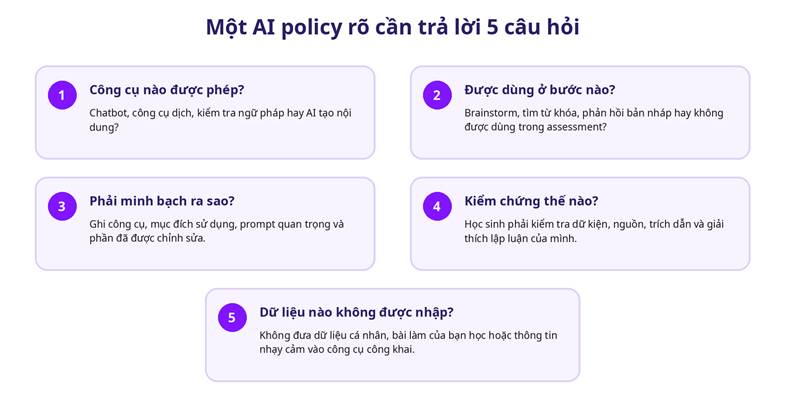
Schools also need to agree on how to cite or declare AI at an age-appropriate level. A simple form can ask students to write down the tool used, the purpose of use, important prompts, and which parts of the product were edited from AI suggestions. Transparency does not automatically make a submission valid; Teachers still need to see if AI is being used in the authorized steps.
Process-proof design: making student thinking visible
A more sustainable way to protect academic integrity is to design assessments with more evidence of the process. When only collecting a finished product, it is difficult for teachers to know how the lesson was created. When there is an outline, draft, feedback and revision, the development of ideas becomes clearer.
Teachers do not need to collect every trace in every lesson. For important articles, a short outline, a draft, an explanation of three major changes after feedback, and an oral discussion lasting a few minutes may be required. For projects, students can submit decision logs, verified sources, or photos of milestones.
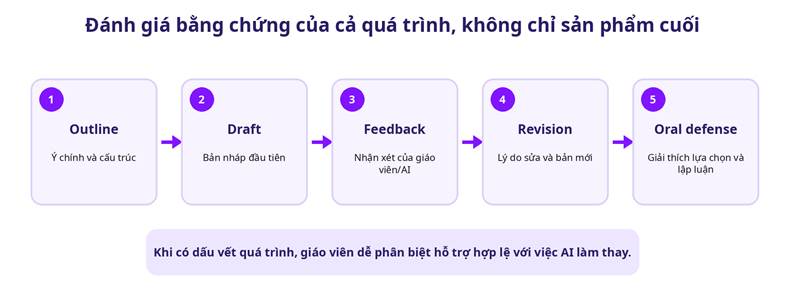
Oral defense doesn't have to be a stressful question and answer session. Teachers can ask: “Why did you choose this evidence?”, “What part is the most difficult?”, “What would you change if you rewrote it?” or “How does this source support the argument?”. Students who actually participate in the process can usually explain the choice, even if the writing is not perfect.
When in doubt, have a pedagogical dialogue before concluding
Schools should have a consistent process so that teachers do not have to emotionally handle each case:
1. Record signals: content changes abnormally, source does not exist, high level of duplication, unusual completion speed or student cannot explain the lesson.
2. See more evidence: topic, AI policy applied to activities, drafts, edit history, source and process data.
3. Neutral discussion: ask students to describe how they worked, the tools used and the part they decided; Avoid opening with the conclusion "I cheated".
4. Choose an educational response: supervised revision, doing an equivalent piece, adding oral defense, or relearning content about citations and AI literacy.
5. Apply consistent policy: if there is a violation, record it based on published regulations, level of impact on learning goals and opportunity to correct errors.
This procedure is not meant to condone intentional behavior. It helps schools make decisions based on multiple sources of evidence, reducing the risk of incorrect conclusions and keeping the focus on what competencies students need to demonstrate.
Three layers of technical protection in Edgenuity/EdgeEX
In an academic integrity system, technology can help detect signals and control certain assessment conditions. However, the tools below should be used with clear regulation, appropriate assessment design and pedagogical dialogue - not as sole evidence that students have used ChatGPT for homework.
Plagiarism scanning: detect content that matches the source
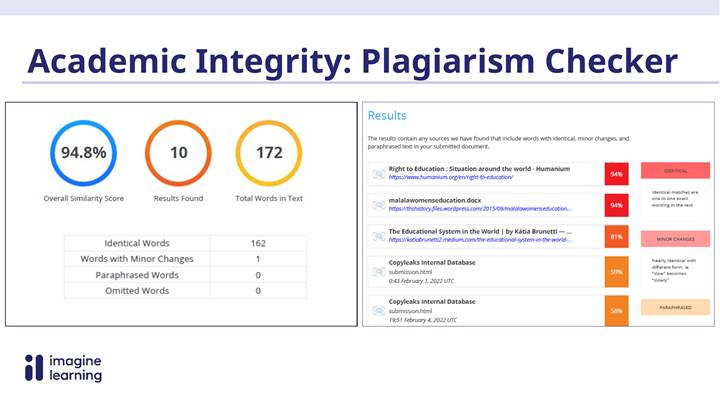
Plagiarism Checker in Imagine Edgenuity can automatically or manually scan a number of articles, displaying similarity score, matching text and related sources. Useful tool when teachers need to identify content that is copied, slightly altered, or paraphrased from an existing source.
Duplicate results do not by themselves prove that the student used AI. A duplicate may be a valid citation but lacks the required formatting, language, or references. On the contrary, AI-generated articles may not match the specific source. Teachers still need to see the context and communicate with students.
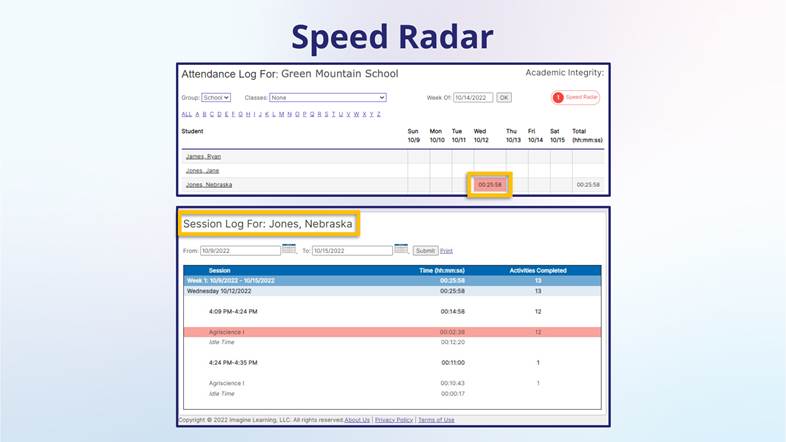
Speed Radar: detects unusually fast progress
Speed Radar helps teachers identify activities that are completed faster than usual. This is a signal worth checking because unusual speed can be related to skipping content, using a tool to do homework for you, or not fully participating in the learning activity.
However, fast does not mean cheating. Students may have mastered the knowledge, return to the content they have learned, or have effective ways of doing things. Teachers should open Attendance Log and Session Log, see the number of activities, active/idle time, quality of answers and ask students to explain before concluding.
Lockdown Browser: control environment during critical assessment
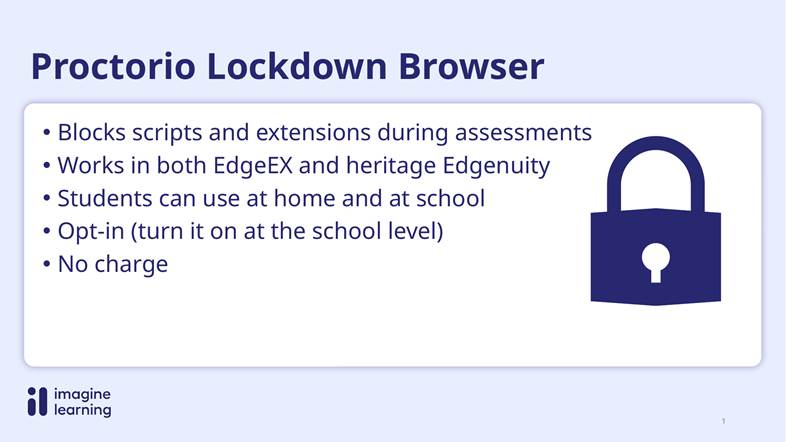
Proctorio Lockdown Browser is a layer of control that can be enabled at the school level for assessment, to block scripts, extensions, tabs or other applications during testing. The tool is suitable for tasks that need to measure independent ability in a controlled environment, even when students work at school or at home.
Lockdown Browser should not replace teaching AI literacy nor does it need to be applied to every activity. If every lesson is locked, students have little opportunity to learn how to use digital tools responsibly. Schools should clearly identify which assessments require a controlled environment and which activities allow declarative AI use.
Technology is an additional layer of protection, not sole evidence
Plagiarism scanning indicates whether the content is similar to another source or not. Speed Radar shows whether progress is abnormal or not. Lockdown Browser partially controls the assessment environment. None of the tools in the three groups above can fully answer the questions on their own: what did the student understand, at what step was AI used, and did the behavior violate the lesson's policy?
A balanced model needs to combine four layers: AI literacy education; clearly defined for each type of article; process proof design; and technical signals to prioritize cases for consideration. The final decision still requires teachers to read the lesson, understand the context and discuss with students.
Parents can support without doing homework for their children
Parents often only see two options: ban it completely or let their children use ChatGPT themselves. A better way to support is to ask your child to explain the lesson in his or her own words, pointing out the sources he/she checked and stating clearly which step the AI helped.
1. Do not enter the entire question and then give the answer to your child; Use AI to create open-ended questions or practice examples.
2. Encourage your child to save outlines and drafts so they can demonstrate their progress.
3. When your child is in doubt, review the policy and evidence with them and prepare an honest explanation instead of just arguing that the detector may be wrong.
Checklist deploys learning integrity for schools
1. Activity classification: AI allowed, limited use, or must be done independently.
2. Put AI instructions right in the questions and rubrics, not just in the handbook.
3. Unify how to declare tools, prompts and supported content.
4. Design at least one process evidence for critical assessments.
5. Train teachers to use detector, plagiarism report and speed data as signals instead of single conclusions.
6. There is a communication process, opportunity for explanation and redo plan appropriate to the level of violation.
7. Monitor impact: number of disputes, percentage of students understanding policy, revision quality and ability to explain articles.
Deploy without turning the classroom into a cheat hunt
Schools can start with a pilot in some subjects that have many articles or online assessments. In four to six weeks, the expert team agrees on an AI disclosure form, a suspect handling process and two or three easy-to-apply forms of process evidence. Then, teachers review which cases are resolved faster and which regulations are still misleading.
The message to students needs to be clear: the school does not consider all use of AI as cheating, but also does not accept AI to replace the thinking required by learning goals. Students have the right to know the criteria before taking the test, the opportunity to explain when in doubt, and the responsibility to be transparent about the tools used.
Imagine Edgenuity and Imagine EdgeEX can provide several layers of support such as plagiarism scanning, speed radar and lockdown browser. The value of these tools lies in helping teachers detect signals and control assessment appropriately; The quality of academic integrity still depends on policy, assessment design and how the school dialogues with students.
Register for a free Trial account, demo book, quote:
Schools and teachers, please contact BooksVN, the designated distributor of Imagine Learning, in charge of countries including Vietnam, Philippines, Malaysia, Singapore, Hong Kong, Indonesia, India, Bangladesh, Cambodia, Laos, Japan and Taiwan through the following channels:
Website: www.booksvn.com Email: cs@booksvn.com
Mobile/WhatsApp: +84-915 920 514
Facebook: https://web.facebook.com/BooksVNeBooksachNgoaiVanchinhhang
Zalo OA: https://zalo.me/2230563715259512406


.svg)