












Can Schools Teach Hands-On Science Without a Fully Equipped Lab?
Practice Science is a way of learning, not just a room
Teaching Science without a lab is a real difficulty in many schools. The school wants to increase hands-on learning but does not have a dedicated laboratory space, teachers lack preparation time, materials are scattered and there is no dedicated staff to inventory, clean or preserve equipment. Therefore, Science class can easily return to the format of the teacher lecturing, students taking notes and watching a demonstration video.
However, the goal of Practical Science is not to put students in a room with a lot of equipment. The goal is to provide opportunities for students to observe, question, measure, experiment, build models, analyze data, and explain with evidence. Many of these experiences can be held in a regular classroom if the activity is sized appropriately, the materials are safe, and management procedures are clear.
Dedicated labs are still needed for experiments that involve chemicals, high temperatures, precision equipment, or require strict safety controls. But the lack of a lab does not mean the school has to delay all practical Science. A more reasonable approach is to determine which activities can be performed in a micro-lab format, which activities should use science kits, and which phenomena are better suited to digital labs, video investigations, or pre-collected data.
Not all experiments need a dedicated lab
A hands-on activity's value is not determined by the number of devices on the table. An activity is only meaningful when it serves an explicit learning question and generates evidence for students to think about. Before worrying about space, teachers need to determine what students are being asked to do about the scientific phenomenon or problem.
1. Observation: Students identify characteristics, changes, patterns, or relationships. The activity may just require a sample object, a chronological photo, a close-up video, or a simple phenomenon that happens right in the classroom.
2. Measurement: Students use rulers, clocks, scales, thermometers, or digital tools to collect data. The key requirements are knowing what quantities to measure, how to record the data, and where errors can occur.
3. Test an idea: Students change one variable, keep other conditions relatively constant and compare the results. This could be performance on friction, material strength, melt rate, shading or heat retention.
4. Solution design: Students create prototypes, test, get feedback, and improve. Challenges such as building a paper bridge, designing a model water filter or creating a windbreak can be implemented on a desk with simple materials.
5. Modeling: When it is not possible to directly observe the solar system, the internal structure of the Earth, or the motion of molecules, students can use physical models, diagrams, data, or numerical simulations to explain the mechanism.
After determining the goals, teachers choose the format. If the goal is pattern recognition, a series of images or real data may be more effective than a fancy experiment. If the goal is design and innovation, students need to be able to touch materials and try out many options. If the phenomenon is too dangerous or cannot be scaled, digital simulation is a purposeful choice, not a replacement for all hands-on activities.
Micro-lab: shrinking scale, not shrinking scientific thinking
Micro-lab is a scientific investigation activity designed on a small scale, using few materials, short in time and can be done right at the desk or in a flexible area in the classroom. “Micro” refers to the scale of organization, not that students just follow simple instructions or receive ready-made results.
A good micro-lab still needs questions, predictions, observations or measurements, a way to record data, and an explanation after the activity. Teachers can reduce the amount of materials, but they should not eliminate the step of students thinking about variables, comparing results, and relating evidence to conclusions.
1. Small material scale: Priority is given to plastic cups, small trays, paper, rubber bands, wooden sticks, soil, water, rocks, magnets, flashlights or items that are easy to buy and easy to replace.
2. Controllable execution time: An activity should have a start and end point consistent with the session. Phenomena lasting multiple days can be prepared in advance, observed by station, or combined with classroom data and sample data.
3. Simple cleaning process: Materials are divided into groups, with trays, labels, quantity and return location. Cleaning time needs to be calculated as part of the lesson plan, not as a part of the work that occurs at the end of the hour.
4. Age-appropriate safety: Do not use substances of unknown origin, sharp objects, heat sources or gas-generating reactions when the classroom has no controlled conditions. Safety instructions must be presented before dispensing materials.
5. Visible evidence of learning: Students need to leave data sheets, model drawings, test sample photos, observation notes or Claim-Evidence-Reasoning answers. If the activity ends with "finishing the product", it is difficult for teachers to know what students have understood.
For example, when learning about force and motion, students can use a small wooden block, rubber bands, and surfaces of varying roughness to observe how energy is stored and released. While learning about materials, groups can test the load-bearing capacity of various paper structures. When learning about water, students can compare the rate of permeation through layers of materials in a small model. These activities do not require a lab but still generate data for analysis.
Classroom safety and management must be designed from the ground up
The reason many teachers hesitate to organize hands-on learning is not only the lack of equipment. A class of 25 to 35 students can quickly become chaotic if materials are freely distributed, group roles are unclear, and the teacher must provide both instruction and troubleshooting. Therefore, activity management must be included in lesson design from the beginning.
1. Standardize roles in the group: Each group has a materials manager, a data recorder, an operations person, and a reporter. Roles can rotate so that every student participates.
2. Divide materials by tray: Each tray carries a group code, a list of quantities and photos illustrating the arrangement. Teachers quickly check before and after class instead of counting each separate item.
3. Teach the procedure before handing out equipment: Students need to know when to touch materials, the stop signal, how to report problems, and how to handle spilled liquids.
4. Pre-operation test: Teachers should do a trial run with the right materials, time, and classroom conditions. A beautiful performance on the Internet may become unstable when changing the paper type, water content or pattern size.
5. There are alternatives: If materials are lacking, equipment is not working, or time is running short, teachers need to know which sections can be turned to sample data, videos, or discussions while still maintaining the learning objectives.
When these processes are repeated consistently, students gradually develop the habit of working as a scientific community. The initial organization time may be more, but later sessions will be more effective because the teacher does not have to explain all over again how to receive, use and return materials.
Science kits help standardize materials and reduce preparation time
If each teacher has to buy their own materials, portion them, label them, and find a place to store them, the operating costs can be greater than the value of the materials themselves. Science kits solve this problem by gathering materials by module, lesson or student group. The important benefit is not just “having supplies on hand,” but increasing consistency between layers and reducing the risk of missing a critical ingredient at the last minute.
A useful science kit should come with clear information, instead of just a box of materials. Schools can use the following checklist when evaluating:
1. List of materials by session: Teachers know which dishes to use for demonstration, which dishes to distribute in groups, and which dishes need to be prepared locally.
2. Distinguish between consumable and reusable materials: Schools can create replenishment plans to avoid discovering that important ingredients are out of stock in the middle of the year.
3. Instructions for preservation and cleaning: The conditions in which equipment needs to be cleaned, dried, or stored must be clearly stated so that it can be shared by multiple teachers.
4. Quantity specifications: Kit needs to match the actual group size and organization. A set of samples for teachers cannot replace a set of materials for direct student investigation.
5. Direct link to lesson plan: Each item of materials must be associated with questions, investigation steps, and evidence of learning. If teachers have to guess "which lesson will this box be used for", the kit hasn't really reduced the load.
Science kits do not completely eliminate preparation. Teachers still need to preview the lesson, check the status of materials, and adjust according to the classroom context. However, a good kit helps change the job from "building a material system yourself" to "testing and organizing a standardized system".
When is digital lab or video investigation a reasonable choice?
Digital lab, numerical simulation and video investigation are often contrasted with hands-on learning. In fact, each form helps students approach a different type of phenomenon. Technology is valuable when it opens up what students cannot safely or fully observe in class, not when it just makes slides more dynamic.
1. Phenomenon too large or too far away: Tectonic plate movements, weather systems, large ecosystems, space, or geological processes cannot be fully recreated on a school desk.
2. Phenomenon that is too small or too fast: An interaction at the cellular, molecular, electrical level, or a very short reaction may require close-up images, scientific animation, or pauseable simulations.
3. Dangerous or age-inappropriate phenomena: Wildfires, earthquakes, chemicals, high pressure, or industrial equipment should be observed through data, video, and safety models.
4. Prolonged phenomenon: Organism growth, environmental change, and climate data can span weeks or years. Students can combine their short-term observations with long-term data sets.
5. Need to try many scenarios: Simulation allows students to change variables, run it many times and see the consequences quickly. This is advantageous when the goal is to identify relationships between variables, but the results still need to be discussed and verified by argument.
A good digital simulation should not turn students into people pressing buttons to receive effects. Students still need to predict, select variables, record data, compare runs, and interpret. Video investigation also requires observation questions, stopping points and information processing tasks. Without this structure, technology simply replaces teacher narrating with screen narrating.
Blended lab model: combining physical experiences, digital data and scientific reading
In the absence of a lab, the most feasible model is often not completely hands-on or completely digital. A blended lab combines multiple sources of evidence for students to build understanding. Each form takes on a different role in the same survey question.
Step 1 - Evoke the phenomenon: Students observe a sample object, photo, short demonstration or video on purpose and record what they notice and what they have questions about.
Step 2 - Physical experience: Group conducts a micro-lab or design challenge to generate their own data. The activity should focus on one or two controllable variables in the classroom.
Step 3 - Expand with digital data: Students use simulations, datasets, or videos to test situations that cannot be performed directly, increase the number of samples, or view phenomena on a different scale.
Step 4 - Read scientific documents: A short scientific text that helps students supplement concepts, vocabulary and information from experts. Text does not replace investigation but helps explain what students have observed.
Step 5 - Evidence Report: Students present Claim-Evidence-Reasoning, update the model or suggest improvements. Teachers use formative assessment to identify misconceptions and decide what needs to be re-teached.
For example, in a 50-minute lesson on friction, the teacher could open with a short video about the braking system. Students use different surfaces to measure the distance an object slides, then observe simulations or data of friction under conditions that are difficult to create in class. At the end of the lesson, each group makes a claim about the type of surface that creates greater friction, quotes the group's data as evidence and explains the mechanism using reasoning.
Evaluate evidence-based practices, not just beautiful products
Another difficulty when teaching practical Science is that teachers easily grade the final product instead of the thinking process. A paper bridge that stands firmly, a filter that makes water clearer, or a beautifully decorated model is not enough to demonstrate that students understand scientific principles. Results can come from luck, the support of a group mate, or following instructions without understanding why.
Formative assessment should appear before, during and after the activity. Before investigating, the teacher asks for predictions and reasons. During the process, the teacher observes how the group changes variables, records data, and handles unexpected results. After the activity, students must use evidence to explain, compare with initial predictions, and state the limits of the experiment.
Claim: Direct answer or conclusion to the investigation question. Claims need to be specific enough to be supported or refuted by evidence.
Evidence: Data, observations, images, simulation results or information from scientific text that is directly related. Students need to select evidence, not just copy the entire data table.
Reasoning: An explanation of why the evidence supports the claim, using appropriate scientific concepts. This is often the part that helps teachers see whether students really understand or are just describing results.
When assessments are designed this way, schools do not need a large lab to produce quality evidence of learning. It is important that each activity has clear goals, thinking products, and rubrics or observation criteria.
What do schools need to prepare to implement practical Science without a lab?
Sustainable implementation takes more than the individual efforts of an enthusiastic teacher. Schools should view hands-on learning as a common operating process, with assignments, budgets and safety criteria.
1. Programmatic activity mapping: Classify which lessons can be used in a micro-lab in class, which lessons need dedicated space, which lessons are suitable for digital investigation, and which lessons need data or video.
2. Create centralized storage: Even without a lab, the school still needs a small cabinet or warehouse with labels, lists and people in charge. Materials should not be scattered in individual teachers' rooms.
3. Standardize safety routine: Create short instructions according to age, rules for using tools, handling liquids, hand hygiene, reporting incidents and checking materials before class.
4. Spend time planning as a group: Teachers of the same grade or subject should test the activity, agree on how to collect evidence, and share experiences after the first session.
5. Track consumable expenses: The budget is not just for the initial kit, but there needs to be a plan to replenish supplies, replace broken tools, and handle and preserve them.
6. Evaluate according to the level of student participation: A program should not be judged by the number of experiments alone. It is necessary to see whether students ask questions, use data, explain, design and innovate.
With this organization, schools can start small, such as one module per semester or a pilot grade, and then expand based on data about preparation time, safety, engagement and quality of student work.
An example: how Twig Science combines multiple forms of investigation
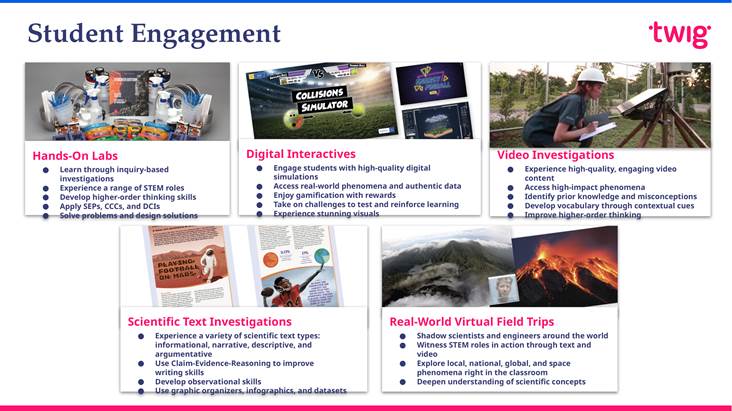
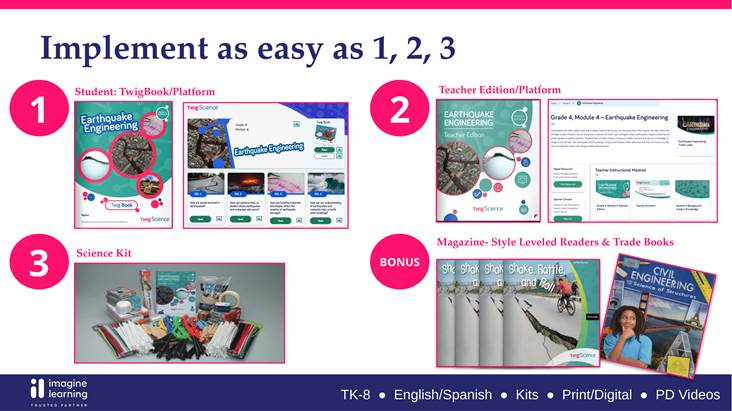
When evaluating a Science program for a school that does not have a full lab, the school can refer to how the hands-on, digital and scientific text components are organized in the same learning flow. Imagine Learning Twig Science is an example of this model: students approach phenomena through hands-on labs, digital labs or interactives, STEM experiences, scientific text investigations and video investigations instead of depending on a single type of activity.
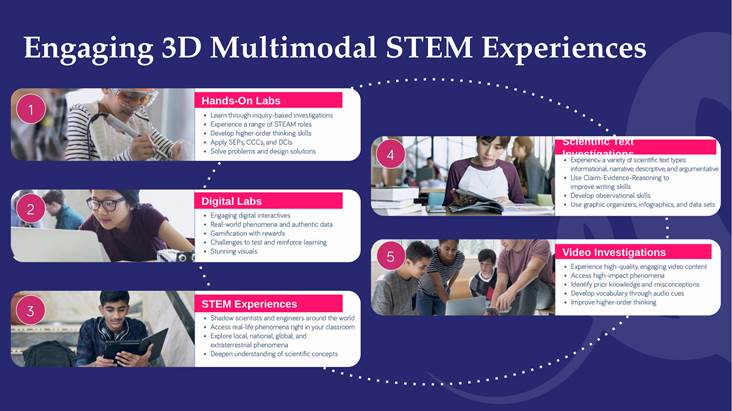
The notable point lies not in the fact that the program has many media, but in the role of each media. Hands-on is used when students need to manipulate, design, or create data. Digital interactions extend phenomena that are difficult to replicate. Video investigation exposes students to real-world contexts and STEM careers. Scientific text helps children read, write and use evidence as part of learning Science.
Micro-labs and tutorials for students directly
In Twig Science's leveled readers, the "Be a Scientist" section introduces micro-labs that can be performed without specialized equipment. Instructions are presented to the student, including materials, setup, experimental steps, and a requirement to record or represent the results. This is a useful criterion when schools evaluate resources: the activity should be clear enough for students to actively work on, but still leave space for prediction, observation and comparison.
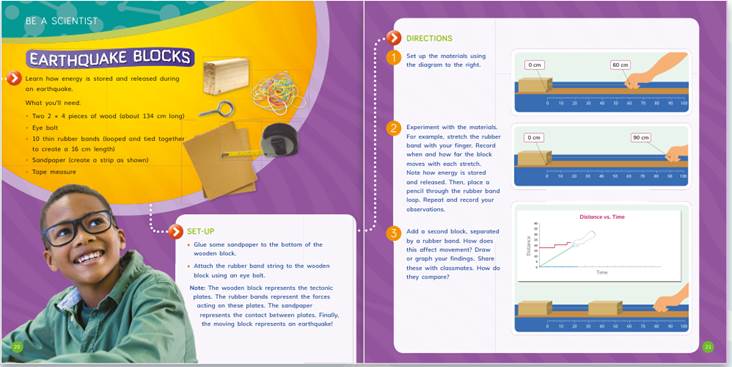
Even though the activity has instructions, teachers still need to preview safety levels, adjust materials to local conditions, and determine the evidence to collect. A ready-to-teach program should reduce repetitive preparation, not eliminate the teacher's professional discretion.
Science kits, digital resources and lesson plans need to be in the same system
Twig Science organizes implementation components including student materials, Teacher Edition or teacher platform, science kits, and digital resources. For schools lacking labs, this organization can help clearly identify which activities use physical materials, which activities use digital investigation, and which resources need to be prepared by teachers in advance.
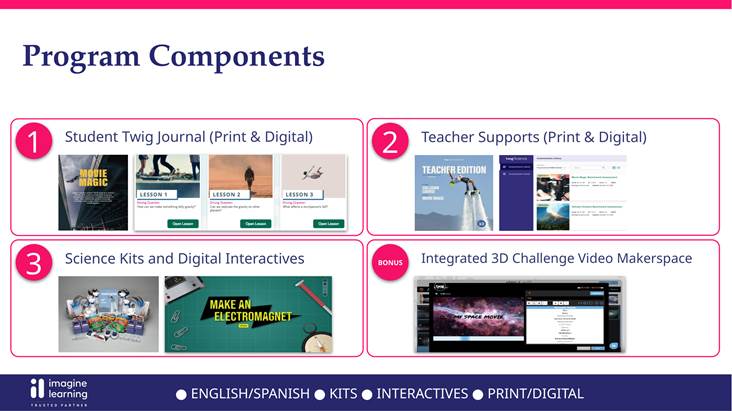
At the middle school level, program components also represent Student Twig Journal, Teacher Supports, science kits, digital interactives and video makerspace tools. Schools should not look at these components as a list of individual features. The important question is whether they are directly linked to scope and sequence, lesson flow, assessment and class management.
Which schools might Twig Science be a good fit for?
Twig Science can be a reference choice for international schools, bilingual schools or units that want to implement Science programs in the direction of phenomenon-based, inquiry-based learning and three-dimensional learning but do not have dedicated labs at all levels. Combining science kits, micro-labs, digital interactives, videos and scientific texts creates more implementation options than the traditional experiment-based model.
However, the school still needs to check the number of students, session length, storage space, student equipment, teaching language, the process of importing and adding kits, as well as the level of compatibility with the school's learning outcomes. Digital lab cannot solve the problem if the network infrastructure is unstable; Science kits also do not create effective hands-on learning if teachers do not have time to onboard and test the lesson.
A pilot should measure at least four factors: teacher preparation time, the extent to which students directly manipulate or analyze data, the quality of Claim-Evidence-Reasoning, and the ability to operate material across multiple classes. The pilot results will help the school decide whether to implement the entire program, select a few modules or adjust the blended lab model according to actual conditions.
Register for a free Trial account, demo book, quote:
Schools and teachers, please contact BooksVN, the designated distributor of Imagine Learning, in charge of countries including Vietnam, Philippines, Malaysia, Singapore, Hong Kong, Indonesia, India, Bangladesh, Cambodia, Laos, Japan and Taiwan through the following channels:
Website: www.booksvn.com Email: cs@booksvn.com
Mobile/WhatsApp: +84-915 920 514
Facebook: https://web.facebook.com/BooksVNeBooksachNgoaiVanchinhhang
Zalo OA: https://zalo.me/2230563715259512406


.svg)